Face Fit Testing: A Complete Guide to RPE Safety and Compliance
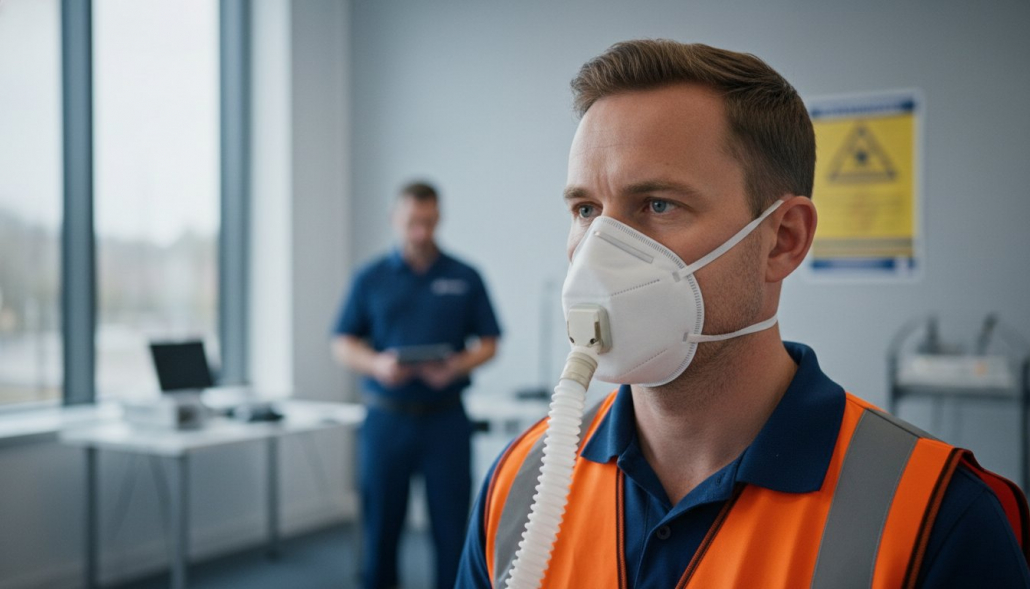
Are you confident your team’s Respiratory Protective Equipment (RPE) offers genuine protection against workplace hazards? For many UK businesses, navigating the legal requirements of COSHH and specific HSE guidance like INDG 479 can be a significant burden. The responsibility to ensure every mask provides an adequate seal is critical, yet confusion around the process is common. This is where professional face fit testing becomes an essential, non-negotiable component of your health and safety strategy, providing the only reliable way to confirm your RPE is effective and your legal duties are met.
This comprehensive guide is designed to remove that uncertainty and provide clear, actionable information. We will walk you through the entire process, explaining the key differences between qualitative and quantitative testing and what to do if an employee fails. Our goal is to take the burden of compliance off your shoulders by equipping you with the expert knowledge needed to implement a straightforward testing programme. By the end, you will understand exactly how to ensure your team is fully protected, achieve complete compliance, and secure the peace of mind that comes from knowing you are doing everything right.
What is Face Fit Testing and Why Is It a Legal Requirement?
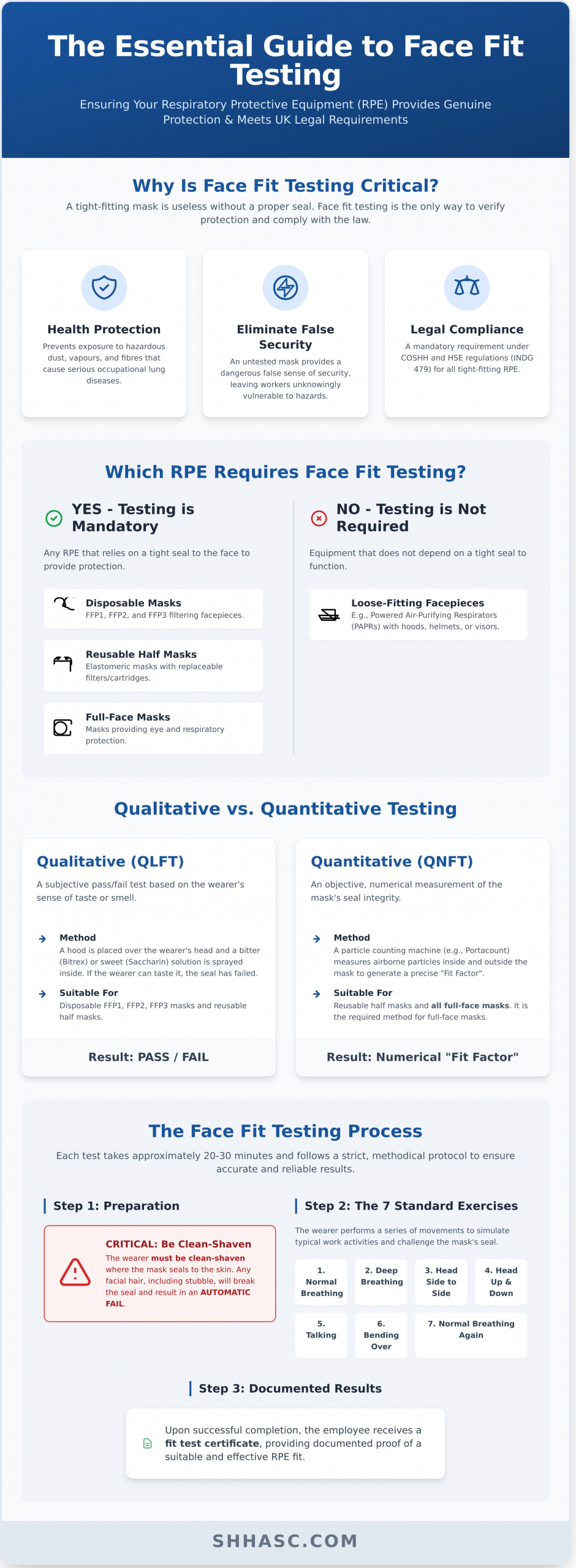
Face fit testing is a critical process used to verify that a tight-fitting respirator mask forms a complete seal with the wearer’s face. Its primary goal is to prevent inward leakage of contaminated air, ensuring the Respiratory Protective Equipment (RPE) provides the expected level of protection. A Respirator fit test confirms that the specific make, model, and size of mask is suitable for the individual. Without this seal, workers can be unknowingly exposed to hazardous substances like dust, chemical vapours, and asbestos fibres, leading to serious, long-term occupational lung diseases.
Failing to ensure a correct fit renders the RPE ineffective, providing a false sense of security while leaving the wearer vulnerable. This is why the procedure is not just a recommendation but a mandatory requirement for workplace safety compliance.
The Legal Framework: Understanding Your Responsibilities
In the United Kingdom, the requirement for face fit testing is a legal obligation. This duty is underpinned by regulations such as the Control of Substances Hazardous to Health (COSHH) Regulations 2002 and the Control of Asbestos Regulations 2012. The Health and Safety Executive (HSE) provides specific guidance in its document INDG 479, which states that RPE must be both adequate and suitable. ‘Suitable’ explicitly includes being correctly matched and fitted to the individual wearer. As an employer, you have a legal responsibility to ensure any tight-fitting RPE provided to your employees is proven to be effective through a documented fit test.
Which Types of Masks Require Face Fit Testing?
It is essential to understand which types of RPE fall under these legal requirements. The test is mandatory for all tight-fitting facepieces where a complete seal is necessary for protection.
- Masks that DO require testing include:
- Disposable Filtering Facepieces: Commonly known as FFP1, FFP2, or FFP3 masks.
- Reusable Half Masks: These cover the nose and mouth and use replaceable filters or cartridges.
- Full-Face Masks: These provide protection for the eyes as well as the respiratory system.
- Equipment that does NOT require testing includes:
- Loose-fitting RPE such as powered air-purifying respirators (PAPRs) with hoods, helmets, or visors, as they do not depend on a tight seal to function.
Qualitative vs. Quantitative: Choosing the Right Test Method
When conducting RPE face fit testing, the Health and Safety Executive (HSE) recognises two approved methods: Qualitative and Quantitative. The choice between them is not a matter of preference; it is determined by the type of respiratory protective equipment (RPE) you are testing. Think of it as the difference between a simple pass/fail taste test and using a highly sensitive instrument to get a precise measurement. Each method is suited to different masks and provides a different level of assurance.
Understanding which test is required for your team’s RPE is a critical step in remaining compliant and ensuring maximum protection. Our expert technicians are trained to perform both methods, providing the correct, accredited test for your specific safety needs.
The Qualitative Fit Test (QLFT)
A Qualitative Fit Test is a subjective assessment based on the wearer’s sense of taste. During the test, the wearer puts on their mask and a hood is placed over their head. A strong-tasting solution, either bitter (Bitrex) or sweet (Saccharin), is then sprayed into the hood. If the wearer can taste the solution, it indicates a leak in the mask’s seal, resulting in a fail. The wearer performs seven specific exercises to simulate workplace movements, a protocol detailed in standards like OSHA’s mandatory fit testing procedures, ensuring the test is thorough and consistent.
- Suitable For: Disposable filtering facepieces (FFP1, FFP2, FFP3) and reusable half masks.
The Quantitative Fit Test (QNFT)
A Quantitative Fit Test provides an objective, numerical measurement of the mask’s seal. This method uses a particle counting machine, such as a Portacount, which measures the number of airborne particles both inside and outside the mask. The machine then calculates a “Fit Factor”-a precise ratio that quantifies the level of protection. This removes any subjectivity and provides verifiable data on the mask’s performance. This method is essential for RPE used in high-hazard environments where an inadequate seal could have severe consequences.
- Suitable For: Reusable half masks and all full-face masks.
- Required For: All full-face masks require a quantitative test to verify their high protection levels.
The Face Fit Testing Process: A Step-by-Step Guide
Understanding the face fit testing process is key to ensuring a smooth and effective outcome for your team. With a competent provider, the procedure is straightforward, methodical, and designed to give you complete confidence in your Respiratory Protective Equipment (RPE). Each individual test typically takes around 20-30 minutes to complete, from the initial briefing to the final result, ensuring minimal disruption to your workday while maximising safety compliance.
Before the Test: Booking and Preparation
Preparation is simple but crucial for a valid test. Sessions can be booked for individuals or groups, either at a dedicated facility or on-site at your premises for maximum convenience. For qualitative tests, we begin with a brief sensitivity check to ensure the testing agent can be detected by the wearer. Most importantly, the individual must be clean-shaven in the area where the mask seals against the face. Any facial hair, including stubble, will compromise the seal and result in an automatic fail. This is a non-negotiable safety requirement.
During the Test: The 7 Standard Exercises
The core of the test involves the wearer performing a series of seven exercises while wearing their RPE. These movements are mandated by the Health and Safety Executive (HSE) to simulate typical workplace activities and challenge the mask’s seal. The tester will guide the wearer through each one:
- Normal breathing.
- Deep breathing.
- Turning the head from side to side.
- Moving the head up and down.
- Talking aloud (e.g., reading a passage of text).
- Bending over or touching toes.
- Normal breathing again.
Throughout these exercises, the tester meticulously checks for any inward leakage, ensuring the mask maintains a protective seal against the face at all times.
After the Test: Pass, Fail, and Certification
Upon successful completion, the wearer receives a pass certificate. This formal document confirms that the specific make, model, and size of the mask provides an effective seal for that individual. The certificate includes the wearer’s name, the mask details, the test date, and the competent tester’s information. In the event of a fail, the process does not simply end. It indicates that the chosen mask is unsuitable for the individual’s facial shape. Our expert tester will then assist in selecting a different size or model of RPE to re-test until a suitable, safe fit is achieved. Have questions about the process? Contact our expert team for guidance.
How to Prepare for a Test: A Checklist for Employers and Employees
A successful face fit test is a result of careful preparation from both employers and employees. Proper planning not only ensures the accuracy and validity of the test but also minimises disruption and prevents the need for costly re-testing. By following a structured approach, you can guarantee that every test session is efficient, effective, and fully compliant with Health and Safety Executive (HSE) requirements.
This shared responsibility is crucial for a seamless process. Below, we have outlined key preparation steps for both parties to ensure the highest chance of a first-time pass.
Employer Checklist
As an employer, your role is to create the right environment for a successful test. Taking these steps beforehand will help our technicians conduct the face fit testing smoothly and without delay.
- Provide a Suitable Test Area: Designate a clean, well-lit room with adequate ventilation. It must have enough space for the testing equipment and for the employee to move freely during the exercises.
- Ensure Mask Availability: Have a range of RPE models and sizes available on the day. This allows the tester to find the most suitable mask for each individual if their primary one is not a good fit.
- Inform Your Team: Communicate the test requirements to all participating employees at least 24 hours in advance. Ensure they understand what is expected of them, particularly regarding the clean-shaven policy.
- Schedule Effectively: Plan the testing schedule to avoid interrupting critical operations. Staggering appointments can help maintain productivity throughout the day.
Employee Checklist
For the test to be accurate, your personal preparation is essential. Please follow these critical instructions prior to your appointment to avoid a failed result.
- Be Clean-Shaven: This is the most important requirement. You must be clean-shaven in the area where the mask seals against the skin. Any stubble, even from the previous day, can compromise the seal and cause an automatic failure.
- Avoid Contaminants: Do not smoke, vape, eat, or drink anything other than plain water for at least 30 minutes before your scheduled test time. The residue can interfere with the testing equipment.
- Bring Your Assigned RPE: If you have been issued a specific make and model of mask for your daily tasks, please bring it with you to the test.
- Remove Obstructions: Any facial piercings, such as nose or lip studs, that sit under the mask’s seal must be removed before the test begins.
By working together, we can ensure the process is straightforward and confirms that your team’s respiratory protection is effective. This commitment to preparation is a fundamental part of maintaining a safe and compliant workplace. For further guidance, our experts are always available to assist.
Why Choose Safehouse for Your Face Fit Testing Needs?
Understanding the critical importance of respiratory protective equipment (RPE) is the first step. The next, and most crucial, is choosing a competent partner to ensure that equipment provides effective protection. At Safehouse Health and Safety Consultants Ltd, we move beyond simple compliance checks, offering a comprehensive and personal service designed to take the burden of safety management from your shoulders and give you complete peace of mind.
We combine deep industry expertise, particularly within the construction sector, with a commitment to making your safety processes as straightforward and effective as possible.
Fit2Fit Accredited and Experienced Testers
Your legal compliance and your team’s safety depend on the competency of the tester. That’s why all our technicians are Fit2Fit accredited. This is the Health and Safety Executive’s (HSE) officially recognised competency scheme for face fit testing, providing you with an undeniable assurance that the service you receive is of the highest professional standard. Our years of practical experience across construction and other high-risk industries mean we understand your environment and its specific challenges.
Flexible On-Site Testing Across the UK
We know that downtime costs money. To minimise disruption to your operations, we bring our expert testing service directly to your site, anywhere in the UK. This convenient approach allows you to get your entire team tested efficiently, whether it’s a small group or a large workforce, getting them back to work quickly and safely. As a local company with a nationwide reach, we provide the reliable, personal service you expect, with the capacity to meet your needs wherever your project is located.
A Complete Safety Solution
Effective RPE management is more than just a one-off test. Safehouse acts as your complete safety partner, integrating testing into a wider framework of support. We are a one-stop-shop for your health and safety needs, offering:
- RPE Supply: As an official Portwest distributor, we can supply the exact models of masks your employees have been successfully tested on, removing any uncertainty in your procurement process.
- Expert Consultancy: We assist in developing and implementing robust RPE programmes and provide wider health and safety consultancy to ensure you are fully compliant.
- Comprehensive Training: From CITB and IOSH courses to bespoke safety training, we can upskill your entire team.
Let us handle the complexities of compliance so you can focus on your business. Get a quote for on-site face fit testing for your team today.
Protect Your Workforce and Ensure Compliance with Expert Face Fit Testing
As we have detailed, effective Respiratory Protective Equipment (RPE) is a critical component of workplace safety, not an optional extra. Understanding that face fit testing is a legal necessity is the first step, but ensuring a verified seal through the correct testing method is what truly protects your team from respiratory hazards. A successful test depends on choosing the right provider and preparing your employees properly, safeguarding both their health and your business’s compliance.
At Safehouse, we take the burden of compliance from your shoulders. Our Fit2Fit Accredited Testers provide a professional, personal service tailored to your needs, with deep expertise in construction industry regulations. We bring our support directly to your business with convenient on-site testing available across Yorkshire and the UK, making it simple to stay safe and compliant.
Book your accredited face fit testing service and ensure your team’s safety.
Invest in your team’s well-being and your company’s peace of mind today.
Frequently Asked Questions
How often do I need to get a face fit test?
While UK HSE guidance does not set a mandatory expiry date, it is considered best practice to conduct a re-test at least every two years. A re-test is legally required immediately if an employee experiences significant weight change, undergoes major dental work, or if the make, model, or size of their Respiratory Protective Equipment (RPE) changes. This ensures the seal remains effective and you stay compliant with safety regulations.
Why is being clean-shaven so important for a face fit test?
The effectiveness of any tight-fitting mask depends entirely on achieving a complete seal against the skin. Facial hair, including stubble, creates gaps in this seal, allowing hazardous airborne particles to bypass the filter and be inhaled. Being clean-shaven where the mask makes contact is therefore a non-negotiable requirement for both the test and for daily use in the workplace. Without it, the RPE cannot provide its intended protection.
What happens if an employee fails their face fit test?
A failed test simply means the specific mask being tested does not provide an adequate seal for that individual. The employee must not use that respirator. The immediate next step is to try a different size, make, or model of mask and repeat the test process. Our accredited testers are trained to assist in finding a suitable alternative mask that provides the necessary protection, ensuring your workforce remains safe and your company stays compliant.
Can I be tested wearing my own specific make and model of mask?
Yes, you must be. It is a legal requirement that the test is performed on the exact make, model, and size of RPE that you will be using for work. A face fit test certificate is only valid for the specific respirator worn during the test. This ensures that the protection verified during the test is accurately replicated in the workplace environment, which is a critical component of your respiratory safety programme.
How long does a face fit test appointment typically take per person?
A standard face fit test appointment takes approximately 20 to 30 minutes per individual. This allows sufficient time for a pre-test briefing, instruction on how to correctly put on and check the mask, and the test itself. The test involves a series of seven exercises designed to simulate typical workplace movements, such as turning the head and talking, to ensure the mask’s seal is maintained during activity.
Is a face fit test certificate transferable between employers?
The responsibility for ensuring RPE is adequate and correctly fitted lies with the current employer. While the certificate is a record for the individual, a new employer must verify that the previous test is still valid for the mask they provide and the specific hazards present. To ensure full compliance and remove any doubt, the recommended best practice is for the new employer to arrange for a fresh face fit testing session.
Are face fit tests required for paper dust masks (FFP1/2/3)?
Yes. Any tight-fitting respirator requires a test, and this includes all disposable masks, often called ‘dust masks’ (rated FFP1, FFP2, or FFP3). These are classified as RPE and are subject to the same legal requirements as reusable half-masks. If your risk assessment identifies the need for a disposable FFP mask to protect against dust, mists, or fumes, then a face fit test is mandatory to ensure its effectiveness.












Leave a Reply
Want to join the discussion?Feel free to contribute!