Are you confident your team’s Respiratory Protective Equipment (RPE) offers the crucial protection required on site? For many business owners, navigating the complexities of HSE and COSHH regulations can be a significant burden, bringing with it the constant worry of non-compliance fines and, more importantly, the risk to employee health. Securing professional and reliable face fit testing in Barnsley is the definitive step to remove this uncertainty. It is a legal requirement that ensures the RPE you provide is a suitable and effective shield against hazardous dusts, fumes, and vapours.
This guide is designed to take the stress out of compliance. We will explain how our accredited, local service helps you meet your legal obligations with minimal disruption to your work schedule. Discover how to ensure your workforce is genuinely protected, achieve full compliance with HSE standards, and receive the formal certification needed to prove it. Let us provide the expertise and support you need to stay safe, compliant, and focused on your business.
Key Takeaways
- Understand why face fit testing is a non-negotiable legal requirement under HSE regulations for any employee wearing tight-fitting respiratory protective equipment (RPE).
- Discover our straightforward, accredited face fit testing Barnsley process, available either at your site or our local office for maximum convenience and minimal disruption.
- Learn the simple preparation steps your employees must follow before their appointment to ensure a successful first-time pass and maintain project timelines.
- Identify if your specific industry in Barnsley and South Yorkshire, from construction to manufacturing, falls under the mandatory RPE testing requirements.
What is Face Fit Testing and Why is it a Legal Requirement?
Face fit testing is a mandatory process for any employee required to wear tight-fitting Respiratory Protective Equipment (RPE). In simple terms, it is a physical test to ensure a respirator mask creates a complete seal against the wearer’s face, preventing contaminated air from leaking in. Without this seal, the RPE is ineffective and offers a false sense of security. Understanding what a respirator fit test is is the first step for any employer in ensuring their workforce is genuinely protected from airborne hazards.
This is not merely a best practice recommendation; it is a legal requirement under several key UK regulations. The Control of Substances Hazardous to Health (COSHH) Regulations, the Control of Asbestos Regulations, and the Health and Safety Executive’s (HSE) guidance note HSG53 all mandate face fit testing. An improper fit exposes your team to serious risks, including fine dusts like silica, chemical fumes, asbestos fibres, and harmful viruses. Providing a mask is only half the job; you must prove it fits the individual correctly through a professional service for face fit testing in Barnsley.
Qualitative vs. Quantitative Testing: Which Do You Need?
Qualitative Face Fit Testing (QLFT) is a pass/fail test based on the wearer’s ability to taste or smell a harmless, specific agent while wearing the mask and performing a series of exercises. This subjective method is suitable for disposable half-masks and reusable half-mask respirators, such as FFP2 and FFP3 models, which are commonly used across many industries.
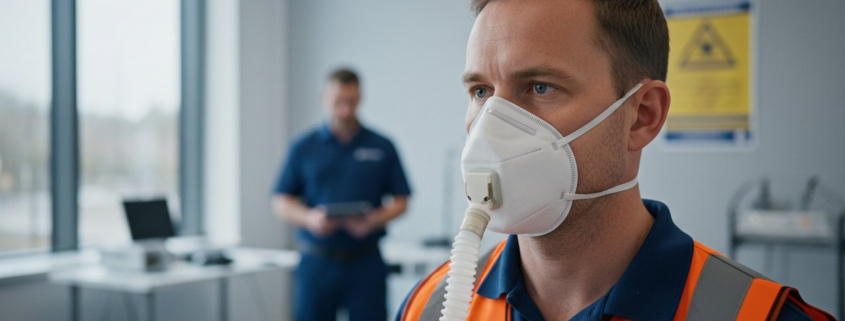
Quantitative Face Fit Testing (QNFT) provides an objective, numerical measurement of the seal’s integrity. It uses specialised equipment to measure the number of particles inside the mask compared to outside, generating a “fit factor.” This highly accurate method is required for all full-face masks or when a particularly hazardous substance requires the highest level of respiratory protection.
The Consequences of Non-Compliance for Barnsley Businesses
Failing to comply with RPE regulations can lead to severe consequences. The HSE actively carries out site inspections and can issue improvement notices, prohibition notices stopping work immediately, and substantial fines. These penalties not only impact your finances but can also cause significant damage to your business’s professional reputation.
Beyond regulatory action, non-compliance puts your employees’ health at direct risk, potentially leading to long-term occupational diseases and subsequent civil claims for negligence. Investing in accredited face fit testing is a crucial part of professional business management. It demonstrates your commitment to safety, protects your workforce, and safeguards your business from legal and financial liability.
Our Face Fit Testing Process in Barnsley: Simple & Compliant
At Safehouse, we have streamlined our face fit testing Barnsley process to be as straightforward and efficient as possible, removing the burden of compliance from your shoulders. We understand that your time is valuable, which is why we offer flexible options to suit your operational needs. Tests can be conducted at your own site or at our conveniently located Barnsley office, with weekend availability to minimise disruption to your work week. Each test is conducted by our fully trained and Fit2Fit accredited experts, is straightforward for the wearer, and typically takes only 20 minutes to complete.
Step 1: Booking and Initial Consultation
Beginning the process is simple. You can get in touch with our team directly by phone, email, or by using the contact form on our website. During this initial consultation, we will discuss your specific requirements, such as the number of employees needing a test and the types of Respiratory Protective Equipment (RPE) they use. This allows us to provide expert advice on the correct test type-either Qualitative or Quantitative-to ensure you meet your legal health and safety obligations.
Step 2: The Test Day – What to Expect
On the scheduled day, our accredited tester will either arrive promptly at your location or welcome your team to our Barnsley facility. The session starts with a clear pre-test briefing to explain the procedure, followed by a sensitivity check. The wearer then performs a series of seven simple exercises designed to challenge the mask’s seal by simulating typical work movements. This practical assessment is crucial for verifying protection and fulfilling the legal requirement for face fit testing as outlined in HSE guidance.
Step 3: Certification and Record Keeping
Upon a successful test, a certificate is issued immediately for each wearer. This certificate serves as your official record and tangible proof of compliance for your HSE records, providing peace of mind during any potential inspections. We also provide professional advice on re-test schedules, which are typically recommended every one to two years or if there are significant changes to a wearer’s facial features. Ensure your team is protected and your business remains compliant. Book your team’s face fit test today.
How to Prepare for Your Face Fit Test: A Practical Checklist
A failed face fit test results in wasted time, additional costs, and potential delays to your operations. Proper preparation is the most effective way to ensure a first-time pass and maintain compliance. Following this simple checklist for your upcoming face fit testing in Barnsley will help guarantee the process is efficient and successful for everyone involved. The Health and Safety Executive (HSE) strongly supports the use of competent testers, and this guidance complements the high standards set by bodies like the BSIF, which accredits testers through its scheme. A valid test depends on both the tester’s competence and the individual’s readiness.
To assist your team, we have broken down the key responsibilities for both the individuals being tested and the managers arranging the session.
For Employees Being Tested
Your full cooperation is essential for an accurate test result. Before your scheduled appointment, you must complete the following steps:
- Be Clean-Shaven: The most common reason for test failure is facial hair. You must be clean-shaven in the area where the respirator seals against your skin. Any stubble, even from the previous day, can break the seal and lead to a failed test.
- Do Not Smoke: Refrain from smoking or vaping for at least 30 minutes prior to your test, as it can affect the equipment’s readings.
- Bring Your Assigned RPE: You must be tested on the specific make, model, and size of Respiratory Protective Equipment that you wear daily. Please bring your mask with you to the appointment.
- Ensure You Are in Good Health: If you have a heavy cold, cough, or any other condition that affects your normal breathing, please reschedule your test.
For Managers Arranging the Test
Organising a session of face fit testing in Barnsley requires some simple logistical planning to ensure the day runs smoothly and without disruption. Please ensure the following is in place:
- Provide Adequate RPE Stock: Ensure you have a sufficient supply of the masks your employees use, including different sizes if applicable, so that an alternative can be tried if the initial mask fails.
- Arrange a Suitable Testing Area: Our tester will require a well-lit, indoor room with a table and two chairs. The area should be free from excessive dust and contaminants to ensure test integrity.
- Schedule Sufficient Time: Each qualitative or quantitative test takes approximately 20-25 minutes per person. Please schedule appointments accordingly to avoid rushing the process.
- Communicate with Your Team: It is vital to share the employee preparation checklist with your staff well in advance of the testing date to maximise the chances of a first-time pass.
Who Needs Testing in Barnsley and South Yorkshire?
In Barnsley and across South Yorkshire, numerous industries have a legal and moral duty to protect their employees from respiratory hazards. If your work activities generate dust, fumes, vapours, or aerosols, then Respiratory Protective Equipment (RPE) is essential. However, providing a mask is not enough; you must ensure it fits the wearer correctly to offer effective protection. This is a non-negotiable requirement under HSE regulations.
At Safehouse, we have a deep understanding of the local economic landscape. We provide expert face fit testing Barnsley businesses rely on to remain safe and compliant, taking the burden of this critical task away from you.
Key Industries We Serve
Our accredited testers regularly support businesses across the region’s core sectors. We understand the specific risks associated with your industry and can provide tailored testing solutions. Key sectors that require mandatory face fit testing include:
- Construction and Demolition: Protection against silica dust, wood dust, and asbestos fibres is paramount on any site.
- Manufacturing and Engineering: Operatives exposed to welding fumes, solvent vapours, and chemical dusts must have correctly fitted RPE.
- Woodworking: Wood dust is a known carcinogen, making correctly sealed masks a necessity for joiners and machinists.
- Healthcare and Social Care: Staff performing aerosol-generating procedures (AGPs) or working in high-risk environments need certified RPE.
Common Job Roles Requiring a Face Fit Test
If you or your employees perform any of the following roles, a face fit test is not just recommended-it is a legal requirement. An ill-fitting mask provides a false sense of security and leaves the wearer dangerously exposed. We frequently test individuals in roles such as:
- Plasterers, bricklayers, and groundworkers
- Welders and metal fabricators
- Painters and decorators (especially those using spray paints)
- Asbestos removal operatives
- Pharmaceutical and chemical plant workers
- Stonemasons
This list is not exhaustive. If your risk assessment identifies a need for tight-fitting RPE, you must arrange for testing. To discuss your specific requirements and ensure your team is protected, get in touch with our safety experts today.
Why Choose Safehouse as Your Local Barnsley Provider?
Selecting a partner for your health and safety compliance is a critical business decision. It requires confidence, trust, and the assurance of genuine expertise. At Safehouse, we provide more than just a certificate; we offer the peace of mind that comes from working with a dedicated, local specialist committed to protecting your workforce and your business. Our goal is to make achieving compliance straightforward and sustainable.
When you choose us for face fit testing in Barnsley, you are choosing a partner invested in the local community and its industries.
Local Experts with a Personal Approach
As a company based in Barnsley, we offer a convenient, responsive, and reliable service that faceless national chains simply cannot match. We have a deep understanding of the specific demands and challenges faced by our region’s construction, manufacturing, and industrial sectors. We pride ourselves on building lasting professional relationships, offering a personal approach that ensures the advice and support you receive is perfectly tailored to your operational needs.
More Than Just Testing: A Complete Safety Partner
Our commitment to your safety extends far beyond a single test. We are a comprehensive health and safety consultancy, equipped to support every aspect of your compliance strategy. By partnering with Safehouse, you gain access to an integrated safety solution that takes the burden of compliance from your shoulders. We can assist you with:
- RPE Supply: As official Portwest distributors, we can supply the very masks and respirators you need tested, ensuring you have access to high-quality, suitable equipment.
- Accredited Training: Combine your face fit testing schedule with our fully accredited CITB and IOSH training courses, creating an efficient and cost-effective programme for upskilling your team.
- H&S Consultancy: Let our qualified experts act as your competent health and safety advisors, providing ongoing support to help you navigate complex legislation and maintain a safe working environment.
Let us handle the complexities so you can focus on your core business. Contact our Barnsley office to discuss your safety needs.
Your Partner for Compliant Face Fit Testing in Barnsley
Ensuring your team is equipped with properly fitted RPE is a non-negotiable legal duty. From understanding the testing process to preparing your staff, each step is crucial for maintaining a safe and compliant work environment. By partnering with a local and accredited expert, you can navigate these health and safety obligations with confidence and ease, protecting both your employees and your business.
As your local, Barnsley-based provider, Safehouse offers the professional face fit testing Barnsley companies rely on for peace of mind. Our service is delivered by Fit2Fit Accredited Testers, guaranteeing the highest standard of assessment. To minimise disruption to your schedule, we provide flexible on-site and weekend testing options tailored to your operational needs. We are here to provide the expert support you need to stay safe and compliant.
Don’t leave safety to chance. Take the definitive step to protect your team today. Call our Barnsley office to book your face fit test and ensure compliance.
Frequently Asked Questions About Face Fit Testing
How much does a face fit test cost in Barnsley?
The cost for professional face fit testing in Barnsley depends on factors such as the number of employees to be tested and whether testing is conducted at your site or our facility. We provide competitive pricing for both individual and group bookings to ensure our services are cost-effective. For a precise, no-obligation quote tailored to your company’s specific requirements, please get in touch with our expert team today. We can then provide a detailed cost breakdown.
What happens if an employee fails their face fit test?
If an employee fails a face fit test, it indicates that the specific mask being tested does not create an adequate seal for them. They must not use that respirator in a hazardous environment. Our accredited tester will then help them try a different size or an alternative model of Respiratory Protective Equipment (RPE). The test is repeated with a new mask until a suitable one is found that achieves a pass, ensuring the wearer is protected and you remain compliant.
How long is a face fit test certificate valid for?
While there is no strict legal expiry date, HSE guidance (INDG 479) strongly recommends that fit testing is repeated at least every two years. A re-test is also legally required if the wearer has significant weight loss or gain, undergoes major dental work, or develops facial scarring in the area where the mask seals. This ensures the RPE continues to provide effective protection as circumstances change and maintains your duty of care.
Why can’t you be face fit tested with a beard or stubble?
Facial hair, including stubble, beards, and even sideburns, will compromise the seal of a tight-fitting respirator. The hair creates gaps between the mask’s seal and the skin, allowing hazardous airborne contaminants to leak in and be inhaled by the wearer. To comply with HSE regulations and ensure a valid test, the individual’s face must be clean-shaven in the area where the mask makes contact. This is critical for the RPE to provide any effective protection.
Do I need to bring my own mask to the test?
Yes, it is essential that each employee brings the specific make, model, and size of the respirator they will be required to use in the workplace. The face fit test qualifies an individual for that exact mask only. If they were to use a different model or size on-site, the test would be invalid. This process ensures that the test accurately confirms the level of protection your team will receive during their day-to-day duties.
Is a face fit test required for FFP3 masks?
Yes, a face fit test is a legal requirement for anyone wearing a tight-fitting FFP3 mask as RPE at work. FFP3 masks are designed to offer a high level of protection, but this is entirely dependent on a tight seal against the wearer’s face. Without a successful fit test, you cannot prove the mask is providing adequate protection. This is a critical requirement under regulations such as the Control of Substances Hazardous to Health (COSHH) 2002.
Can you carry out face fit testing on our construction site?
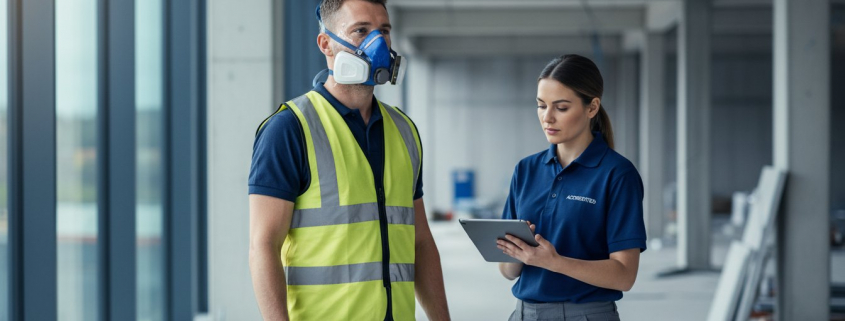
Yes, we provide a fully mobile service and can conduct accredited face fit testing directly on your construction site in Barnsley or at your business premises. Our on-site testing is designed to be convenient and to minimise disruption to your project schedules and reduce employee downtime. We bring all the necessary calibrated equipment to your location, helping you to stay safe and compliant with maximum efficiency.