Tag Archive for: RPE

Navigating the complexities of UK health and safety regulations can feel like a significant burden, especially when the wellbeing of your workforce is on the line. For employers providing tight-fitting Respiratory Protective Equipment (RPE), understanding the specific quantitative face fit testing requirements laid out by the Health and Safety Executive (HSE) is not just best practice-it is a critical legal duty. Confusion over when this precise testing method is mandatory, or what technical terms like ‘fit factor’ actually mean for compliance, can leave your business exposed to significant risk and your employees inadequately protected.

This comprehensive guide is designed to remove that uncertainty. We will provide a clear, practical breakdown of the entire process, helping you to stay safe and compliant. We will detail the specific UK legal obligations, the step-by-step testing protocol, and the pass criteria you must meet. Our aim is to take the stress of compliance from your shoulders, providing you with the expert knowledge and confidence needed to ensure your respiratory protection program is robust, effective, and legally sound.

Key Takeaways

  • Understand that face fit testing is not just best practice but a legal duty under UK law, essential for protecting your employees and avoiding non-compliance penalties.
  • Learn to distinguish between qualitative and quantitative testing to determine which method is legally mandated for the specific types of RPE your team uses.
  • Meeting the UK’s quantitative face fit testing requirements hinges on achieving a specific ‘Fit Factor’-a numerical score that proves the mask’s seal is effective.
  • Implement a pre-test checklist to properly prepare your employees, significantly increasing the pass rate and minimising costly re-tests and operational downtime.

In the United Kingdom, the requirement for face fit testing is not merely best practice; it is a legal mandate underpinned by a robust framework of health and safety law. The foundation of this framework is the Health and Safety at Work etc. Act 1974, which establishes a broad duty of care on employers to ensure, so far as is reasonably practicable, the health, safety, and welfare of their employees at work. This includes providing suitable and adequate protective equipment where risks cannot be eliminated.

When it comes to respiratory hazards, this duty of care is enforced by the Health and Safety Executive (HSE). The HSE makes it unequivocally clear that if you provide Respiratory Protective Equipment (RPE) to your employees, you must ensure it offers effective protection. A key part of this is ensuring it fits correctly through a formal fit test.

COSHH Regulations and RPE Requirements

The Control of Substances Hazardous to Health (COSHH) Regulations 2002 provide specific legal duties regarding RPE. COSHH mandates that RPE should only be used as a last line of defence, after all other reasonably practicable measures to control exposure have been taken. When RPE is required, Regulation 7 states it must be adequate and suitable. For tight-fitting facepieces, “suitable” means it must be correctly fitted to the individual wearer. An improper fit renders the RPE ineffective, providing a false sense of security and leaving your business non-compliant.

HSE’s INDG 479 and HSG53: The Official Guidance

The HSE provides detailed guidance to help employers comply with the law. The two most critical documents are:

  • INDG 479: This is the primary guidance document offering clear, accessible advice on RPE at work.
  • HSG53: This provides more in-depth guidance on the selection, use, and maintenance of RPE.

Both documents explicitly state that face fit testing must be carried out by a competent person for all tight-fitting RPE. While this guidance is not law itself, its special legal status means that failure to follow it can be used in legal proceedings as proof that you have not met your legal obligations. These documents provide the definitive framework, clarifying the quantitative face fit testing requirements for masks used in high-risk environments. For a foundational Respirator fit test overview, it’s clear that the seal between the mask and the wearer’s face is the critical factor for protection, a principle the HSE’s guidance is designed to uphold.

Quantitative vs. Qualitative: When is QNFT Legally required?

When selecting a face fit test for your Respiratory Protective Equipment (RPE), the choice is not a matter of preference but a strict requirement dictated by the type of mask being used. Understanding the difference between Qualitative and Quantitative testing is fundamental to ensuring you remain compliant and your workforce is adequately protected. One method is a subjective check, while the other provides objective, numerical proof of a secure fit.

How Each Test Method Works

A Qualitative Face Fit Test (QLFT) is a pass/fail test that relies on the wearer’s sense of taste or smell. The individual wears their RPE under a hood, and the tester sprays a bitter (Bitrex) or sweet (Saccharin) solution into the hood. The wearer performs a series of exercises, and if they cannot taste the solution, the face seal is considered effective. This method is only suitable for disposable half masks and reusable half-face masks.

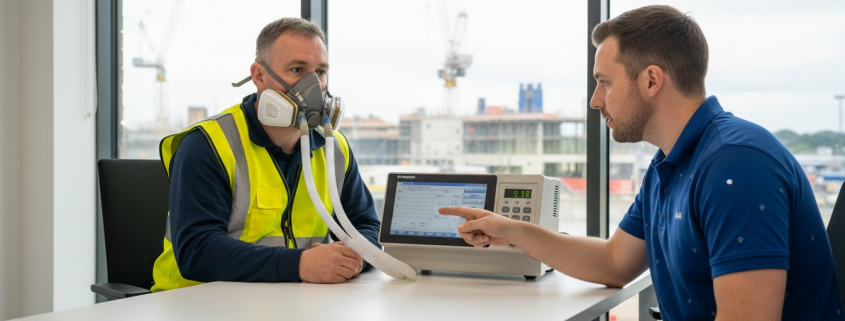
In contrast, a Quantitative Face Fit Test (QNFT) provides a precise, numerical measurement of the seal’s effectiveness. This objective test uses a specialised particle counting device, such as a Portacount machine. The machine measures the number of microscopic particles in the ambient air and compares it to the number of particles that leak into the mask. The result is an exact number called a ‘Fit Factor’. The key advantage of QNFT is its precision, removing any subjective judgement from the process. The protocols for both methods are clearly defined in the official HSE INDG479 Guidance.

Mandatory Scenarios for Quantitative Face Fit Testing

The quantitative face fit testing requirements are unambiguous when it comes to high-protection RPE. A subjective QLFT is not considered sufficiently reliable for masks designed to offer a high protection factor, where even a minor leak could have severe health consequences. QNFT is the only legally acceptable method for all full-face masks.

This mandatory requirement applies to equipment including:

  • Full-face respirators (both negative pressure and powered)
  • Self-Contained Breathing Apparatus (SCBA)
  • Supplied-air breathing apparatus

While QLFT is acceptable for half masks, QNFT is often the preferred and recommended method in high-risk environments, such as those involving asbestos removal or exposure to other highly toxic substances. For this RPE, only an objective, numerical measurement can provide the necessary assurance that the face seal meets the required safety standards.

For instance, in the tightly controlled environments of modern hydroponic facilities, where staff may handle fine nutrient powders or other agents, ensuring proper RPE fit is crucial. These facilities manage many environmental variables, and professionals in this field often explore LED Grow Lights to optimize conditions alongside ensuring staff safety.

The QNFT Process: A Step-by-Step Breakdown

A Quantitative Face Fit Test (QNFT) is a precise and methodical procedure designed to provide objective, numerical data on the seal of a respirator. To ensure a valid result, the entire process must be conducted by a competent and experienced tester who understands the intricate quantitative face fit testing requirements. The test is always performed using the exact make, model, and size of Respiratory Protective Equipment (RPE) the individual will wear in the workplace, as a successful test on one mask does not transfer to another.

Equipment and Environment Setup

The core of a QNFT is a specialised particle counting device, such as a TSI Portacount. This machine measures the number of microscopic dust particles in the ambient air and compares it to the number of particles inside the respirator. To facilitate this, the mask is temporarily adapted with a sampling probe that connects to the machine. The test must be conducted in a controlled environment with a sufficient concentration of ambient particles for the equipment to take an accurate reading. Before any tests are performed, the equipment must be properly calibrated to ensure its measurements are precise and reliable.

The Seven Standard Test Exercises

To verify the mask’s seal under realistic conditions, the wearer must perform a series of seven exercises prescribed by the Health and Safety Executive (HSE). The purpose of these movements is to simulate the physical activities an employee might undertake during their work day, challenging the integrity of the mask’s seal. The HSE provides detailed guidance on the Basics of RPE fit testing, which includes this mandatory exercise protocol. Each exercise lasts for approximately one minute, and the wearer must not adjust the mask at any point once the test has begun.

  • Normal Breathing: The wearer breathes normally, without talking.
  • Deep Breathing: The wearer breathes slowly and deeply to simulate physical exertion.
  • Head Side to Side: The wearer turns their head from one side to the other, pausing at each extreme.
  • Head Up and Down: The wearer moves their head up and down, as if looking at the ceiling and then their feet.
  • Talking: The wearer reads from a prepared text, such as the Rainbow Passage, to simulate jaw movement.
  • Bending Over: The wearer bends at the waist, as if to touch their toes, and then returns to an upright position.
  • Normal Breathing: The test concludes with another period of normal breathing.

Receiving and Understanding Your Fit Test Certificate

Upon successful completion of the test, a fit test certificate is issued. This is the formal, legal record proving the RPE provides adequate protection for the wearer. A valid certificate must include key details such as the wearer’s name, the specific make, model, and size of the RPE tested, the pass level (Fit Factor) achieved, and the date of the test. This document is essential for demonstrating compliance with UK health and safety regulations. Need a certified test to ensure you meet all quantitative face fit testing requirements? Let our safety experts handle your compliance.

Understanding Fit Factors: The Key to Passing the Test

In a quantitative face fit test, the success or failure of the Respiratory Protective Equipment (RPE) is determined by a single, crucial metric: the Fit Factor. This is not a subjective assessment but a precise, numerical measurement of how effectively the mask seals to the wearer’s face. The figure is calculated by a specialised machine that compares the concentration of ambient airborne particles outside the mask to the concentration of particles that have leaked inside.

The resulting ratio is the Fit Factor. Simply put, a higher Fit Factor signifies a more effective seal, less inward leakage, and therefore greater protection for the operative. Achieving the minimum required Fit Factor is the ultimate goal of the test and a fundamental part of UK health and safety compliance.

Required Fit Factors for Different RPE Types

The Health and Safety Executive (HSE) sets clear minimum pass levels as part of the official quantitative face fit testing requirements. A test is only considered a pass if the RPE meets or exceeds these specific thresholds. These are not guidelines; they are absolute minimums required for a pass certificate to be issued and for the RPE to be deemed suitable for the wearer.

The minimum required Fit Factors are:

  • Half Masks (Disposable or Reusable): A minimum Fit Factor of 100 is required.
  • Full-Face Masks: A minimum Fit Factor of 2000 is required.

Common Reasons for a Low Fit Factor (Test Failure)

A failed test indicates that the RPE is not providing adequate protection. This is a critical safety issue that must be addressed immediately. While our expert testers will help identify the cause, failures typically stem from a few common issues:

  • Incorrect Mask Size or Model: Faces vary significantly in shape and size. A mask that fits one person perfectly may be unsuitable for another.
  • Facial Hair: This is the most common reason for failure. Even a day’s stubble can compromise the seal. For a quantitative test to be valid, the wearer must be clean-shaven where the mask meets the skin.
  • Improper Donning Technique: If the mask is not put on correctly, with straps adjusted to the right tension, it will not seal properly.
  • Facial Features or Medical Conditions: Scars, moles, or unique facial structures can sometimes interfere with achieving a secure seal.

Understanding these core components of the quantitative face fit testing requirements is vital for ensuring your workforce remains safe and your business stays compliant. If you need expert assistance or wish to book accredited on-site testing, get in touch with the Safehouse team today.

Preparing for a Quantitative Fit Test: A Checklist for Managers

Effective preparation is the foundation of a successful respiratory protective equipment (RPE) programme. By ensuring your employees and your site are ready for testing, you can minimise test failures, reduce downtime, and ensure your investment in safety delivers the best results. Clear communication and coordination are essential to meeting your legal obligations and protecting your team.

As a manager, your role is to facilitate a smooth process. This involves briefing your staff correctly, having a suitable range of RPE available, and coordinating with your test provider. This checklist will help you manage the key aspects of preparation.

Pre-Test Instructions for Employees

To ensure the test can be conducted accurately, all employees must be informed of the pre-test conditions. Failure to adhere to these can result in an automatic fail and a wasted appointment. Provide your staff with the following instructions:

  • Be clean-shaven: The most common reason for test failure is facial hair. There must be no stubble or hair growth in the area where the mask’s seal meets the skin.
  • Avoid smoking, vaping, or eating: This should be avoided for at least 30 minutes prior to the test, as it can affect the results.
  • Bring relevant PPE: If the employee wears safety glasses, hearing protection, or a hard hat with the RPE, they must bring them to the test to ensure the mask fits correctly with their other equipment.
  • Be in good health: The test cannot be conducted if the individual has a cold, cough, or other respiratory issue that could affect their breathing.

What Happens After the Test?

The outcome of the fit test determines whether an employee is permitted to use a specific mask in a hazardous environment. If an employee passes, they receive a certificate confirming the make, model, and size of the RPE they are approved to wear. This certificate is a crucial part of your compliance records.

If an employee fails, they are not protected and must not use that mask. The process is then repeated with a different size or model of RPE until a suitable, protective fit is achieved. It is vital to document all results, including failures, as this demonstrates a robust approach to fulfilling the quantitative face fit testing requirements and protecting your workforce.

Frequency of Re-testing: When is it Required?

While the HSE does not mandate a specific expiry date for a fit test certificate, industry best practice recommends re-testing at least every two years. However, a re-test is legally required sooner if certain conditions are met:

  • Significant weight gain or loss.
  • Major dental work (e.g., extractions or dentures).
  • Facial injuries, scarring, or cosmetic surgery in the face seal area.
  • A change in the make, model, or size of the RPE being used.

Staying on top of these triggers is essential for maintaining compliance. For assistance in managing your company’s testing schedule and requirements, please get in touch with our expert team.

Partner with the Experts for Compliant Face Fit Testing

Navigating UK health and safety legislation is a significant responsibility for any employer. As this guide has outlined, quantitative face fit testing is a legal necessity for all full-face masks and is the required method when a half mask fails a qualitative test or requires a higher fit factor. Achieving a successful, numerical fit factor is the only verifiable proof that Respiratory Protective Equipment (RPE) offers the intended protection against airborne hazards. Understanding this process is therefore critical for both worker safety and your legal compliance.

Meeting the stringent quantitative face fit testing requirements demands precision and expertise that cannot be overlooked. Let our team of specialists take this complex burden from your shoulders. Our Fit2Fit accredited testers provide a comprehensive, professional service covering all types of RPE, ensuring every test is conducted to the highest standard. As a trusted local company with nationwide reach and expertise, we are ideally positioned to support your business wherever you operate in the UK.

Ensure your team is protected and compliant. Book your professional face fit testing service today.

Frequently Asked Questions

Who is considered a ‘competent person’ to conduct a quantitative face fit test?

A competent person is someone with the necessary knowledge, training, and practical experience to conduct the test correctly. As per HSE guidance (INDG 479), they must understand the testing equipment, the RPE being tested, and the exercises required. While not legally mandatory, accreditation from a scheme like Fit2Fit is the HSE’s recommended proof of competence. This ensures all UK quantitative face fit testing requirements are met, providing reliable and compliant results for your business.

Can you pass a quantitative face fit test with a beard or stubble?

No, it is not possible to pass a face fit test with any facial hair that interferes with the mask’s seal. Even a day’s stubble can create gaps, allowing hazardous airborne particles to bypass the filter. For any tight-fitting respirator, the wearer must be clean-shaven in the contact area between the mask and the skin. This is a non-negotiable safety requirement to ensure the Respiratory Protective Equipment (RPE) provides the intended level of protection.

What is the main difference in cost between quantitative and qualitative testing?

Quantitative testing is generally more expensive than qualitative testing. This is because it requires sophisticated and costly particle-counting equipment, such as a Portacount machine, and a more highly trained operator to administer the test. In contrast, qualitative testing uses a simple hood and taste solution. Typically, you can expect to pay from £45-£70 per person for a quantitative test, whereas a qualitative test may cost between £25-£40, depending on the provider.

How long does a single quantitative face fit test typically take?

A single quantitative face fit test session usually takes approximately 20 to 30 minutes to complete per individual. This includes a briefing on the test procedure, correct donning of the mask, and the test itself. The test involves the wearer performing a series of seven exercises designed to simulate typical work movements, such as turning the head, bending over, and speaking. This ensures the mask maintains its protective seal during a range of activities.

What is the legal consequence of not having a valid fit test certificate for an employee?

Failing to provide a valid fit test certificate for an employee using tight-fitting RPE is a breach of UK health and safety law, including COSHH and CAR 2012 regulations. The Health and Safety Executive (HSE) can issue enforcement notices, including prohibition notices that stop work immediately. In serious cases, this can lead to prosecution, resulting in significant fines for the company and, potentially, the responsible individuals. It is a critical compliance issue for any employer.

Does a fit test certificate cover all types of respirator masks?

No, a fit test certificate is specific to the exact make, model, and size of the respirator the employee was tested on. It does not provide a universal pass for all types of RPE. If an employee needs to switch to a different mask for any reason-even one that appears similar-a new face fit test must be conducted for that specific model. This ensures a protective seal is confirmed for every piece of equipment they are required to wear.

Are you confident your team’s Respiratory Protective Equipment (RPE) offers the crucial protection required on site? For many business owners, navigating the complexities of HSE and COSHH regulations can be a significant burden, bringing with it the constant worry of non-compliance fines and, more importantly, the risk to employee health. Securing professional and reliable face fit testing in Barnsley is the definitive step to remove this uncertainty. It is a legal requirement that ensures the RPE you provide is a suitable and effective shield against hazardous dusts, fumes, and vapours.

This guide is designed to take the stress out of compliance. We will explain how our accredited, local service helps you meet your legal obligations with minimal disruption to your work schedule. Discover how to ensure your workforce is genuinely protected, achieve full compliance with HSE standards, and receive the formal certification needed to prove it. Let us provide the expertise and support you need to stay safe, compliant, and focused on your business.

Key Takeaways

  • Understand why face fit testing is a non-negotiable legal requirement under HSE regulations for any employee wearing tight-fitting respiratory protective equipment (RPE).
  • Discover our straightforward, accredited face fit testing Barnsley process, available either at your site or our local office for maximum convenience and minimal disruption.
  • Learn the simple preparation steps your employees must follow before their appointment to ensure a successful first-time pass and maintain project timelines.
  • Identify if your specific industry in Barnsley and South Yorkshire, from construction to manufacturing, falls under the mandatory RPE testing requirements.

What is Face Fit Testing and Why is it a Legal Requirement?

Face fit testing is a mandatory process for any employee required to wear tight-fitting Respiratory Protective Equipment (RPE). In simple terms, it is a physical test to ensure a respirator mask creates a complete seal against the wearer’s face, preventing contaminated air from leaking in. Without this seal, the RPE is ineffective and offers a false sense of security. Understanding what a respirator fit test is is the first step for any employer in ensuring their workforce is genuinely protected from airborne hazards.

This is not merely a best practice recommendation; it is a legal requirement under several key UK regulations. The Control of Substances Hazardous to Health (COSHH) Regulations, the Control of Asbestos Regulations, and the Health and Safety Executive’s (HSE) guidance note HSG53 all mandate face fit testing. An improper fit exposes your team to serious risks, including fine dusts like silica, chemical fumes, asbestos fibres, and harmful viruses. Providing a mask is only half the job; you must prove it fits the individual correctly through a professional service for face fit testing in Barnsley.

Qualitative vs. Quantitative Testing: Which Do You Need?

Qualitative Face Fit Testing (QLFT) is a pass/fail test based on the wearer’s ability to taste or smell a harmless, specific agent while wearing the mask and performing a series of exercises. This subjective method is suitable for disposable half-masks and reusable half-mask respirators, such as FFP2 and FFP3 models, which are commonly used across many industries.

Quantitative Face Fit Testing (QNFT) provides an objective, numerical measurement of the seal’s integrity. It uses specialised equipment to measure the number of particles inside the mask compared to outside, generating a “fit factor.” This highly accurate method is required for all full-face masks or when a particularly hazardous substance requires the highest level of respiratory protection.

The Consequences of Non-Compliance for Barnsley Businesses

Failing to comply with RPE regulations can lead to severe consequences. The HSE actively carries out site inspections and can issue improvement notices, prohibition notices stopping work immediately, and substantial fines. These penalties not only impact your finances but can also cause significant damage to your business’s professional reputation.

Beyond regulatory action, non-compliance puts your employees’ health at direct risk, potentially leading to long-term occupational diseases and subsequent civil claims for negligence. Investing in accredited face fit testing is a crucial part of professional business management. It demonstrates your commitment to safety, protects your workforce, and safeguards your business from legal and financial liability.

Our Face Fit Testing Process in Barnsley: Simple & Compliant

At Safehouse, we have streamlined our face fit testing Barnsley process to be as straightforward and efficient as possible, removing the burden of compliance from your shoulders. We understand that your time is valuable, which is why we offer flexible options to suit your operational needs. Tests can be conducted at your own site or at our conveniently located Barnsley office, with weekend availability to minimise disruption to your work week. Each test is conducted by our fully trained and Fit2Fit accredited experts, is straightforward for the wearer, and typically takes only 20 minutes to complete.

Step 1: Booking and Initial Consultation

Beginning the process is simple. You can get in touch with our team directly by phone, email, or by using the contact form on our website. During this initial consultation, we will discuss your specific requirements, such as the number of employees needing a test and the types of Respiratory Protective Equipment (RPE) they use. This allows us to provide expert advice on the correct test type-either Qualitative or Quantitative-to ensure you meet your legal health and safety obligations.

Step 2: The Test Day – What to Expect

On the scheduled day, our accredited tester will either arrive promptly at your location or welcome your team to our Barnsley facility. The session starts with a clear pre-test briefing to explain the procedure, followed by a sensitivity check. The wearer then performs a series of seven simple exercises designed to challenge the mask’s seal by simulating typical work movements. This practical assessment is crucial for verifying protection and fulfilling the legal requirement for face fit testing as outlined in HSE guidance.

Step 3: Certification and Record Keeping

Upon a successful test, a certificate is issued immediately for each wearer. This certificate serves as your official record and tangible proof of compliance for your HSE records, providing peace of mind during any potential inspections. We also provide professional advice on re-test schedules, which are typically recommended every one to two years or if there are significant changes to a wearer’s facial features. Ensure your team is protected and your business remains compliant. Book your team’s face fit test today.

How to Prepare for Your Face Fit Test: A Practical Checklist

A failed face fit test results in wasted time, additional costs, and potential delays to your operations. Proper preparation is the most effective way to ensure a first-time pass and maintain compliance. Following this simple checklist for your upcoming face fit testing in Barnsley will help guarantee the process is efficient and successful for everyone involved. The Health and Safety Executive (HSE) strongly supports the use of competent testers, and this guidance complements the high standards set by bodies like the BSIF, which accredits testers through its scheme. A valid test depends on both the tester’s competence and the individual’s readiness.

To assist your team, we have broken down the key responsibilities for both the individuals being tested and the managers arranging the session.

For Employees Being Tested

Your full cooperation is essential for an accurate test result. Before your scheduled appointment, you must complete the following steps:

  • Be Clean-Shaven: The most common reason for test failure is facial hair. You must be clean-shaven in the area where the respirator seals against your skin. Any stubble, even from the previous day, can break the seal and lead to a failed test.
  • Do Not Smoke: Refrain from smoking or vaping for at least 30 minutes prior to your test, as it can affect the equipment’s readings.
  • Bring Your Assigned RPE: You must be tested on the specific make, model, and size of Respiratory Protective Equipment that you wear daily. Please bring your mask with you to the appointment.
  • Ensure You Are in Good Health: If you have a heavy cold, cough, or any other condition that affects your normal breathing, please reschedule your test.

For Managers Arranging the Test

Organising a session of face fit testing in Barnsley requires some simple logistical planning to ensure the day runs smoothly and without disruption. Please ensure the following is in place:

  • Provide Adequate RPE Stock: Ensure you have a sufficient supply of the masks your employees use, including different sizes if applicable, so that an alternative can be tried if the initial mask fails.
  • Arrange a Suitable Testing Area: Our tester will require a well-lit, indoor room with a table and two chairs. The area should be free from excessive dust and contaminants to ensure test integrity.
  • Schedule Sufficient Time: Each qualitative or quantitative test takes approximately 20-25 minutes per person. Please schedule appointments accordingly to avoid rushing the process.
  • Communicate with Your Team: It is vital to share the employee preparation checklist with your staff well in advance of the testing date to maximise the chances of a first-time pass.

Who Needs Testing in Barnsley and South Yorkshire?

In Barnsley and across South Yorkshire, numerous industries have a legal and moral duty to protect their employees from respiratory hazards. If your work activities generate dust, fumes, vapours, or aerosols, then Respiratory Protective Equipment (RPE) is essential. However, providing a mask is not enough; you must ensure it fits the wearer correctly to offer effective protection. This is a non-negotiable requirement under HSE regulations.

At Safehouse, we have a deep understanding of the local economic landscape. We provide expert face fit testing Barnsley businesses rely on to remain safe and compliant, taking the burden of this critical task away from you.

Key Industries We Serve

Our accredited testers regularly support businesses across the region’s core sectors. We understand the specific risks associated with your industry and can provide tailored testing solutions. Key sectors that require mandatory face fit testing include:

  • Construction and Demolition: Protection against silica dust, wood dust, and asbestos fibres is paramount on any site.
  • Manufacturing and Engineering: Operatives exposed to welding fumes, solvent vapours, and chemical dusts must have correctly fitted RPE.
  • Woodworking: Wood dust is a known carcinogen, making correctly sealed masks a necessity for joiners and machinists.
  • Healthcare and Social Care: Staff performing aerosol-generating procedures (AGPs) or working in high-risk environments need certified RPE.

Common Job Roles Requiring a Face Fit Test

If you or your employees perform any of the following roles, a face fit test is not just recommended-it is a legal requirement. An ill-fitting mask provides a false sense of security and leaves the wearer dangerously exposed. We frequently test individuals in roles such as:

  • Plasterers, bricklayers, and groundworkers
  • Welders and metal fabricators
  • Painters and decorators (especially those using spray paints)
  • Asbestos removal operatives
  • Pharmaceutical and chemical plant workers
  • Stonemasons

This list is not exhaustive. If your risk assessment identifies a need for tight-fitting RPE, you must arrange for testing. To discuss your specific requirements and ensure your team is protected, get in touch with our safety experts today.

Why Choose Safehouse as Your Local Barnsley Provider?

Selecting a partner for your health and safety compliance is a critical business decision. It requires confidence, trust, and the assurance of genuine expertise. At Safehouse, we provide more than just a certificate; we offer the peace of mind that comes from working with a dedicated, local specialist committed to protecting your workforce and your business. Our goal is to make achieving compliance straightforward and sustainable.

When you choose us for face fit testing in Barnsley, you are choosing a partner invested in the local community and its industries.

Local Experts with a Personal Approach

As a company based in Barnsley, we offer a convenient, responsive, and reliable service that faceless national chains simply cannot match. We have a deep understanding of the specific demands and challenges faced by our region’s construction, manufacturing, and industrial sectors. We pride ourselves on building lasting professional relationships, offering a personal approach that ensures the advice and support you receive is perfectly tailored to your operational needs.

More Than Just Testing: A Complete Safety Partner

Our commitment to your safety extends far beyond a single test. We are a comprehensive health and safety consultancy, equipped to support every aspect of your compliance strategy. By partnering with Safehouse, you gain access to an integrated safety solution that takes the burden of compliance from your shoulders. We can assist you with:

  • RPE Supply: As official Portwest distributors, we can supply the very masks and respirators you need tested, ensuring you have access to high-quality, suitable equipment.
  • Accredited Training: Combine your face fit testing schedule with our fully accredited CITB and IOSH training courses, creating an efficient and cost-effective programme for upskilling your team.
  • H&S Consultancy: Let our qualified experts act as your competent health and safety advisors, providing ongoing support to help you navigate complex legislation and maintain a safe working environment.

Let us handle the complexities so you can focus on your core business. Contact our Barnsley office to discuss your safety needs.

Your Partner for Compliant Face Fit Testing in Barnsley

Ensuring your team is equipped with properly fitted RPE is a non-negotiable legal duty. From understanding the testing process to preparing your staff, each step is crucial for maintaining a safe and compliant work environment. By partnering with a local and accredited expert, you can navigate these health and safety obligations with confidence and ease, protecting both your employees and your business.

As your local, Barnsley-based provider, Safehouse offers the professional face fit testing Barnsley companies rely on for peace of mind. Our service is delivered by Fit2Fit Accredited Testers, guaranteeing the highest standard of assessment. To minimise disruption to your schedule, we provide flexible on-site and weekend testing options tailored to your operational needs. We are here to provide the expert support you need to stay safe and compliant.

Don’t leave safety to chance. Take the definitive step to protect your team today. Call our Barnsley office to book your face fit test and ensure compliance.

Frequently Asked Questions About Face Fit Testing

How much does a face fit test cost in Barnsley?

The cost for professional face fit testing in Barnsley depends on factors such as the number of employees to be tested and whether testing is conducted at your site or our facility. We provide competitive pricing for both individual and group bookings to ensure our services are cost-effective. For a precise, no-obligation quote tailored to your company’s specific requirements, please get in touch with our expert team today. We can then provide a detailed cost breakdown.

What happens if an employee fails their face fit test?

If an employee fails a face fit test, it indicates that the specific mask being tested does not create an adequate seal for them. They must not use that respirator in a hazardous environment. Our accredited tester will then help them try a different size or an alternative model of Respiratory Protective Equipment (RPE). The test is repeated with a new mask until a suitable one is found that achieves a pass, ensuring the wearer is protected and you remain compliant.

How long is a face fit test certificate valid for?

While there is no strict legal expiry date, HSE guidance (INDG 479) strongly recommends that fit testing is repeated at least every two years. A re-test is also legally required if the wearer has significant weight loss or gain, undergoes major dental work, or develops facial scarring in the area where the mask seals. This ensures the RPE continues to provide effective protection as circumstances change and maintains your duty of care.

Why can’t you be face fit tested with a beard or stubble?

Facial hair, including stubble, beards, and even sideburns, will compromise the seal of a tight-fitting respirator. The hair creates gaps between the mask’s seal and the skin, allowing hazardous airborne contaminants to leak in and be inhaled by the wearer. To comply with HSE regulations and ensure a valid test, the individual’s face must be clean-shaven in the area where the mask makes contact. This is critical for the RPE to provide any effective protection.

Do I need to bring my own mask to the test?

Yes, it is essential that each employee brings the specific make, model, and size of the respirator they will be required to use in the workplace. The face fit test qualifies an individual for that exact mask only. If they were to use a different model or size on-site, the test would be invalid. This process ensures that the test accurately confirms the level of protection your team will receive during their day-to-day duties.

Is a face fit test required for FFP3 masks?

Yes, a face fit test is a legal requirement for anyone wearing a tight-fitting FFP3 mask as RPE at work. FFP3 masks are designed to offer a high level of protection, but this is entirely dependent on a tight seal against the wearer’s face. Without a successful fit test, you cannot prove the mask is providing adequate protection. This is a critical requirement under regulations such as the Control of Substances Hazardous to Health (COSHH) 2002.

Can you carry out face fit testing on our construction site?

Yes, we provide a fully mobile service and can conduct accredited face fit testing directly on your construction site in Barnsley or at your business premises. Our on-site testing is designed to be convenient and to minimise disruption to your project schedules and reduce employee downtime. We bring all the necessary calibrated equipment to your location, helping you to stay safe and compliant with maximum efficiency.

Are you confident your team’s Respiratory Protective Equipment (RPE) offers genuine protection against workplace hazards? For many UK businesses, navigating the legal requirements of COSHH and specific HSE guidance like INDG 479 can be a significant burden. The responsibility to ensure every mask provides an adequate seal is critical, yet confusion around the process is common. This is where professional face fit testing becomes an essential, non-negotiable component of your health and safety strategy, providing the only reliable way to confirm your RPE is effective and your legal duties are met.

This comprehensive guide is designed to remove that uncertainty and provide clear, actionable information. We will walk you through the entire process, explaining the key differences between qualitative and quantitative testing and what to do if an employee fails. Our goal is to take the burden of compliance off your shoulders by equipping you with the expert knowledge needed to implement a straightforward testing programme. By the end, you will understand exactly how to ensure your team is fully protected, achieve complete compliance, and secure the peace of mind that comes from knowing you are doing everything right.

What is Face Fit Testing and Why Is It a Legal Requirement?

Face fit testing is a critical process used to verify that a tight-fitting respirator mask forms a complete seal with the wearer’s face. Its primary goal is to prevent inward leakage of contaminated air, ensuring the Respiratory Protective Equipment (RPE) provides the expected level of protection. A Respirator fit test confirms that the specific make, model, and size of mask is suitable for the individual. Without this seal, workers can be unknowingly exposed to hazardous substances like dust, chemical vapours, and asbestos fibres, leading to serious, long-term occupational lung diseases.

Failing to ensure a correct fit renders the RPE ineffective, providing a false sense of security while leaving the wearer vulnerable. This is why the procedure is not just a recommendation but a mandatory requirement for workplace safety compliance.

The Legal Framework: Understanding Your Responsibilities

In the United Kingdom, the requirement for face fit testing is a legal obligation. This duty is underpinned by regulations such as the Control of Substances Hazardous to Health (COSHH) Regulations 2002 and the Control of Asbestos Regulations 2012. The Health and Safety Executive (HSE) provides specific guidance in its document INDG 479, which states that RPE must be both adequate and suitable. ‘Suitable’ explicitly includes being correctly matched and fitted to the individual wearer. As an employer, you have a legal responsibility to ensure any tight-fitting RPE provided to your employees is proven to be effective through a documented fit test.

Which Types of Masks Require Face Fit Testing?

It is essential to understand which types of RPE fall under these legal requirements. The test is mandatory for all tight-fitting facepieces where a complete seal is necessary for protection.

  • Masks that DO require testing include:
    • Disposable Filtering Facepieces: Commonly known as FFP1, FFP2, or FFP3 masks.
    • Reusable Half Masks: These cover the nose and mouth and use replaceable filters or cartridges.
    • Full-Face Masks: These provide protection for the eyes as well as the respiratory system.
  • Equipment that does NOT require testing includes:
    • Loose-fitting RPE such as powered air-purifying respirators (PAPRs) with hoods, helmets, or visors, as they do not depend on a tight seal to function.

Qualitative vs. Quantitative: Choosing the Right Test Method

When conducting RPE face fit testing, the Health and Safety Executive (HSE) recognises two approved methods: Qualitative and Quantitative. The choice between them is not a matter of preference; it is determined by the type of respiratory protective equipment (RPE) you are testing. Think of it as the difference between a simple pass/fail taste test and using a highly sensitive instrument to get a precise measurement. Each method is suited to different masks and provides a different level of assurance.

Understanding which test is required for your team’s RPE is a critical step in remaining compliant and ensuring maximum protection. Our expert technicians are trained to perform both methods, providing the correct, accredited test for your specific safety needs.

The Qualitative Fit Test (QLFT)

A Qualitative Fit Test is a subjective assessment based on the wearer’s sense of taste. During the test, the wearer puts on their mask and a hood is placed over their head. A strong-tasting solution, either bitter (Bitrex) or sweet (Saccharin), is then sprayed into the hood. If the wearer can taste the solution, it indicates a leak in the mask’s seal, resulting in a fail. The wearer performs seven specific exercises to simulate workplace movements, a protocol detailed in standards like OSHA’s mandatory fit testing procedures, ensuring the test is thorough and consistent.

  • Suitable For: Disposable filtering facepieces (FFP1, FFP2, FFP3) and reusable half masks.

The Quantitative Fit Test (QNFT)

A Quantitative Fit Test provides an objective, numerical measurement of the mask’s seal. This method uses a particle counting machine, such as a Portacount, which measures the number of airborne particles both inside and outside the mask. The machine then calculates a “Fit Factor”-a precise ratio that quantifies the level of protection. This removes any subjectivity and provides verifiable data on the mask’s performance. This method is essential for RPE used in high-hazard environments where an inadequate seal could have severe consequences.

  • Suitable For: Reusable half masks and all full-face masks.
  • Required For: All full-face masks require a quantitative test to verify their high protection levels.

The Face Fit Testing Process: A Step-by-Step Guide

Understanding the face fit testing process is key to ensuring a smooth and effective outcome for your team. With a competent provider, the procedure is straightforward, methodical, and designed to give you complete confidence in your Respiratory Protective Equipment (RPE). Each individual test typically takes around 20-30 minutes to complete, from the initial briefing to the final result, ensuring minimal disruption to your workday while maximising safety compliance.

Before the Test: Booking and Preparation

Preparation is simple but crucial for a valid test. Sessions can be booked for individuals or groups, either at a dedicated facility or on-site at your premises for maximum convenience. For qualitative tests, we begin with a brief sensitivity check to ensure the testing agent can be detected by the wearer. Most importantly, the individual must be clean-shaven in the area where the mask seals against the face. Any facial hair, including stubble, will compromise the seal and result in an automatic fail. This is a non-negotiable safety requirement.

During the Test: The 7 Standard Exercises

The core of the test involves the wearer performing a series of seven exercises while wearing their RPE. These movements are mandated by the Health and Safety Executive (HSE) to simulate typical workplace activities and challenge the mask’s seal. The tester will guide the wearer through each one:

  • Normal breathing.
  • Deep breathing.
  • Turning the head from side to side.
  • Moving the head up and down.
  • Talking aloud (e.g., reading a passage of text).
  • Bending over or touching toes.
  • Normal breathing again.

Throughout these exercises, the tester meticulously checks for any inward leakage, ensuring the mask maintains a protective seal against the face at all times.

After the Test: Pass, Fail, and Certification

Upon successful completion, the wearer receives a pass certificate. This formal document confirms that the specific make, model, and size of the mask provides an effective seal for that individual. The certificate includes the wearer’s name, the mask details, the test date, and the competent tester’s information. In the event of a fail, the process does not simply end. It indicates that the chosen mask is unsuitable for the individual’s facial shape. Our expert tester will then assist in selecting a different size or model of RPE to re-test until a suitable, safe fit is achieved. Have questions about the process? Contact our expert team for guidance.

How to Prepare for a Test: A Checklist for Employers and Employees

A successful face fit test is a result of careful preparation from both employers and employees. Proper planning not only ensures the accuracy and validity of the test but also minimises disruption and prevents the need for costly re-testing. By following a structured approach, you can guarantee that every test session is efficient, effective, and fully compliant with Health and Safety Executive (HSE) requirements.

This shared responsibility is crucial for a seamless process. Below, we have outlined key preparation steps for both parties to ensure the highest chance of a first-time pass.

Employer Checklist

As an employer, your role is to create the right environment for a successful test. Taking these steps beforehand will help our technicians conduct the face fit testing smoothly and without delay.

  • Provide a Suitable Test Area: Designate a clean, well-lit room with adequate ventilation. It must have enough space for the testing equipment and for the employee to move freely during the exercises.
  • Ensure Mask Availability: Have a range of RPE models and sizes available on the day. This allows the tester to find the most suitable mask for each individual if their primary one is not a good fit.
  • Inform Your Team: Communicate the test requirements to all participating employees at least 24 hours in advance. Ensure they understand what is expected of them, particularly regarding the clean-shaven policy.
  • Schedule Effectively: Plan the testing schedule to avoid interrupting critical operations. Staggering appointments can help maintain productivity throughout the day.

Employee Checklist

For the test to be accurate, your personal preparation is essential. Please follow these critical instructions prior to your appointment to avoid a failed result.

  • Be Clean-Shaven: This is the most important requirement. You must be clean-shaven in the area where the mask seals against the skin. Any stubble, even from the previous day, can compromise the seal and cause an automatic failure.
  • Avoid Contaminants: Do not smoke, vape, eat, or drink anything other than plain water for at least 30 minutes before your scheduled test time. The residue can interfere with the testing equipment.
  • Bring Your Assigned RPE: If you have been issued a specific make and model of mask for your daily tasks, please bring it with you to the test.
  • Remove Obstructions: Any facial piercings, such as nose or lip studs, that sit under the mask’s seal must be removed before the test begins.

By working together, we can ensure the process is straightforward and confirms that your team’s respiratory protection is effective. This commitment to preparation is a fundamental part of maintaining a safe and compliant workplace. For further guidance, our experts are always available to assist.

Why Choose Safehouse for Your Face Fit Testing Needs?

Understanding the critical importance of respiratory protective equipment (RPE) is the first step. The next, and most crucial, is choosing a competent partner to ensure that equipment provides effective protection. At Safehouse Health and Safety Consultants Ltd, we move beyond simple compliance checks, offering a comprehensive and personal service designed to take the burden of safety management from your shoulders and give you complete peace of mind.

We combine deep industry expertise, particularly within the construction sector, with a commitment to making your safety processes as straightforward and effective as possible.

Fit2Fit Accredited and Experienced Testers

Your legal compliance and your team’s safety depend on the competency of the tester. That’s why all our technicians are Fit2Fit accredited. This is the Health and Safety Executive’s (HSE) officially recognised competency scheme for face fit testing, providing you with an undeniable assurance that the service you receive is of the highest professional standard. Our years of practical experience across construction and other high-risk industries mean we understand your environment and its specific challenges.

Flexible On-Site Testing Across the UK

We know that downtime costs money. To minimise disruption to your operations, we bring our expert testing service directly to your site, anywhere in the UK. This convenient approach allows you to get your entire team tested efficiently, whether it’s a small group or a large workforce, getting them back to work quickly and safely. As a local company with a nationwide reach, we provide the reliable, personal service you expect, with the capacity to meet your needs wherever your project is located.

A Complete Safety Solution

Effective RPE management is more than just a one-off test. Safehouse acts as your complete safety partner, integrating testing into a wider framework of support. We are a one-stop-shop for your health and safety needs, offering:

  • RPE Supply: As an official Portwest distributor, we can supply the exact models of masks your employees have been successfully tested on, removing any uncertainty in your procurement process.
  • Expert Consultancy: We assist in developing and implementing robust RPE programmes and provide wider health and safety consultancy to ensure you are fully compliant.
  • Comprehensive Training: From CITB and IOSH courses to bespoke safety training, we can upskill your entire team.

Let us handle the complexities of compliance so you can focus on your business. Get a quote for on-site face fit testing for your team today.

Protect Your Workforce and Ensure Compliance with Expert Face Fit Testing

As we have detailed, effective Respiratory Protective Equipment (RPE) is a critical component of workplace safety, not an optional extra. Understanding that face fit testing is a legal necessity is the first step, but ensuring a verified seal through the correct testing method is what truly protects your team from respiratory hazards. A successful test depends on choosing the right provider and preparing your employees properly, safeguarding both their health and your business’s compliance.

At Safehouse, we take the burden of compliance from your shoulders. Our Fit2Fit Accredited Testers provide a professional, personal service tailored to your needs, with deep expertise in construction industry regulations. We bring our support directly to your business with convenient on-site testing available across Yorkshire and the UK, making it simple to stay safe and compliant.

Book your accredited face fit testing service and ensure your team’s safety.

Invest in your team’s well-being and your company’s peace of mind today.

Frequently Asked Questions

How often do I need to get a face fit test?

While UK HSE guidance does not set a mandatory expiry date, it is considered best practice to conduct a re-test at least every two years. A re-test is legally required immediately if an employee experiences significant weight change, undergoes major dental work, or if the make, model, or size of their Respiratory Protective Equipment (RPE) changes. This ensures the seal remains effective and you stay compliant with safety regulations.

Why is being clean-shaven so important for a face fit test?

The effectiveness of any tight-fitting mask depends entirely on achieving a complete seal against the skin. Facial hair, including stubble, creates gaps in this seal, allowing hazardous airborne particles to bypass the filter and be inhaled. Being clean-shaven where the mask makes contact is therefore a non-negotiable requirement for both the test and for daily use in the workplace. Without it, the RPE cannot provide its intended protection.

What happens if an employee fails their face fit test?

A failed test simply means the specific mask being tested does not provide an adequate seal for that individual. The employee must not use that respirator. The immediate next step is to try a different size, make, or model of mask and repeat the test process. Our accredited testers are trained to assist in finding a suitable alternative mask that provides the necessary protection, ensuring your workforce remains safe and your company stays compliant.

Can I be tested wearing my own specific make and model of mask?

Yes, you must be. It is a legal requirement that the test is performed on the exact make, model, and size of RPE that you will be using for work. A face fit test certificate is only valid for the specific respirator worn during the test. This ensures that the protection verified during the test is accurately replicated in the workplace environment, which is a critical component of your respiratory safety programme.

How long does a face fit test appointment typically take per person?

A standard face fit test appointment takes approximately 20 to 30 minutes per individual. This allows sufficient time for a pre-test briefing, instruction on how to correctly put on and check the mask, and the test itself. The test involves a series of seven exercises designed to simulate typical workplace movements, such as turning the head and talking, to ensure the mask’s seal is maintained during activity.

Is a face fit test certificate transferable between employers?

The responsibility for ensuring RPE is adequate and correctly fitted lies with the current employer. While the certificate is a record for the individual, a new employer must verify that the previous test is still valid for the mask they provide and the specific hazards present. To ensure full compliance and remove any doubt, the recommended best practice is for the new employer to arrange for a fresh face fit testing session.

Are face fit tests required for paper dust masks (FFP1/2/3)?

Yes. Any tight-fitting respirator requires a test, and this includes all disposable masks, often called ‘dust masks’ (rated FFP1, FFP2, or FFP3). These are classified as RPE and are subject to the same legal requirements as reusable half-masks. If your risk assessment identifies the need for a disposable FFP mask to protect against dust, mists, or fumes, then a face fit test is mandatory to ensure its effectiveness.