
Tag Archive for: Health and Safety

In the UK construction industry, managing risk is more than a legal requirement; it’s the foundation of every successful project. Yet, navigating the complexities of CDM regulations and the ever-present risk of HSE intervention can feel like a significant burden for any site manager. Lacking the in-house time or specialist expertise to move beyond basic compliance can leave your business exposed to substantial fines, costly project delays, and the devastating impact of an on-site accident.

This is where professional construction risk assessment services provide a critical solution, taking the stress of compliance away and allowing you to focus on your core operations. In this complete UK guide, we will provide the clarity you need. We’ll explain how to achieve full legal compliance, create a genuinely safer working environment for everyone on site, and gain the peace of mind that comes from knowing your safety is being handled by experts. Let’s ensure your site is safe, compliant, and productive.

Key Takeaways

  • Understand that a risk assessment is a legal duty under the Health and Safety at Work Act 1974, not just procedural paperwork.
  • Follow the HSE’s proven five-step framework to systematically identify hazards and implement effective control measures on your site.
  • Learn how to translate your assessment findings into actionable safety plans by developing robust Risk Assessment Method Statements (RAMS).
  • Discover how expert construction risk assessment services go beyond simple box-ticking to enhance site safety, ensure compliance, and boost productivity.

What is a Construction Risk Assessment (and Why is it Crucial)?

A construction risk assessment is a systematic and essential process for identifying potential hazards on a building site and implementing robust control measures to manage the associated risks. Far from being a simple paperwork exercise, it is a dynamic tool that underpins site safety. While many understand what a risk assessment is in a general sense, construction environments present unique and high-stakes dangers-from working at height and excavations to moving machinery and hazardous materials-that generic templates simply cannot address. A thorough assessment is driven by three core imperatives: your legal duties, your moral obligations, and your financial stability.

Attempting to navigate this complex landscape with a generic, one-size-fits-all approach is a significant gamble. Professional construction risk assessment services provide the necessary expertise to ensure every specific risk on your project is identified, evaluated, and controlled effectively, taking the burden of compliance from your shoulders.

The Legal Mandate: Your Duties Under UK Law

In the United Kingdom, conducting a suitable and sufficient risk assessment is not optional; it is a legal requirement under the Health and Safety at Work Act 1974. The Health and Safety Executive (HSE) enforces these duties, with specific requirements detailed within the Construction (Design and Management) Regulations 2015 (CDM). Failure to comply can lead to severe consequences, including prohibition notices that halt work, unlimited fines, and even prosecution for directors and senior managers. Ensuring you are fully compliant is the first and most critical step in protecting your business.

Beyond Compliance: The Moral and Financial Imperative

Beyond the legal statutes lies a fundamental moral duty to ensure the wellbeing of every individual on and near your site, from your direct employees and subcontractors to members of the public. However, the benefits of a robust safety culture extend directly to your bottom line. The true cost of an accident goes far beyond any initial fine:

  • Project Delays: Site shutdowns for investigations can derail timelines and incur significant financial penalties.
  • Increased Costs: Insurance premiums can rise dramatically following an incident.
  • Reputational Damage: A poor safety record can deter clients and make it harder to win competitive tenders.

Conversely, a strong, demonstrable commitment to health and safety enhances your company’s reputation, making you a more attractive partner for major contracts and skilled workers alike.

The 5 Steps of a Professional Construction Risk Assessment

A professional construction risk assessment is far more than a box-ticking exercise; it is a dynamic and logical process that forms the bedrock of a safe construction site. Our approach is built upon the Health and Safety Executive’s (HSE) proven five-step framework. This methodical structure ensures that no detail is overlooked and provides the robust foundation for developing your site-specific Safe Systems of Work and Method Statements. Engaging professional construction risk assessment services means investing in this structured expertise, taking the burden of compliance from your shoulders and ensuring your legal duties are met.

Step 1 & 2: Identifying Hazards and Assessing Potential Harm

The first stage involves a comprehensive site inspection and consultation with your team to identify potential hazards. These are anything that could cause harm, such as working at height, deep excavations, exposure to asbestos, moving plant, or faulty electrical equipment. We then determine who might be harmed-including your employees, subcontractors, visitors, and members of the public-and how, ensuring a complete picture of the potential risks on your project.

Step 3: Evaluating Risks and Implementing Control Measures

Once hazards are identified, we evaluate the level of risk and determine the necessary control measures using the established ‘hierarchy of control’. This prioritises the most effective solutions:

  • Elimination: Designing the hazard out of the project completely.
  • Substitution: Replacing a hazardous material or process with a safer one.
  • Engineering Controls: Using physical solutions like guardrails or local exhaust ventilation.
  • Administrative Controls: Implementing safe work procedures, training, and warning signage.
  • Personal Protective Equipment (PPE): Providing equipment like hard hats and harnesses as a last line of defence.

We assess your existing controls to confirm they are adequate or advise on necessary improvements to reduce risk so far as is reasonably practicable.

Step 4 & 5: Recording Findings and Continuous Review

A crucial output is the formal, written record of your risk assessment. This document is not only a legal requirement but also forms the core of your Risk Assessment and Method Statements (RAMS), demonstrating compliance with legislation like the Construction (Design and Management) Regulations 2015. A risk assessment is a living document, not a one-time task. It must be reviewed regularly and updated whenever there are significant changes, such as after an accident, the introduction of new equipment, or changes to key personnel or procedures. This continuous review ensures your safety measures remain relevant and effective.

Common Hazards on UK Construction Sites We Assess

A UK construction site is a dynamic and high-risk environment. Identifying potential dangers before they lead to an incident is the cornerstone of effective site management and legal compliance. Our expert construction risk assessment services are designed to provide a systematic and thorough evaluation of your project, moving beyond generic checklists to address the specific, tangible hazards present on your site. We take the burden of this critical task, allowing you to focus on project delivery with peace of mind.

Our assessments are categorised to ensure comprehensive coverage, addressing every facet of site operations. This structured approach ensures no risk is overlooked and that control measures are both practical and compliant.

Physical & Environmental Hazards

These are often the most immediate and visible risks on any site. Our assessments rigorously examine:

  • Working at Height: Scaffolding stability, ladder use, mobile elevating work platforms (MEWPs), and the integrity of fragile roofs are all scrutinised to prevent falls.
  • Slips, Trips, and Falls: We identify hazards from uneven ground, poor housekeeping, trailing cables, and inadequate lighting that contribute to the most common type of site injury.
  • Hazardous Substances (COSHH): We assess exposure to dust (including silica), chemicals, and legacy materials like asbestos. Controlling these common health hazards is a legal requirement and vital for long-term workforce wellbeing.
  • Noise and Vibration: Prolonged exposure from tools and machinery can cause permanent damage. We evaluate your control measures, including equipment selection and usage limits.

Equipment and Machinery Risks

The safe operation of plant and equipment is non-negotiable. We focus on key areas including the segregation of mobile plant and pedestrian workers, the safe use of power tools, and the integrity of temporary electrical installations. Our comprehensive construction risk assessment services also cover the significant dangers associated with lifting operations, ensuring crane safety, correct slinging techniques, and robust lift plans are in place to prevent catastrophic failure.

Protecting these high-value assets from theft is another critical aspect of site risk management. To learn more about insurance-approved security solutions like vehicle trackers, you can visit Safe & Sound Mobile.

Structural and Procedural Dangers

Some of the greatest risks stem from the construction process itself. Our expertise covers:

  • Excavation Work: Assessing the risk of trench collapse and ensuring appropriate shoring or battering is in place.
  • Demolition: Evaluating plans to prevent unplanned collapse and the uncontrolled release of hazardous materials.
  • Fire Safety: Reviewing controls for hot works, storage of flammable materials, and the provision of clear emergency escape routes.
  • Manual Handling: Identifying tasks that pose a risk of musculoskeletal injury and advising on mechanical aids and proper handling techniques to protect your team.

These on-site procedural risks are distinct from the long-term structural risks inherent in a property. For assessing the condition of an existing building for purchase or maintenance, a different kind of expert is needed. To see how RICS-regulated professionals handle property evaluations, you can learn more about South Surveyors.

From Assessment to Action: Developing Your RAMS

A thorough risk assessment is the foundation of site safety, but it is only the first step. Identifying potential hazards is a critical task, but the real value lies in translating that knowledge into a practical, safe system of work. This is where we bridge the gap between assessment and action, developing robust Risk Assessment and Method Statements (RAMS) that form the backbone of your on-site safety management.

What are Risk Assessment and Method Statements (RAMS)?

Think of the relationship between the two documents like this: the risk assessment identifies ‘what’ the hazards are, while the Method Statement details ‘how’ the task will be completed safely, step-by-step. The Method Statement is a direct response to the risks identified. When combined, RAMS provide a comprehensive guide for carrying out specific tasks, and they are essential for high-risk activities such as working at height, excavation, or operating heavy machinery.

Why Effective RAMS are Vital for Site Safety

Well-written, clear RAMS are more than just a compliance document; they are an active tool for preventing accidents. On a well-managed site, they are used to:

  • Brief the workforce: RAMS are the primary document used in toolbox talks and pre-start briefings to ensure every operative understands the risks and required control measures.
  • Coordinate trades and subcontractors: They provide a clear, agreed-upon procedure for how work will be conducted, preventing conflicts and ensuring all parties on site are aligned.
  • Demonstrate due diligence: Clear, practical RAMS are a tangible sign of a professionally managed project and provide a crucial record of your safe systems of work.

Our Process for Delivering Actionable RAMS

As a core component of our construction risk assessment services, we take the burden of creating these critical documents away from you. We work collaboratively with your team to develop site-specific RAMS that are practical tools, not generic templates. Our personal approach ensures the documents reflect the reality of your project. We also provide support in communicating the contents of the RAMS to your workforce, ensuring the information is understood and implemented correctly. Let us assist you in creating RAMS that protect your team and keep your project safe and compliant.

Why Outsource Your Construction Risk Assessments to Safehouse?

Managing health and safety on a construction site is a significant responsibility. While handling risk assessments in-house may seem like a cost-effective option, it often places a substantial strain on your site managers and carries the risk of oversight. Partnering with a specialist consultant provides not only guaranteed compliance but also invaluable peace of mind, freeing your team to focus on project delivery.

At Safehouse, we provide professional construction risk assessment services that are designed to protect your people, your project, and your business reputation. We act as a dedicated partner, integrating seamlessly with your team to manage safety with authority and expertise.

Gain Independent Expertise and Ensure Compliance

An external assessment from a qualified Health and Safety professional provides an objective, impartial view of your site’s risks. Our consultants are experts in current HSE legislation and construction industry best practices. We ensure your risk assessments are robust, comprehensive, and will stand up to scrutiny from clients, principal contractors, and regulatory bodies, helping you stay safe and compliant.

Reduce Your Administrative Burden

The paperwork and detailed processes involved in thorough risk assessments can consume hours of your site management team’s time. Our service is designed to ‘take the burden away’. We handle the complex documentation and methodical analysis, delivering clear, concise, and actionable reports. This allows your key personnel to concentrate on managing the project, not the paperwork.

A Personal, Pragmatic Approach to Your Safety

We combine the assurance of a ‘local company with nationwide reach’, offering a service that is both personal and highly capable. Our advice is never theoretical; it is always practical and tailored specifically to the unique environment and challenges of your site. We believe in building strong partnerships to achieve the highest standards of safety. Partner with us to make your site safer and more compliant.

Secure Your Site and Simplify Compliance with Expert Support

A thorough construction risk assessment is more than a box-ticking exercise; it is a legal necessity and the cornerstone of a safe, productive UK construction site. From the initial five-step assessment process to the development of robust Risk Assessment Method Statements (RAMS), every stage requires meticulous attention to detail to effectively mitigate hazards and protect your workforce.

Engaging professional construction risk assessment services takes the burden of this critical task off your shoulders. At Safehouse, our guidance is built on decades of direct, on-site industry experience. As an accredited CITB and IOSH Training Provider, we combine regulatory expertise with a personal, pragmatic approach to provide solutions that work in the real world, not just on paper.

Ready to ensure your project meets the highest standards of safety and compliance? Discuss your project’s safety needs with our expert consultants. Let us be your trusted partner in creating a safer working environment for everyone.

Frequently Asked Questions About Construction Risk Assessment Services

What is the difference between a risk assessment and a method statement (RAMS)?

A risk assessment identifies potential hazards and evaluates the risks involved in a construction task. Its purpose is to determine what control measures are needed to keep people safe. A method statement, on the other hand, is a detailed, step-by-step guide explaining how to carry out that specific task safely. When combined, they are known as RAMS (Risk Assessment Method Statements), providing a comprehensive safety document that outlines both the ‘what’ (risks) and the ‘how’ (safe procedure).

How often does a construction risk assessment need to be reviewed?

There is no fixed legal timeframe, but under UK HSE guidance, a risk assessment must be kept up to date. We recommend a formal review at least annually. However, it must be reviewed immediately if there is reason to suspect it is no longer valid. This includes after an accident or near-miss, when new equipment or substances are introduced, or when work processes change significantly. Regular reviews ensure your safety measures remain effective and compliant.

Are risk assessments legally required for small construction jobs?

Yes, all construction work requires a risk assessment, regardless of size. The Health and Safety at Work etc. Act 1974 places a duty on all employers and self-employed persons to assess risks. While businesses with fewer than five employees are not legally required to write down their risk assessment, it is considered best practice to do so. A documented assessment provides clear proof that you have fulfilled your legal duties and properly considered site safety.

Who is responsible for carrying out risk assessments on a construction site?

The ultimate legal responsibility lies with the employer or the self-employed person in control of the work. This duty can be delegated to a ‘competent person’-someone with the necessary skills, knowledge, and experience to identify hazards correctly. For many businesses, fulfilling this role means engaging external health and safety consultants to ensure the assessment is ‘suitable and sufficient’ and meets all legal standards, taking the burden of compliance away from you.

What does a construction risk assessment service typically cost?

The cost of a professional risk assessment varies based on the complexity and scale of your project. A straightforward assessment for a single, low-risk task might cost between £200 – £400. For larger, multi-phase projects involving high-risk activities like working at height or demolition, costs can range from £500 to over £1,500. We provide a personal approach, offering a clear, itemised quote based on your specific site requirements to ensure you only pay for the expertise you need.

Can I perform a risk assessment myself using a template?

While generic templates can be a starting point, they are rarely sufficient to meet legal requirements for a construction site. A ‘suitable and sufficient’ risk assessment must be specific to the site, the task, and the people involved. Templates often miss nuanced, site-specific hazards, leaving you non-compliant and your workforce at risk. Using professional construction risk assessment services ensures a bespoke, expert evaluation that provides genuine protection and peace of mind.

Absolutely. The core principles of identifying hazards and controlling risks are universal. While this guide focuses on construction, the same systematic approach is vital in other areas, such as designing safe play environments for children. To see how safety principles are applied in a completely different context, you can visit SoftplayToys4kids for a guide on soft play.

Do these risk assessment principles apply outside of construction?

Navigating the complexities of UK health and safety regulations can feel like a significant burden, especially when the wellbeing of your workforce is on the line. For employers providing tight-fitting Respiratory Protective Equipment (RPE), understanding the specific quantitative face fit testing requirements laid out by the Health and Safety Executive (HSE) is not just best practice-it is a critical legal duty. Confusion over when this precise testing method is mandatory, or what technical terms like ‘fit factor’ actually mean for compliance, can leave your business exposed to significant risk and your employees inadequately protected.

This comprehensive guide is designed to remove that uncertainty. We will provide a clear, practical breakdown of the entire process, helping you to stay safe and compliant. We will detail the specific UK legal obligations, the step-by-step testing protocol, and the pass criteria you must meet. Our aim is to take the stress of compliance from your shoulders, providing you with the expert knowledge and confidence needed to ensure your respiratory protection program is robust, effective, and legally sound.

Key Takeaways

  • Understand that face fit testing is not just best practice but a legal duty under UK law, essential for protecting your employees and avoiding non-compliance penalties.
  • Learn to distinguish between qualitative and quantitative testing to determine which method is legally mandated for the specific types of RPE your team uses.
  • Meeting the UK’s quantitative face fit testing requirements hinges on achieving a specific ‘Fit Factor’-a numerical score that proves the mask’s seal is effective.
  • Implement a pre-test checklist to properly prepare your employees, significantly increasing the pass rate and minimising costly re-tests and operational downtime.

In the United Kingdom, the requirement for face fit testing is not merely best practice; it is a legal mandate underpinned by a robust framework of health and safety law. The foundation of this framework is the Health and Safety at Work etc. Act 1974, which establishes a broad duty of care on employers to ensure, so far as is reasonably practicable, the health, safety, and welfare of their employees at work. This includes providing suitable and adequate protective equipment where risks cannot be eliminated.

When it comes to respiratory hazards, this duty of care is enforced by the Health and Safety Executive (HSE). The HSE makes it unequivocally clear that if you provide Respiratory Protective Equipment (RPE) to your employees, you must ensure it offers effective protection. A key part of this is ensuring it fits correctly through a formal fit test.

COSHH Regulations and RPE Requirements

The Control of Substances Hazardous to Health (COSHH) Regulations 2002 provide specific legal duties regarding RPE. COSHH mandates that RPE should only be used as a last line of defence, after all other reasonably practicable measures to control exposure have been taken. When RPE is required, Regulation 7 states it must be adequate and suitable. For tight-fitting facepieces, “suitable” means it must be correctly fitted to the individual wearer. An improper fit renders the RPE ineffective, providing a false sense of security and leaving your business non-compliant.

HSE’s INDG 479 and HSG53: The Official Guidance

The HSE provides detailed guidance to help employers comply with the law. The two most critical documents are:

  • INDG 479: This is the primary guidance document offering clear, accessible advice on RPE at work.
  • HSG53: This provides more in-depth guidance on the selection, use, and maintenance of RPE.

Both documents explicitly state that face fit testing must be carried out by a competent person for all tight-fitting RPE. While this guidance is not law itself, its special legal status means that failure to follow it can be used in legal proceedings as proof that you have not met your legal obligations. These documents provide the definitive framework, clarifying the quantitative face fit testing requirements for masks used in high-risk environments. For a foundational Respirator fit test overview, it’s clear that the seal between the mask and the wearer’s face is the critical factor for protection, a principle the HSE’s guidance is designed to uphold.

Quantitative vs. Qualitative: When is QNFT Legally required?

When selecting a face fit test for your Respiratory Protective Equipment (RPE), the choice is not a matter of preference but a strict requirement dictated by the type of mask being used. Understanding the difference between Qualitative and Quantitative testing is fundamental to ensuring you remain compliant and your workforce is adequately protected. One method is a subjective check, while the other provides objective, numerical proof of a secure fit.

How Each Test Method Works

A Qualitative Face Fit Test (QLFT) is a pass/fail test that relies on the wearer’s sense of taste or smell. The individual wears their RPE under a hood, and the tester sprays a bitter (Bitrex) or sweet (Saccharin) solution into the hood. The wearer performs a series of exercises, and if they cannot taste the solution, the face seal is considered effective. This method is only suitable for disposable half masks and reusable half-face masks.

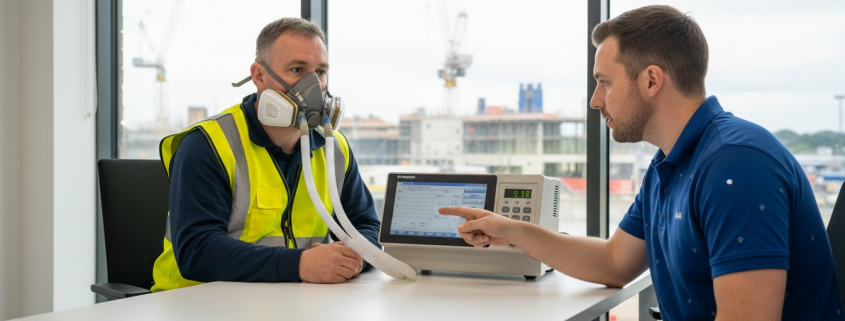
In contrast, a Quantitative Face Fit Test (QNFT) provides a precise, numerical measurement of the seal’s effectiveness. This objective test uses a specialised particle counting device, such as a Portacount machine. The machine measures the number of microscopic particles in the ambient air and compares it to the number of particles that leak into the mask. The result is an exact number called a ‘Fit Factor’. The key advantage of QNFT is its precision, removing any subjective judgement from the process. The protocols for both methods are clearly defined in the official HSE INDG479 Guidance.

Mandatory Scenarios for Quantitative Face Fit Testing

The quantitative face fit testing requirements are unambiguous when it comes to high-protection RPE. A subjective QLFT is not considered sufficiently reliable for masks designed to offer a high protection factor, where even a minor leak could have severe health consequences. QNFT is the only legally acceptable method for all full-face masks.

This mandatory requirement applies to equipment including:

  • Full-face respirators (both negative pressure and powered)
  • Self-Contained Breathing Apparatus (SCBA)
  • Supplied-air breathing apparatus

While QLFT is acceptable for half masks, QNFT is often the preferred and recommended method in high-risk environments, such as those involving asbestos removal or exposure to other highly toxic substances. For this RPE, only an objective, numerical measurement can provide the necessary assurance that the face seal meets the required safety standards.

For instance, in the tightly controlled environments of modern hydroponic facilities, where staff may handle fine nutrient powders or other agents, ensuring proper RPE fit is crucial. These facilities manage many environmental variables, and professionals in this field often explore LED Grow Lights to optimize conditions alongside ensuring staff safety.

The QNFT Process: A Step-by-Step Breakdown

A Quantitative Face Fit Test (QNFT) is a precise and methodical procedure designed to provide objective, numerical data on the seal of a respirator. To ensure a valid result, the entire process must be conducted by a competent and experienced tester who understands the intricate quantitative face fit testing requirements. The test is always performed using the exact make, model, and size of Respiratory Protective Equipment (RPE) the individual will wear in the workplace, as a successful test on one mask does not transfer to another.

Equipment and Environment Setup

The core of a QNFT is a specialised particle counting device, such as a TSI Portacount. This machine measures the number of microscopic dust particles in the ambient air and compares it to the number of particles inside the respirator. To facilitate this, the mask is temporarily adapted with a sampling probe that connects to the machine. The test must be conducted in a controlled environment with a sufficient concentration of ambient particles for the equipment to take an accurate reading. Before any tests are performed, the equipment must be properly calibrated to ensure its measurements are precise and reliable.

The Seven Standard Test Exercises

To verify the mask’s seal under realistic conditions, the wearer must perform a series of seven exercises prescribed by the Health and Safety Executive (HSE). The purpose of these movements is to simulate the physical activities an employee might undertake during their work day, challenging the integrity of the mask’s seal. The HSE provides detailed guidance on the Basics of RPE fit testing, which includes this mandatory exercise protocol. Each exercise lasts for approximately one minute, and the wearer must not adjust the mask at any point once the test has begun.

  • Normal Breathing: The wearer breathes normally, without talking.
  • Deep Breathing: The wearer breathes slowly and deeply to simulate physical exertion.
  • Head Side to Side: The wearer turns their head from one side to the other, pausing at each extreme.
  • Head Up and Down: The wearer moves their head up and down, as if looking at the ceiling and then their feet.
  • Talking: The wearer reads from a prepared text, such as the Rainbow Passage, to simulate jaw movement.
  • Bending Over: The wearer bends at the waist, as if to touch their toes, and then returns to an upright position.
  • Normal Breathing: The test concludes with another period of normal breathing.

Receiving and Understanding Your Fit Test Certificate

Upon successful completion of the test, a fit test certificate is issued. This is the formal, legal record proving the RPE provides adequate protection for the wearer. A valid certificate must include key details such as the wearer’s name, the specific make, model, and size of the RPE tested, the pass level (Fit Factor) achieved, and the date of the test. This document is essential for demonstrating compliance with UK health and safety regulations. Need a certified test to ensure you meet all quantitative face fit testing requirements? Let our safety experts handle your compliance.

Understanding Fit Factors: The Key to Passing the Test

In a quantitative face fit test, the success or failure of the Respiratory Protective Equipment (RPE) is determined by a single, crucial metric: the Fit Factor. This is not a subjective assessment but a precise, numerical measurement of how effectively the mask seals to the wearer’s face. The figure is calculated by a specialised machine that compares the concentration of ambient airborne particles outside the mask to the concentration of particles that have leaked inside.

The resulting ratio is the Fit Factor. Simply put, a higher Fit Factor signifies a more effective seal, less inward leakage, and therefore greater protection for the operative. Achieving the minimum required Fit Factor is the ultimate goal of the test and a fundamental part of UK health and safety compliance.

Required Fit Factors for Different RPE Types

The Health and Safety Executive (HSE) sets clear minimum pass levels as part of the official quantitative face fit testing requirements. A test is only considered a pass if the RPE meets or exceeds these specific thresholds. These are not guidelines; they are absolute minimums required for a pass certificate to be issued and for the RPE to be deemed suitable for the wearer.

The minimum required Fit Factors are:

  • Half Masks (Disposable or Reusable): A minimum Fit Factor of 100 is required.
  • Full-Face Masks: A minimum Fit Factor of 2000 is required.

Common Reasons for a Low Fit Factor (Test Failure)

A failed test indicates that the RPE is not providing adequate protection. This is a critical safety issue that must be addressed immediately. While our expert testers will help identify the cause, failures typically stem from a few common issues:

  • Incorrect Mask Size or Model: Faces vary significantly in shape and size. A mask that fits one person perfectly may be unsuitable for another.
  • Facial Hair: This is the most common reason for failure. Even a day’s stubble can compromise the seal. For a quantitative test to be valid, the wearer must be clean-shaven where the mask meets the skin.
  • Improper Donning Technique: If the mask is not put on correctly, with straps adjusted to the right tension, it will not seal properly.
  • Facial Features or Medical Conditions: Scars, moles, or unique facial structures can sometimes interfere with achieving a secure seal.

Understanding these core components of the quantitative face fit testing requirements is vital for ensuring your workforce remains safe and your business stays compliant. If you need expert assistance or wish to book accredited on-site testing, get in touch with the Safehouse team today.

Preparing for a Quantitative Fit Test: A Checklist for Managers

Effective preparation is the foundation of a successful respiratory protective equipment (RPE) programme. By ensuring your employees and your site are ready for testing, you can minimise test failures, reduce downtime, and ensure your investment in safety delivers the best results. Clear communication and coordination are essential to meeting your legal obligations and protecting your team.

As a manager, your role is to facilitate a smooth process. This involves briefing your staff correctly, having a suitable range of RPE available, and coordinating with your test provider. This checklist will help you manage the key aspects of preparation.

Pre-Test Instructions for Employees

To ensure the test can be conducted accurately, all employees must be informed of the pre-test conditions. Failure to adhere to these can result in an automatic fail and a wasted appointment. Provide your staff with the following instructions:

  • Be clean-shaven: The most common reason for test failure is facial hair. There must be no stubble or hair growth in the area where the mask’s seal meets the skin.
  • Avoid smoking, vaping, or eating: This should be avoided for at least 30 minutes prior to the test, as it can affect the results.
  • Bring relevant PPE: If the employee wears safety glasses, hearing protection, or a hard hat with the RPE, they must bring them to the test to ensure the mask fits correctly with their other equipment.
  • Be in good health: The test cannot be conducted if the individual has a cold, cough, or other respiratory issue that could affect their breathing.

What Happens After the Test?

The outcome of the fit test determines whether an employee is permitted to use a specific mask in a hazardous environment. If an employee passes, they receive a certificate confirming the make, model, and size of the RPE they are approved to wear. This certificate is a crucial part of your compliance records.

If an employee fails, they are not protected and must not use that mask. The process is then repeated with a different size or model of RPE until a suitable, protective fit is achieved. It is vital to document all results, including failures, as this demonstrates a robust approach to fulfilling the quantitative face fit testing requirements and protecting your workforce.

Frequency of Re-testing: When is it Required?

While the HSE does not mandate a specific expiry date for a fit test certificate, industry best practice recommends re-testing at least every two years. However, a re-test is legally required sooner if certain conditions are met:

  • Significant weight gain or loss.
  • Major dental work (e.g., extractions or dentures).
  • Facial injuries, scarring, or cosmetic surgery in the face seal area.
  • A change in the make, model, or size of the RPE being used.

Staying on top of these triggers is essential for maintaining compliance. For assistance in managing your company’s testing schedule and requirements, please get in touch with our expert team.

Partner with the Experts for Compliant Face Fit Testing

Navigating UK health and safety legislation is a significant responsibility for any employer. As this guide has outlined, quantitative face fit testing is a legal necessity for all full-face masks and is the required method when a half mask fails a qualitative test or requires a higher fit factor. Achieving a successful, numerical fit factor is the only verifiable proof that Respiratory Protective Equipment (RPE) offers the intended protection against airborne hazards. Understanding this process is therefore critical for both worker safety and your legal compliance.

Meeting the stringent quantitative face fit testing requirements demands precision and expertise that cannot be overlooked. Let our team of specialists take this complex burden from your shoulders. Our Fit2Fit accredited testers provide a comprehensive, professional service covering all types of RPE, ensuring every test is conducted to the highest standard. As a trusted local company with nationwide reach and expertise, we are ideally positioned to support your business wherever you operate in the UK.

Ensure your team is protected and compliant. Book your professional face fit testing service today.

Frequently Asked Questions

Who is considered a ‘competent person’ to conduct a quantitative face fit test?

A competent person is someone with the necessary knowledge, training, and practical experience to conduct the test correctly. As per HSE guidance (INDG 479), they must understand the testing equipment, the RPE being tested, and the exercises required. While not legally mandatory, accreditation from a scheme like Fit2Fit is the HSE’s recommended proof of competence. This ensures all UK quantitative face fit testing requirements are met, providing reliable and compliant results for your business.

Can you pass a quantitative face fit test with a beard or stubble?

No, it is not possible to pass a face fit test with any facial hair that interferes with the mask’s seal. Even a day’s stubble can create gaps, allowing hazardous airborne particles to bypass the filter. For any tight-fitting respirator, the wearer must be clean-shaven in the contact area between the mask and the skin. This is a non-negotiable safety requirement to ensure the Respiratory Protective Equipment (RPE) provides the intended level of protection.

What is the main difference in cost between quantitative and qualitative testing?

Quantitative testing is generally more expensive than qualitative testing. This is because it requires sophisticated and costly particle-counting equipment, such as a Portacount machine, and a more highly trained operator to administer the test. In contrast, qualitative testing uses a simple hood and taste solution. Typically, you can expect to pay from £45-£70 per person for a quantitative test, whereas a qualitative test may cost between £25-£40, depending on the provider.

How long does a single quantitative face fit test typically take?

A single quantitative face fit test session usually takes approximately 20 to 30 minutes to complete per individual. This includes a briefing on the test procedure, correct donning of the mask, and the test itself. The test involves the wearer performing a series of seven exercises designed to simulate typical work movements, such as turning the head, bending over, and speaking. This ensures the mask maintains its protective seal during a range of activities.

What is the legal consequence of not having a valid fit test certificate for an employee?

Failing to provide a valid fit test certificate for an employee using tight-fitting RPE is a breach of UK health and safety law, including COSHH and CAR 2012 regulations. The Health and Safety Executive (HSE) can issue enforcement notices, including prohibition notices that stop work immediately. In serious cases, this can lead to prosecution, resulting in significant fines for the company and, potentially, the responsible individuals. It is a critical compliance issue for any employer.

Does a fit test certificate cover all types of respirator masks?

No, a fit test certificate is specific to the exact make, model, and size of the respirator the employee was tested on. It does not provide a universal pass for all types of RPE. If an employee needs to switch to a different mask for any reason-even one that appears similar-a new face fit test must be conducted for that specific model. This ensures a protective seal is confirmed for every piece of equipment they are required to wear.

Investing in your team’s safety is a critical business decision, but navigating the financial commitment can be complex. When researching the typical IOSH Working Safely course cost in the UK, you’ll find a wide spectrum of prices for online and classroom training, often leading to uncertainty. What constitutes a fair price? Are there hidden fees for exams or certificates? And how can you be sure you are choosing a reputable provider that delivers genuine value beyond a low price tag?

This guide removes that ambiguity. Here, we provide a clear, authoritative breakdown of the costs you can expect for an accredited IOSH Working Safely course. We will examine the factors that influence the price, from the training format to the provider’s credentials, helping you make an informed investment. Our goal is to equip you with the confidence to select a high-quality course that not only fits your budget but also ensures your business remains safe and compliant.

Key Takeaways

  • Understand the typical price range for the IOSH Working Safely course, whether you choose online, virtual, or classroom-based training.
  • Discover the key factors that influence the final iosh working safely course cost, including provider accreditation and included materials.
  • Learn to evaluate the course not just as an expense, but as a crucial investment in legal compliance, staff safety, and business reputation.
  • Gain a practical framework to compare training providers, ensuring you select a partner that delivers the best value, not just the lowest price.

What is the IOSH Working Safely Course?

The IOSH Working Safely course is a foundational, one-day qualification designed to provide employees with the essential knowledge of health and safety in the workplace. It serves as an internationally recognised benchmark for safety awareness, accredited by the Institution of Occupational Safety and Health (IOSH). The course is suitable for staff at any level, across all industries, from construction and manufacturing to office-based environments.

Unlike purely compliance-driven training, Working Safely focuses on why health and safety is important to each individual’s role. It aims to change behaviours and improve a company’s safety culture from the ground up. For businesses, providing this accredited training is a key step in meeting the legal duty to ensure a safe working environment for all staff. Understanding the course content is crucial when considering the overall iosh working safely course cost and the significant return on investment it provides through reduced accidents and a more safety-conscious workforce.

Who is this qualification for?

This qualification is designed for maximum accessibility and is an excellent investment for a wide range of employees. It is particularly beneficial for:

  • New starters as a core component of their company induction process.
  • Any team member, regardless of their specific job role, to ensure a consistent level of safety awareness.
  • Young workers or apprentices who are new to the workforce and its inherent risks.
  • Individuals seeking a solid foundation before undertaking more advanced IOSH or NEBOSH qualifications.

Key Differences: Working Safely vs. Managing Safely

It is vital to choose the correct IOSH course for your needs. While both are highly respected, they serve different purposes and audiences:

  • Target Audience: Working Safely is for all employees, focusing on individual responsibility. Managing Safely is specifically for managers and supervisors responsible for the safety of their teams.
  • Course Duration: Working Safely is a concise one-day course. Managing Safely is a more in-depth programme, typically lasting three days.
  • Focus: Working Safely teaches how to keep oneself and colleagues safe. Managing Safely covers risk assessment, safety management systems, and leadership responsibilities.

This difference in scope and duration is also reflected in the price; the iosh working safely course cost is significantly more accessible than the managerial equivalent. Ensure you select the qualification that directly aligns with your job role and responsibilities.

Average IOSH Working Safely Course Cost in the UK

Understanding the typical iosh working safely course cost is a crucial first step in budgeting for this essential health and safety qualification. In the UK, the price varies significantly depending on the training provider and the delivery method you choose. As a general rule, the investment reflects the level of tutor interaction, the quality of course materials, and the overall learning experience. Below, we break down the average market prices for the three primary training formats.

Please note: All prices provided are indicative, per person, and exclusive of VAT. We always recommend confirming the final cost directly with your chosen training provider.

Online E-learning Course Prices

For individuals seeking maximum flexibility, online e-learning is the most cost-effective option, with prices typically ranging from £90 to £150. This format is ideal for self-motivated learners who are comfortable with digital platforms. The price generally includes:

  • Access to online learning modules to complete at your own pace.
  • A digital assessment to test your understanding.
  • An official IOSH Working Safely certificate upon successful completion.

Virtual Classroom Course Prices

A virtual classroom course offers a blend of convenience and expert guidance, with costs generally between £125 and £180. This method involves joining a scheduled, live training session with an accredited tutor via a video conferencing platform like Zoom or Teams. It provides a structured learning environment with the benefit of direct interaction, allowing you to ask questions and engage with the instructor and other delegates from any location.

In-Person Classroom Course Prices

The traditional in-person classroom setting provides the most comprehensive and immersive training experience, with prices ranging from £150 to £250. This format is perfect for those who benefit from face-to-face tuition and practical, hands-on learning away from workplace distractions. The higher cost covers the venue, physical course materials, and the invaluable opportunity for group discussions and direct networking with peers and the instructor.

While cost is an important consideration, the ultimate goal is to ensure your team receives high-quality training that genuinely improves workplace safety. The official IOSH Working Safely course is designed to provide a foundational understanding of health and safety principles. Choosing a reputable, IOSH-accredited provider ensures the training delivered meets the high standards required to keep your workforce safe and your business compliant.

What Factors Influence the Course Price?

When searching for an IOSH Working Safely course, you will encounter a wide range of prices. This variation can be confusing, but the headline figure rarely tells the whole story. A lower price does not always equate to better value. Understanding the key factors that determine the iosh working safely course cost allows you to look beyond the initial price tag and assess the quality, support, and overall return on your investment.

Making an informed decision ensures your team receives training that is not only compliant but genuinely effective in creating a safer workplace. Before you book, consider the following critical elements.

Training Provider’s Reputation and Accreditation

The provider’s standing in the industry is a primary driver of cost and quality. Established, IOSH-accredited training centres invest significantly in developing high-calibre course materials, employing experienced tutors, and providing robust administrative support. This commitment to quality ensures a valuable learning experience. Choosing an accredited provider is essential for demonstrating due diligence and meeting your legal obligations under key legislation like the Health and Safety at Work etc. Act 1974. Conversely, unusually cheap providers may be cutting corners on resources or support, which can compromise the training’s effectiveness. Always verify a provider is officially approved on the IOSH website.

What’s Included in the Fee?

A transparent pricing structure is the hallmark of a reputable provider. The advertised price should be comprehensive, but it is crucial to confirm what is covered to avoid unexpected “hidden” costs. Before committing, ask specific questions:

  • IOSH Certificate Fee: Is the official IOSH certificate cost (£25 as of 2023, but subject to change) included in the total price?
  • Exam and Retake Fees: Are there additional charges for the final assessment or for a potential retake if required?
  • Course Materials: Are workbooks, handouts, and other learning resources provided within the fee, or are they an extra expense?
  • Tutor Support: What level of access will delegates have to the tutor for questions and guidance throughout the course?

Group Bookings & In-Company Training

For businesses training multiple employees, significant cost efficiencies can be achieved. Most providers offer discounts for group bookings on public courses. An even more cost-effective solution for teams is in-company training, where a tutor delivers the course at your premises. This option not only reduces costs per delegate but also allows the training content to be tailored to your specific workplace hazards and operational procedures, making the learning directly relevant and impactful. Ask us about our group booking discounts.

Is the IOSH Working Safely Course a Good Investment?

When considering the iosh working safely course cost, it is more accurate to view it not as an expense, but as a critical investment in your organisation’s most valuable asset: its people. This foundational training delivers tangible returns that far outweigh the initial fee, safeguarding both your workforce and your business’s future. The value is realised through improved safety, enhanced compliance, and a more competent, risk-aware team.

Benefits for Employers: Compliance and Culture

For any business, the return on investment is clear and multifaceted. Enrolling your team demonstrates a proactive commitment to your legal duties under the Health and Safety at Work etc. Act 1974. This directly translates into a safer workplace, reducing accident rates, associated sick leave, and the risk of costly civil claims. More profoundly, it helps build a positive safety culture where every individual understands their role. When compared to potential fines from the Health and Safety Executive (HSE), which can be unlimited and are often based on company turnover, the course fee is a minor, preventative measure against catastrophic financial and reputational damage.

This commitment to a comprehensive safety culture naturally extends to other areas of business risk, such as data security and environmental compliance when disposing of old IT equipment. Ensuring sensitive information is properly destroyed is another crucial aspect of protecting a business from legal and financial penalties. For guidance on this specific area of corporate responsibility, specialist providers like Surplus Technology Solutions offer certified services that align with a robust, all-encompassing safety strategy.

Benefits for Employees: Skills and Safety

For individual employees, the course provides essential skills and a recognised qualification that enhances career prospects. The benefits are immediate and long-lasting:

  • A respected IOSH certificate to strengthen your CV and professional credibility.
  • Increased awareness of common workplace hazards, empowering you to keep yourself and your colleagues safe.
  • A clear signal to current and future employers of your professionalism and commitment to safety.
  • The confidence to identify, assess, and report risks effectively without hesitation.

Ultimately, the value of IOSH Working Safely extends far beyond a certificate. It fosters a shared responsibility for safety that protects individuals and strengthens the entire organisation. When evaluating the iosh working safely course cost, remember that investing in accredited, high-quality training is a non-negotiable part of responsible business practice. The cost of an accident-in human, financial, and legal terms-is always infinitely higher. Ensure your team receives the expert training they deserve by choosing a trusted provider. You can view our accredited IOSH courses to take the next step.

How to Choose the Right IOSH Training Provider

Finding the right training partner is about more than just comparing the iosh working safely course cost. The quality of the training directly impacts your team’s safety and your company’s compliance. A cheaper course from an unaccredited or inexperienced provider offers poor value and can leave your business exposed. Making an informed decision means looking beyond the price tag to the expertise, accreditation, and support on offer.

Verify IOSH Accreditation

This is the most critical check you must perform. Only training providers officially approved by the Institution of Occupational Safety and Health (IOSH) can deliver the course and issue a genuine, recognised certificate. You can verify a provider’s status directly on the IOSH website. A non-accredited course is a false economy, as the certificate will be invalid and the training will not meet the required standard.

Assess Tutor Expertise and Training Style

The person leading the course makes all the difference. Does the tutor have real-world, practical experience in health and safety, or are they simply reciting a textbook? Effective training is engaging and draws on frontline knowledge. To help you evaluate your options, consider this simple checklist:

  • Accreditation: Is the provider listed as an approved partner on the official IOSH website?
  • Tutor Experience: Do trainers have demonstrable, hands-on industry experience?
  • Training Style: Is the approach interactive and engaging, encouraging participation and questions?
  • Support: Is the tutor accessible and willing to provide support throughout the course?

Why Choose Safehouse for Your Training?

At Safehouse, we are committed to providing training that delivers real value and helps you stay safe and compliant. We take the burden of health and safety training away, giving you peace of mind. As a trusted partner, we offer:

  • Full IOSH Accreditation: We are a fully approved IOSH training provider, guaranteeing a valid and respected qualification.
  • Expert, Supportive Tutors: Our trainers are seasoned safety professionals who provide a personal, supportive, and engaging learning experience.
  • Practical Focus: We concentrate on building practical skills that make a tangible difference in your workplace.
  • Local Company, Nationwide Reach: Based in Barnsley, we combine the personal approach of a local business with the capacity to serve clients across the UK.

When considering the total iosh working safely course cost, remember that investing in expert training is an investment in your people and your business. Get in touch with our team to discuss your requirements and secure your place.

Your Next Step: Investing in a Safer, Compliant Workplace

As we have explored, the IOSH Working Safely course is a foundational investment in your organisation’s health and safety culture. While the price can vary depending on the training provider, location, and delivery format, its value extends far beyond the initial fee. Understanding the complete iosh working safely course cost involves recognising its critical role in ensuring legal compliance, reducing workplace incidents, and empowering your employees with essential safety knowledge. The key to maximising this return is selecting a provider that delivers quality and expertise.

At Safehouse Health and Safety Consultants Ltd, we are a Fully Accredited IOSH Training Provider dedicated to helping you stay safe and compliant. Our courses are led by Expert Tutors with Real-World Experience who deliver practical, engaging training. We are proud of our Personal Approach to Health & Safety Training, ensuring we understand your business needs to provide the most effective support and guidance.

Ready to take the definitive step towards a safer work environment? Contact our expert team to book your IOSH course today.

Frequently Asked Questions

How long is the IOSH Working Safely certificate valid for?

The IOSH Working Safely certificate does not have a formal expiry date. However, health and safety knowledge must be kept current to remain effective and compliant with evolving legislation. It is considered industry best practice for delegates to undertake a refresher course every three years. This ensures that employees’ awareness of workplace hazards and safety protocols remains at the required standard, protecting both your staff and your business.

Is there an exam at the end of the IOSH Working Safely course?

Yes, successful completion of the IOSH Working Safely course requires delegates to pass a two-part assessment. The first part is a short multiple-choice examination to test theoretical understanding of the key safety principles covered. The second part is a practical hazard-spotting assessment where delegates must identify potential risks in a series of workplace scenarios. Our expert trainers provide full support to ensure all delegates are prepared for these assessments.

Is IOSH Working Safely a recognised qualification in the UK?

Absolutely. The IOSH Working Safely certificate is a highly respected and internationally recognised qualification. Within the UK, it is valued by employers across all industries as a benchmark for essential health and safety training. Holding this qualification demonstrates a clear commitment to workplace safety and provides proof that individuals have received training that meets established standards. It is an essential component of a compliant and safe working environment.

What level is the IOSH Working Safely course?

The IOSH Working Safely course is designed as a foundational, entry-level qualification. While it is not formally on the UK’s Regulated Qualifications Framework (RQF), IOSH benchmarks it as being equivalent to a Level 1 award. This makes it an ideal course for employees at any level, in any sector, who need a fundamental understanding of workplace health and safety principles without requiring in-depth management-level detail.

Is an IOSH course the same as a CSCS card?

No, an IOSH course and a CSCS card serve different functions. IOSH Working Safely is a health and safety training qualification, whereas a CSCS card is a credential that provides proof of occupational competence required for access to most construction sites in the UK. However, successfully completing the IOSH Working Safely course, along with the CITB Health, Safety and Environment test, is a recognised route to applying for the green CSCS Labourer card.

Can my business get funding for IOSH training?

While direct government funding is uncommon for this course, some businesses may be able to reclaim costs. For construction companies registered with the Construction Industry Training Board (CITB), the IOSH Working Safely course is often eligible for grant funding. This can significantly reduce the overall IOSH Working Safely course cost for your business. We recommend checking the current CITB Levy and Grants Scheme for specific eligibility criteria and grant values.

Is your Site Supervisor Safety Training Scheme (SSSTS) certificate approaching its five-year expiry date? We understand the pressure of keeping your qualifications current while managing a demanding work schedule. The search for a convenient, CITB-accredited sssts refresher course near me can often feel like another task on an already long list, especially when you need training that minimises time away from site and is located right here in Yorkshire.

This guide is designed to remove that burden. We provide all the essential information to help you find, prepare for, and successfully complete your 1-day SSSTS Refresher course in the Barnsley area. We’ll cover what to expect from the updated curriculum, how to approach the final assessment with confidence, and how to choose a reputable training provider that ensures you stay safe and compliant. Let us assist you in securing your qualification efficiently, so you can continue to lead with authority on site.

Key Takeaways

  • Your SSSTS certificate is valid for five years; renewing it is mandatory to remain qualified for site supervisory roles and stay compliant.
  • The intensive 1-day course efficiently updates your knowledge on the latest health, safety, welfare, and environmental legislation.
  • Finding an ‘SSSTS refresher course near me’ is straightforward, with our Barnsley centre serving as a convenient location for all of South Yorkshire.
  • Learn how to prepare for your course and book your place with a trusted, CITB-approved provider focused on practical safety skills.

Why You Must Renew Your SSSTS Certificate: The 5-Year Rule

Your Site Supervisor Safety Training Scheme (SSSTS) certificate is a vital credential, but it is not permanent. It is valid for exactly five years from the date of issue. To remain qualified for supervisory roles on UK construction sites, renewing your certificate is a mandatory requirement. Letting it lapse can result in being denied site access, halting your work, and jeopardising your career progression.

Fortunately, maintaining your qualification is straightforward and cost-effective. The one-day SSSTS Refresher course is designed specifically to update your knowledge on the latest health and safety regulations, legislation, and best practices. It is a much quicker and more affordable route than having to re-take the full two-day course from scratch. Proactively searching for an “sssts refresher course near me” before your expiry date is the most efficient way to stay compliant and active in your role.

CITB Regulations on Certificate Expiry

The rules governing certificate renewal are set by the Construction Industry Training Board (CITB) and they are strict. You must attend and pass the one-day refresher course before your current SSSTS certificate expires. If your certificate’s expiry date passes, even by a single day, you will no longer be eligible for the refresher. Your only option at that point is to enrol in the full two-day SSSTS course again, costing you more time and money. We strongly advise you to check your certificate’s expiry date now to ensure you have ample time to book your renewal.

The Cost of Non-Compliance for You and Your Employer

An expired SSSTS certificate carries significant consequences for both individuals and their employers. For a site supervisor, it can mean an immediate loss of work and earnings, as you cannot legally fulfil your duties. For an employer, having unqualified supervisors on site creates a serious liability, potentially invalidating insurance policies and risking project delays or even fines during a safety audit. Ultimately, ensuring your qualifications are current is a shared responsibility that protects your career, your colleagues, and your company’s reputation.

What to Expect from the 1-Day SSSTS Refresher Course

The Site Supervisor Safety Training Scheme (SSSTS) Refresher is an intensive one-day programme, typically running for 7.5 hours, designed to bring your health and safety knowledge up to date with current industry standards. If you are looking for an “sssts refresher course near me,” you are taking a critical step to remain compliant and effective in your supervisory role. The primary goal is to ensure you are fully aware of recent changes in legislation and can continue to implement best practices on site.

This is not simply a lecture. The course is highly interactive, combining individual and group exercises, case studies, and open discussions. This format allows you to share experiences with peers and apply new knowledge to real-world scenarios, reinforcing best practices in risk assessment, method statements, and effective site supervision.

Key Topics Covered

Our expert tutors guide you through the most critical updates and core principles of modern site safety. The syllabus is focused on providing practical knowledge that you can apply immediately. Key areas of focus include:

  • A comprehensive review of the latest changes to UK construction safety regulations, including the Construction (Design and Management) Regulations 2015 (CDM).
  • Updates and reinforcement of the Health and Safety at Work Act and its implications for supervisors.
  • Methods for the effective supervision of occupational health, including mental health awareness and managing workplace stress.
  • Understanding behavioural safety and how to promote a positive, proactive safety culture within your team.

The End-of-Course Assessment

To successfully renew your qualification, you must pass a final assessment at the end of the day. This consists of a multiple-choice question paper covering the key topics discussed during the training. Our experienced tutors are dedicated to your success; they provide clear instruction and ensure you are well-prepared to confidently answer the questions. At Safehouse, we pride ourselves on our supportive training environment and consistently high pass rates, giving you the peace of mind that you are receiving industry-leading instruction. Upon successful completion, you will be issued with a renewed, CITB-accredited SSSTS certificate, valid for a further five years.

Finding Your Local Course in Barnsley & South Yorkshire

When you search for an “SSSTS refresher course near me,” you are prioritising convenience and efficiency. You need to renew your CITB qualification without the significant disruption of long-distance travel, overnight stays, and excessive time away from site. Wasting a full day on the motorway is an unnecessary cost to your business and your schedule.

Safehouse Health and Safety Consultants is strategically located in Barnsley, making us the ideal training provider for supervisors and managers across South Yorkshire. Our centre is perfectly positioned to serve professionals from Sheffield, Rotherham, and Doncaster, ensuring you can access industry-leading training right on your doorstep. By training locally, you not only save time and money but also benefit from tutors with direct experience of the regional construction industry, its unique challenges, and its safety standards.

Benefits of Choosing a Local Training Provider

Opting for a local provider for your SSSTS Refresher offers tangible advantages that support both you and your business. We are committed to making your compliance journey as straightforward as possible.

  • Reduced Costs and Downtime: Eliminate expensive fuel bills, public transport fares, and the need for hotel accommodation. More importantly, reduce non-productive travel time, allowing you to remain focused on your projects.
  • Hassle-Free Access: Our training centre is easy to reach and offers free on-site parking, removing the stress of finding a space on your training day.
  • Support a Yorkshire Business: As a local company, we are dedicated to upholding the highest safety standards within our region. Your investment supports local expertise and jobs.
  • Local Networking: Train alongside other site supervisors from the South Yorkshire area. This provides a valuable opportunity to share knowledge, discuss regional challenges, and build professional connections.

Our Barnsley Training Centre

Our purpose-built facility in Barnsley is designed to provide a professional and effective learning experience. You will train in modern, air-conditioned classrooms equipped with the latest presentation technology. We ensure a comfortable and focused environment where you can concentrate fully on updating your health and safety knowledge.

Conveniently situated with excellent access from the M1, A628, and other major routes, getting to us is simple. We take the burden out of your training logistics so you can focus on what matters: maintaining your qualification and keeping your sites safe and compliant. View upcoming course dates at our Barnsley centre.

How to Prepare and Book Your Place: A Simple Checklist

At Safehouse Health and Safety, we believe that renewing your SSSTS certificate should be a straightforward and stress-free process. Finding the right sssts refresher course near me is the first step; our goal is to make the next steps-preparation and booking-just as simple. This checklist will guide you through everything you need to do to ensure you are fully prepared for your training day. You can book your place securely online in minutes, or if you prefer, our expert team is available to assist you over the phone.

Step 1: Check Your Eligibility

Before booking, it is essential to confirm you meet the CITB’s requirements for the one-day refresher course. Taking a moment to verify these details now prevents any issues on the day of your training. Please ensure you have the following in order:

  • Your current SSSTS certificate: You must locate your original certificate.
  • Valid expiry date: Your certificate must be in-date. Expired certificates are not eligible for the refresher course.
  • Correct details: Check that your full name and CITB registration number on the certificate are accurate.
  • Language proficiency: You must have a good understanding of spoken and written English to participate fully.

Step 2: The Booking Process

Once you have confirmed your eligibility, securing your place is simple. Our online schedule makes it easy to find an sssts refresher course near me on a date that suits your diary. Follow these steps to complete your booking and take the next step in maintaining your site supervisor qualifications.

  • Visit our SSSTS Refresher course page to view all available dates.
  • Select your preferred training date and add it to your basket.
  • Complete the delegate information and payment details through our secure online portal.
  • Alternatively, you can call our friendly office team who will be happy to book your place over the phone.

Step 3: What to Bring on the Day

To ensure a smooth start to your training day, please arrive prepared with the required documentation and items. This allows our trainers to complete the necessary registration checks efficiently and begin the course on time. We provide lunch and refreshments to keep you focused throughout the day.

  • Valid Photo ID: A UK driving licence, passport, or another form of official photographic identification is mandatory.
  • SSSTS Certificate: Bring your current certificate or have your CITB registration number ready.
  • Note-taking materials: A pen and notebook are highly recommended for taking notes during the sessions.

If you have any questions about preparation or the booking process, please do not hesitate to get in touch with our support team. We are here to assist.

Why Choose Safehouse for Your CITB Training?

When searching for an “sssts refresher course near me,” the quality and approach of the training provider are paramount. At Safehouse, we are a trusted, CITB-approved training provider committed to a personal approach. Our focus extends beyond simply helping you pass an exam; we are dedicated to equipping you with practical safety knowledge that you can apply directly on site. We aim to be more than just a course provider-we strive to be your long-term health and safety partner.

As a local company with a nationwide reputation for excellence, we blend personalised service with industry-leading expertise to ensure you receive the highest standard of training.

Expert Tutors with Real-World Experience

Our training is delivered by seasoned construction safety professionals, not academics. Each of our instructors brings years of hands-on site experience, allowing them to share practical insights and real-world scenarios that go beyond the textbook. This approach ensures you learn not just the regulations, but how to implement them effectively in a live construction environment. You will benefit from a supportive and engaging learning atmosphere where questions are encouraged and knowledge is shared freely.

A Personal and Supportive Approach

We are committed to the success of every delegate. To achieve this, we intentionally maintain small class sizes to foster better interaction and allow for individual attention. Our tutors are always available to provide one-on-one support if you need extra guidance on a specific topic. This supportive environment ensures you leave the course feeling confident in your renewed knowledge and responsibilities as a site supervisor. Your success is our primary measure of success.

Have questions about course content or your eligibility? Talk to our safety experts today. We are here to assist you.

Your Next Step to SSSTS Compliance in Yorkshire

Maintaining your SSSTS qualification is essential for staying compliant and effective in your supervisory role. The one-day refresher course is a direct and efficient way to update your knowledge on the latest health and safety legislation. When looking for an sssts refresher course near me, choosing a trusted, local expert makes all the difference. At Safehouse, our experienced tutors bring real-world site knowledge to every session, ensuring you receive practical, relevant training that you can apply immediately.

As a CITB Approved Training Organisation based in Barnsley, we are dedicated to supporting professionals across Yorkshire. Our excellent pass rates and personal approach are why site supervisors trust us to help them stay safe and compliant. Don’t let your certificate expire and risk falling behind on crucial industry standards.

Book Your Local SSSTS Refresher Course in Barnsley Now.

Invest in your career and continue to lead with confidence. We look forward to welcoming you to our training centre.

SSSTS Refresher Course: Frequently Asked Questions

What happens if my SSSTS certificate has already expired?

Under CITB regulations, you must complete the refresher course before your current SSSTS certificate expires. If your certificate has expired, you are no longer eligible to take the one-day refresher. You will be required to attend the full 2-day SSSTS course again to obtain a new, valid certificate. We strongly advise booking your refresher course in advance to ensure you remain compliant and avoid any lapse in your qualification.

How long is the new SSSTS Refresher certificate valid for?

Upon successful completion of the SSSTS Refresher course, your new CITB Site Safety Plus certificate will be valid for a further five years. To maintain your supervisory qualification beyond this period, you must attend another one-day refresher course before the new certificate’s expiry date. This ensures your knowledge of health and safety legislation remains current and your qualification stays active on site, helping you to stay safe and compliant.

Can I take the SSSTS Refresher course online?

Yes, the CITB SSSTS Refresher course is available via remote online learning. This provides a convenient and fully accredited alternative to attending a physical training centre, allowing you to complete the qualification from your home or office. Our online courses are delivered live by expert tutors, ensuring an interactive and engaging experience. This is an excellent option if you are struggling to find a suitable classroom-based SSSTS refresher course near me that fits your schedule.

What form of photographic ID is acceptable for the course?

To meet CITB scheme rules, all delegates must present a valid form of photographic identification on the day of the course. The most common and acceptable forms of ID are a current passport or a UK photocard driving licence. This is a mandatory requirement for verification purposes for both online and classroom courses. Please ensure you have one of these available to present to the tutor at the start of your training session.

Is there a grant available from the CITB for this course?

Yes, the one-day SSSTS Refresher course is eligible for CITB grant funding. Employers who are registered with the CITB and up to date with their levy payments can claim a grant for each employee who successfully completes the course. The current grant amount is £30. As an accredited training provider, we can provide you with the necessary information and support to assist you in claiming this grant, helping you to reduce your training costs.

What is the pass mark for the SSSTS Refresher test?

The assessment for the SSSTS Refresher course is a multiple-choice examination. The test consists of 25 questions covering a range of health, safety, welfare, and environmental topics. To successfully pass the course and be awarded the CITB certificate, you must achieve a score of 80% or higher. This means you need to answer at least 20 out of the 25 questions correctly. Our tutors ensure you are fully prepared for this final assessment.

Navigating the complex landscape of UK construction safety regulations, from CDM 2015 to the latest HSE directives, can be a significant burden for any site manager. The constant pressure to maintain compliance, prevent accidents, and avoid costly fines or site shutdowns is immense. This is precisely why a comprehensive health and safety audit for a construction site is not merely a procedural task-it is a critical component of responsible project management and your first line of defence against risk.

This complete UK guide is designed to remove that pressure and provide you with a clear, actionable framework. We will demystify the entire process, breaking down your legal obligations and offering a practical checklist you can use immediately. By following our expert advice, you will understand exactly what a thorough audit entails, how to address shortcomings effectively, and how to maintain the documentation required to pass any potential HSE inspection with confidence. Let us help you ensure your site is not just compliant, but genuinely safe for everyone.

Key Takeaways

  • Learn the critical distinction between a routine site inspection and a comprehensive audit, which evaluates your underlying safety management systems, not just individual hazards.
  • A successful health and safety audit for construction site goes beyond a simple walkthrough; discover the core components it must cover to ensure your procedures are robust and legally compliant.
  • Follow a clear, step-by-step process for conducting an audit and gain access to a practical checklist you can use to assess your own site’s performance.
  • Determine when an internal review is sufficient and when engaging an independent external expert is essential for objective insights and demonstrating due diligence.

What is a Construction Site Health and Safety Audit? (And Why It’s Non-Negotiable)

A construction site health and safety audit is a systematic, independent, and documented review of an organisation’s entire health and safety management system. It is a critical deep-dive, designed to verify compliance with legal standards and identify systemic weaknesses before they lead to incidents. It is far more comprehensive than a routine site inspection, which typically focuses on immediate hazards, or a toolbox talk, which addresses specific risks. The primary goal is to assess the effectiveness of your policies, procedures, and practices, ensuring they are not just present on paper but are actively working to protect your team. This proactive approach is fundamental to maintaining high standards in Construction site safety.

The Legal Framework: Complying with HSE Requirements

Under UK law, particularly the Health and Safety at Work etc. Act 1974 and the Construction (Design and Management) Regulations 2015 (CDM), employers and site managers have a stringent duty of care. A formal audit provides documented proof that you have taken ‘reasonably practicable’ steps to manage risks. For the Health and Safety Executive (HSE), this is not a suggestion; it is a requirement. The consequences of non-compliance are severe and can include unlimited fines, imprisonment for individuals, and director disqualification, making a robust health and safety audit for construction site operations an essential part of your governance.

The Business Case: Protecting People, Profits, and Reputation

Beyond legal compliance, a diligent approach to safety audits delivers tangible business benefits. A strong safety culture is a profitable one. By proactively identifying and rectifying systemic failures, you are investing in the stability and growth of your company. Key advantages include:

  • Reduced Accident Rates: Fewer injuries mean less downtime, reduced project delays, and consistent productivity.
  • Lower Operating Costs: A strong safety record can lead to lower insurance premiums and helps you avoid costly legal battles and HSE fees for intervention.
  • Enhanced Company Reputation: Demonstrating a commitment to safety makes your company a more attractive partner for clients, helping you win valuable new contracts.
  • Improved Worker Morale: When workers feel safe and valued, morale and engagement increase, leading to a more positive and productive site culture.

The Core Components: What a Thorough Site Audit Actually Covers

A comprehensive health and safety audit for a construction site is not a simple box-ticking exercise. It is a systematic review designed to assess the effectiveness of your entire safety management system, not just to spot isolated hazards. A truly thorough audit provides a 360-degree view by examining three interconnected areas: the documentation that underpins your policies, the physical conditions on the ground, and the processes for managing high-risk work. While every site has unique challenges, these core principles of assessment apply universally.

Documentation and Management Systems

This is the foundation of your compliance. An auditor will scrutinise your paperwork to ensure that safety is planned, implemented, and recorded, not left to chance. This review confirms that your management systems are robust and fit for purpose. Key areas of focus include:

  • Health and Safety Policy: Review of the core policy and evidence of its practical implementation.
  • RAMS: Assessment of risk assessments and method statements to ensure they are suitable and sufficient.
  • Competence and Training: Verification of worker induction records, qualifications, and ongoing training certificates.
  • Incident Reporting: Checking that procedures for reporting accidents and near-misses are in place and records are maintained.

Site-Wide Physical Conditions and Hazards

Here, the audit verifies that documented policies are reflected in the site’s day-to-day reality. The physical state of a site provides immediate evidence of the prevailing safety culture. Auditors assess compliance with fundamental standards, many of which are detailed by the Health and Safety Executive (HSE), focusing on:

  • Site Organisation: Clear signage, effective traffic management, and secure perimeter fencing.
  • Good Order: General housekeeping, organised material storage, and compliant waste management.
  • Welfare Facilities: Adequacy and cleanliness of toilets, washing areas, and rest facilities.
  • Emergency Preparedness: Clearly marked fire points, accessible extinguishers, and defined assembly areas.
  • Fire & Security Systems: Verification that fire alarm and security systems are professionally installed and maintained to meet regulations. Specialists such as Quartz Empire Fire & Security Ltd are often engaged to manage this critical aspect of site safety.

Maintaining good order and high standards of cleanliness, particularly in welfare facilities, is a simple but effective way to improve site safety and morale. Many sites outsource this to ensure consistent compliance, relying on professional commercial cleaners such as That’s Cleaning to uphold the necessary standards.

High-Risk Activities and Controls

Construction involves inherent risks, and a key part of any audit is to examine how the most hazardous tasks are controlled. An auditor will rigorously inspect the specific safety measures put in place for high-risk activities to ensure they effectively mitigate danger to workers. This critical inspection covers:

  • Working at Height: Integrity of scaffolding, correct use of edge protection, and proper fall arrest systems.
  • Excavations: Correct installation of shoring and support systems to prevent collapse.
  • Lifting Operations: Crane maintenance records, LOLER certification, and proof of slinger/signaller competence.
  • Specific Hazards: Controls for hazardous substances (COSHH) and measures for ensuring electrical safety on site.

The Audit Process: A Step-by-Step Walkthrough

A health and safety audit for a construction site should not be viewed as a test to pass or fail, but as a collaborative tool for continuous improvement. The process is designed to be transparent and supportive, providing your management team with the expert insight needed to enhance site safety and ensure compliance. To demystify the experience, we structure our audits into three distinct and logical phases, working in partnership with you from start to finish.

Phase 1: Planning and Preparation (Pre-Audit)

Effective preparation is the foundation of a valuable audit. In this initial phase, we work with your site management team to establish clear expectations. This involves defining the scope and objectives of the audit, whether it’s a general compliance check or a focus on a specific high-risk activity. We will request key documentation to understand your existing systems, including your health and safety policy, Risk Assessments and Method Statements (RAMS), training records, and evidence of compliance with core legislation such as the Construction (Design and Management) Regulations 2015. Finally, we schedule the on-site visit and agree on a clear itinerary to ensure minimal disruption to your operations.

Phase 2: The On-Site Assessment

This is where we observe your safety management system in action. The day begins with an opening meeting to confirm the plan with site management. Our auditor then undertakes a comprehensive site tour, making impartial observations of workplace conditions, active tasks, and general site practices. A key part of the assessment includes:

  • Interviews: Engaging with operatives and supervisors to gauge their understanding of safety procedures and the overall site safety culture.
  • Observation: Watching work activities to see if safe systems of work are being followed in practice.
  • Documentation Sampling: Reviewing on-the-day records such as permits-to-work, plant inspection logs, and induction records.

Phase 3: Reporting and Follow-Up

Following the on-site visit, our findings are compiled into a formal, structured report. This document is not just a list of faults; it is a practical roadmap designed to help you stay safe and compliant. The report clearly details all non-conformities (where standards are not being met), observations (areas that could become future issues), and examples of good practice. Most importantly, we provide clear, prioritised recommendations for corrective actions. Each recommendation is accompanied by a realistic deadline, giving you an actionable plan to strengthen your safety performance and protect your workforce.

Your Essential Construction Site Audit Checklist

To prepare effectively for an external assessment, conducting regular internal checks is crucial. This checklist serves as a practical, actionable tool for site managers to self-assess their site’s current state of compliance. By systematically working through these key areas, you can identify and rectify potential issues before they become significant problems. Use this as a starting point for your internal health and safety audit for construction site management.

Please note: This checklist is a guide for internal preparation and is not a substitute for a comprehensive, professional audit conducted by a qualified safety consultant.

Site Setup & Welfare

The foundation of a safe site begins with its layout and the provision of adequate facilities. Verify that the fundamental elements of site organisation and worker welfare are in place and maintained to a high standard.

  • Is the site perimeter secure with appropriate fencing and clear, compliant signage (e.g., “Danger Construction Site”) at all entrances?
  • Are welfare facilities (toilets, washing areas, canteen) clean, fully stocked, and sufficient for the number of workers on site?
  • Is there a documented traffic management plan that segregates pedestrians and vehicles, with clear markings and designated routes?
  • Are fire points and first aid stations clearly identified, unobstructed, and properly equipped?

Plant, Equipment & PPE

All machinery and equipment must be fit for purpose and used correctly. Personal Protective Equipment (PPE) is the last line of defence and its proper use is non-negotiable. This section ensures your hardware and gear are compliant.

  • Is all plant and equipment, particularly lifting gear (LOLER), subject to regular, documented inspections and certification?
  • Are all workers wearing the correct, properly-fitted PPE for their specific tasks?
  • Are portable electrical tools subject to regular Portable Appliance Testing (PAT), with records available?
  • Is there a clear system for workers to report faulty equipment, and a designated quarantine area to prevent its use?

Documentation & Competency

A safe site is a well-documented one. Your paperwork provides the evidence that you have planned for safety and that your workforce is competent. An auditor will always scrutinise your records.

  • Are site induction records complete and available for every person currently working on site?
  • Are Risk Assessments and Method Statements (RAMS) available for all relevant tasks and have they been briefed to the operatives involved?
  • Are training and competency records (e.g., CSCS cards, SMSTS, SSSTS, specific plant operator tickets) on file and up to date?
  • Is the accident book correctly maintained, stored in a private location, and are RIDDOR procedures understood?

High-Risk Activities

Certain construction activities carry a significantly higher risk and demand more stringent controls. These areas require daily attention and specific, formal procedures to ensure they are managed safely.

  • Is all scaffolding inspected weekly by a competent person and displaying an up-to-date Scafftag?
  • Are excavations properly supported or battered back, and are they inspected daily before work commences?
  • Are formal permits-to-work being issued and managed for high-risk tasks such as hot works or entry into confined spaces?
  • Are detailed lifting plans in place for all crane operations, prepared by a competent Appointed Person?

While this checklist provides a solid framework, a professional, independent health and safety audit for construction site operations offers the assurance and expertise needed to be fully compliant. To ensure nothing is missed and to take the burden of compliance away from your team, get in touch with our expert consultants today.

Internal vs. External Audits: When to Call in the Experts

A key component of a mature safety management system is understanding not just how to perform a health and safety audit for a construction site, but who should conduct it. Both internal and external reviews have a distinct and valuable role to play in keeping your site compliant and your team safe. The decision isn’t about choosing one over the other; it’s about leveraging each for maximum effect.

The Role of Internal Audits

Regular internal audits are the bedrock of continuous safety improvement. Conducted by a competent site manager or an internal health and safety advisor, these checks are vital for maintaining established standards and reinforcing your safety culture on a day-to-day basis. They help identify immediate hazards and ensure control measures are working as intended. However, their primary limitation is familiarity. Over time, internal teams can develop blind spots, leading to a ‘checklist-ticking’ mentality that may miss deeper, systemic issues.

The Power of an Independent External Audit

An external audit provides a completely impartial and objective assessment of your site’s safety performance. An independent expert brings a fresh perspective, uninfluenced by internal politics or routines, and can identify non-compliance or systemic risks that have become normalised over time. This level of scrutiny is invaluable for true risk management.

  • Unbiased Expertise: External auditors possess deep, current knowledge of HSE regulations, including complex areas like CDM 2015 duties.
  • Enhanced Credibility: A formal report from an independent consultancy demonstrates due diligence and provides powerful assurance to clients, insurers, and regulatory bodies like the HSE.
  • Systemic Improvements: They are skilled at looking beyond isolated incidents to identify root causes and recommend robust, long-term improvements to your safety management system.

Ultimately, a comprehensive approach to site safety should be a two-part strategy. Use internal audits to maintain your standards week to week, and engage external experts for a periodic, in-depth review that validates your processes and uncovers hidden risks. This proactive approach provides the ultimate peace of mind and demonstrates an unwavering commitment to safety.

If you require an objective and thorough assessment of your site, let our experts provide an impartial audit to take the burden away. Our accredited consultants can assist in ensuring you remain fully compliant and your workforce is protected. Get in touch with Safehouse Health and Safety Consultants Ltd today to discuss your requirements.

Your Path to a Safer, Compliant Construction Site

As we’ve detailed, a proactive approach to site safety is not just a legal requirement under UK regulations-it is the bedrock of a successful construction project. A regular, thorough audit moves beyond a simple box-ticking exercise; it is a critical process for identifying hazards, protecting your workforce, and upholding your professional reputation. The key is to implement a structured process that turns compliance from a burden into a core strength of your operation.

Carrying out a comprehensive health and safety audit for a construction site ensures you meet these obligations, but you don’t have to navigate it alone. As an accredited CITB and IOSH training provider with deep expertise in CDM 2015 regulations, Safehouse Health and Safety Consultants offers the specialist support you need. We are a local company with a nationwide reach, dedicated to taking the burden of compliance from your shoulders. Ensure your site is compliant and safe. Book a professional health and safety audit with our experts.

Take the definitive step towards a safer worksite today.

Frequently Asked Questions

How often should a construction site have a health and safety audit?

While no strict legal timeframe is dictated by the HSE, best practice recommends a formal audit at least annually. For complex or high-risk projects, or sites with a history of incidents, more frequent audits are advisable. The frequency should align with your company’s safety management system and any specific requirements from the principal contractor or client. Regular audits demonstrate a proactive commitment to maintaining a safe and compliant working environment for everyone on site.

What is the difference between a safety audit and a safety inspection?

A safety inspection is a snapshot in time, focusing on identifying immediate hazards and unsafe conditions on site, such as faulty equipment or incorrect use of PPE. In contrast, a safety audit is a systematic, in-depth review of your entire health and safety management system. It assesses policies, procedures, training records, and risk assessments to ensure they are not only compliant with UK regulations but are also effective and being implemented correctly across the project.

What are the most common failings found during a construction site audit?

Common failings often relate to documentation and on-site practices. These include incomplete or generic Risk Assessments and Method Statements (RAMS), inadequate welfare facilities, and poor site housekeeping. We frequently identify non-compliance with the Working at Height Regulations, such as improperly erected scaffolding or missing edge protection. Incomplete training records and a failure to conduct regular toolbox talks are also significant issues that a comprehensive audit will uncover, posing serious compliance risks.

What happens if our site fails a health and safety audit?

Failing a health and safety audit for a construction site is an opportunity to rectify issues before they lead to an incident or HSE intervention. You will receive a detailed report outlining all non-conformities, typically categorised by severity. A corrective action plan with clear deadlines will be established. Our consultants can assist you in implementing these changes to ensure you become fully compliant. A follow-up audit is often conducted to verify that all necessary improvements have been made.

How much does a professional construction site safety audit cost?

The cost of a professional audit depends on several factors, including the size and complexity of the construction site, the number of personnel, and the overall scope of the review. As a guide, a straightforward audit for a smaller site may start from around £400 – £600. For larger, more complex projects requiring a more in-depth systems analysis, the cost can be £1,000 or more. We provide a personal approach, offering a clear, bespoke quotation after an initial consultation.

Can a safety audit help lower our company’s insurance premiums?

Yes, it certainly can. Regularly conducting a thorough health and safety audit for a construction site demonstrates a proactive commitment to risk management. Insurance providers view this favourably, as it indicates you are actively working to prevent accidents and subsequent claims. Providing evidence of robust safety systems and independent audits can often lead to reduced premiums for your Employers’ Liability and Public Liability insurance, as your business is recognised as a lower-risk client.

Securing your CSCS card is a vital step for working on any UK construction site, yet the process can often feel unnecessarily complex. Between navigating different card types, identifying the correct CITB test, and avoiding unofficial third-party sites that add hidden fees, it’s easy to feel overwhelmed and unsure where to begin. This confusion can lead to costly delays and prevent you from getting on-site when you need to.

This guide is designed to remove that burden and provide a clear, direct path forward. We understand that you need to know exactly how to get cscs card for your specific role, without the stress or uncertainty. As health and safety experts, our goal is to assist you in becoming fully compliant as efficiently as possible. We will break down the entire application into four simple, actionable steps, from choosing the right card to passing your test and receiving your card in the post.

Follow this guide to gain a clear understanding of the official costs involved-currently £22.50 for the CITB test and £36 for the card itself-and the confidence that you are following the correct procedure to get the right card for your job, fast.

Key Takeaways

  • The first step in how to get a CSCS card is identifying the correct one for your role, as this determines all other requirements.
  • A key part of how to get a CSCS card is passing the mandatory CITB Health, Safety and Environment (HS&E) test, but you also need a separate, role-specific qualification to be eligible.
  • Our guide on how to get your CSCS card breaks the process down into four clear steps, from passing the correct tests to submitting your final application.
  • Once your tests and qualifications are complete, the final step in how to get a CSCS card is a straightforward application with a fixed card fee of £36.

Step 1: Identify the Right CSCS Card for Your Role

Before you book any tests or submit an application, the critical first step is to identify the specific CSCS card you are eligible for. The most common mistake applicants make is assuming one card fits all, which can lead to wasted time and money. The Construction Skills Certification Scheme (CSCS) is designed to certify that individuals working on construction sites have the required training and qualifications for the type of work they carry out. Therefore, the card you need is directly linked to your specific job role, your formal qualifications (such as an NVQ or SVQ), and your level of experience.

Understanding this from the outset is fundamental to learning how to get a CSCS card correctly. The scheme uses a colour-coded system to easily identify a worker’s skill level and occupation, ranging from entry-level labourers to senior managers.

Common CSCS Card Types Explained

While there are over a dozen types of CSCS cards, most workers will fall into one of the following primary categories. Each colour represents a different level of qualification and seniority on site:

  • Green Card (Labourer): This is the entry-level card for individuals performing labouring duties. It requires a Level 1 Award in Health and Safety in a Construction Environment or an equivalent qualification.
  • Blue Card (Skilled Worker): To obtain this card, you must have achieved a construction-related NVQ or SVQ Level 2, or have completed an approved apprenticeship. It demonstrates proven competence in a specific trade.
  • Gold Card (Advanced Craft/Supervisory): This card is for workers with a high level of skill (requiring a construction-related NVQ/SVQ Level 3) or for those in supervisory positions (requiring a supervisory NVQ/SVQ Level 3 or 4).
  • Black Card (Manager): Reserved for managers and senior personnel who have achieved a relevant construction management NVQ/SVQ at Level 4, 5, 6, or 7.

How to Use the Official CSCS Card Finder

The simplest and most reliable way to determine your eligibility is by using the official CSCS Card Finder tool on the CSCS website. This free resource removes all guesswork from the process. Simply enter your occupation and then select the qualifications you hold from the provided list. The tool will then provide a definitive answer, confirming the exact card you should apply for and, just as importantly, the specific CITB Health, Safety and Environment (HS&E) test you must pass. Using this tool ensures you are on the correct path from the very beginning.

Step 2: Pass the CITB Health, Safety and Environment (HS&E) Test

Before you can apply for almost any CSCS card, you must pass the relevant CITB Health, Safety and Environment (HS&E) test. This is a mandatory requirement designed to ensure that every worker on a UK construction site has a minimum level of health and safety awareness. It is a critical step in the process of how to get a CSCS card and demonstrates your commitment to maintaining a safe working environment for yourself and your colleagues.

The test costs £22.50 and your pass certificate is valid for two years. You must use this certificate to apply for your card within this timeframe, otherwise you will be required to retake the test. Successfully passing this test is a non-negotiable prerequisite before moving on to the final application stage.

Understanding the Different HS&E Test Levels

The specific HS&E test you need to take depends on your role and the type of CSCS card you are applying for. It is essential to book the correct one, as passing the wrong test will invalidate your card application. The three main levels are:

  • Operatives Test: This is the most common test, required for the Labourer (Green) card, most Skilled Worker (Blue) cards, and Apprentice cards.
  • Specialist Test: This test is for individuals in specialised roles and includes targeted questions. Examples include tests for supervisors (Gold card) or for specific trades like demolition, plumbing, and working at height.
  • Managers and Professionals (MAP) Test: This is the highest level test, designed for those applying for the Black (Manager) or White (Academically or Professionally Qualified Person) CSCS cards.

How to Book Your Test and Avoid Extra Fees

To ensure you pay the official price and receive genuine booking confirmation, you must book directly with the CITB. You can do this via the official CITB Test Booking website or by calling their booking line. We strongly advise against using unofficial third-party booking sites, as they often charge significant administrative fees for the same service. On the day of your test, you must bring your booking confirmation and a valid form of photo ID, such as a UK driving licence or a passport.

Preparing for the Test: Revision and Mock Exams

While the test is straightforward, preparation is key to ensuring a first-time pass. We recommend using the official revision materials provided by CITB. The most effective tools are the CITB HS&E app and the official revision books, which contain all the questions and answers you could be asked. These resources also include mock tests, allowing you to practice under exam conditions and identify any areas where your knowledge may be weak. Investing time in revision is the most reliable way to secure your pass certificate and continue the process of how to get a CSCS card without delay.

Step 3: Complete Your Required Qualification or Course

This is often the most confusing part of the process for applicants. A common question we hear is, “Do I need a course as well as the test?” The answer is unequivocally yes. Passing the CITB Health, Safety and Environment (HS&E) test demonstrates your awareness of on-site safety, while your formal qualification proves your competence for a specific role. These are two separate and mandatory requirements.

The specific training or qualification you need is determined entirely by the type of CSCS card you are applying for. Understanding this distinction is a crucial step in learning how to get a CSCS card without unnecessary delays or expense.

The Green Labourer Card Requirement

To qualify for the Green Labourer Card, you must hold a specific health and safety qualification. The most common routes are either achieving the RQF Level 1 Award in Health and Safety in a Construction Environment or completing the CITB Site Safety Plus Health and Safety Awareness Course. As an accredited provider, Safehouse delivers this essential training, giving you the knowledge and certification needed to work safely on-site.

Qualifications for Blue, Gold, and Black Cards

For skilled, supervisory, or managerial roles, you must demonstrate your competence through a relevant construction-related National Vocational Qualification (NVQ) or Scottish Vocational Qualification (SVQ). The level of your NVQ/SVQ directly corresponds to the card you can apply for:

  • Blue Skilled Worker Card: Requires a Level 2 NVQ/SVQ in a construction-related trade.
  • Gold Advanced Craft/Supervisory Card: Requires a Level 3 or 4 NVQ/SVQ.
  • Black Manager Card: Requires a Level 4, 5, 6, or 7 NVQ/SVQ in construction management or a related field.

Completing a recognised apprenticeship is also a primary route to achieving the NVQ needed for a skilled worker card.

Finding an Accredited Training Provider

It is vital to choose a training provider that is accredited by the Construction Industry Training Board (CITB) or another recognised awarding body. This guarantees that your qualification will be accepted by CSCS and that you are receiving industry-standard instruction. Expert instruction from a dependable provider ensures you gain the practical skills and knowledge to stay safe and compliant, taking the burden of uncertainty away from you. This is a critical investment in your construction career.

For those looking for intensive, short-term courses to gain these qualifications, accredited centres like YTA Training provide a direct path to getting the certifications you need for your card.

Need the right qualification? View our CITB-accredited courses.

Step 4: Apply for Your CSCS Card

You have successfully passed your CITB Health, Safety and Environment test and have your required qualifications in order. This is the final, straightforward step in the process of securing your access to construction sites across the UK. The application itself is the formal request for your card, confirming you meet the industry-endorsed standards for your role.

The cost for the CSCS card is currently £36. The most efficient and recommended method for application is through the official CSCS online service, which simplifies the entire procedure and reduces waiting times.

Your Application Checklist

To ensure a smooth and rapid application, gather the following essential items before you begin. Having these ready will prevent delays and allow you to complete the submission in one sitting.

  • A clear, scanned copy or photograph of your qualification certificate (e.g., your NVQ or SVQ).
  • The unique ID number from your CITB HS&E test pass certificate.
  • A valid credit or debit card to pay the £36 application fee.

The Online Application Process

Navigating the final part of how to get a CSCS card is designed to be user-friendly. First, you will need to create a personal account on the official CSCS website. Once registered, the system will guide you through the application form, where you will be prompted to enter your personal details and your CITB test ID number.

You will then be asked to upload the digital copy of your qualification certificate. The system will verify your details, after which you can proceed to the secure payment portal to submit the fee. Once paid, your application is officially submitted for review.

Receiving and Using Your Card

Once your application is approved, your physical CSCS card will be printed and posted to your registered address, typically arriving within 3-5 working days. However, for immediate site access, you can use the official MyCSCS app. Your virtual card is often available in the app instantly upon approval, allowing you to present it on your smartphone.

Remember that your CSCS card has an expiry date. It is your professional responsibility to monitor this and begin the renewal process in good time to ensure you always remain compliant and site-ready. If you require further accredited training to renew or upgrade your card, our team at Safehouse Health and Safety Consultants Ltd can provide the necessary support.

Secure Your CSCS Card with Confidence

Securing your CSCS card is a clear and manageable process when broken down into key stages. The journey hinges on two critical milestones: passing the mandatory CITB Health, Safety and Environment (HS&E) test and obtaining the correct qualification for your specific role. By following the steps outlined in this guide, you have a definitive roadmap for understanding how to get a CSCS card and demonstrating your competence on site.

The qualification step is often the most significant, but it doesn’t have to be a barrier. As a fully accredited CITB & IOSH training provider, we are here to support you. Our expert instructors, who bring real-world site experience to every session, take a personal approach to ensure you gain the skills needed to stay safe and compliant. Need the right qualification to get your card? View our accredited CITB courses.

With the right preparation and support, your CSCS card is well within reach. Take the next step today and open the door to new opportunities in the UK construction industry.

Frequently Asked Questions About CSCS Cards

What is the total cost to get a CSCS card?

The total mandatory cost to obtain a CSCS card is £58.50. This is comprised of two separate fees. The first is for the CITB Health, Safety and Environment (HS&E) test, which costs £22.50. The second is the fee for the CSCS card application itself, which is £36. These prices are set by CITB and CSCS respectively and are standard across the UK. Be aware of third-party services that may charge additional administrative fees.

How long is a CSCS card valid for?

The validity period of a CSCS card depends on the type of card you hold. Most skilled worker cards, such as the Blue Skilled Worker and Gold Supervisor cards, are valid for five years. However, temporary cards, like the Red Trainee or Apprentice cards, have shorter validity periods designed to be held while you complete a recognised qualification. It is your responsibility to renew your card before it expires to maintain site access.

Can I get a CSCS card without any qualifications or an NVQ?

For most skilled CSCS cards, a relevant NVQ or an equivalent qualification is a mandatory requirement. However, it is possible to get the green CSCS Labourer card without an NVQ. To be eligible for the green card, you must pass the CITB HS&E test and also complete a specific qualification, such as the RQF Level 1 Award in Health and Safety in a Construction Environment. This provides a clear entry-level pathway into the industry.

How quickly can I get on site after passing my tests?

You can get on site very quickly. Once you pass the CITB HS&E test, you can apply for your CSCS card immediately. Many applications are processed within hours, and upon approval, your virtual CSCS card becomes available instantly via the My CSCS app on your smartphone. This allows you to prove your credentials and gain site access without waiting for the physical card, which typically arrives by post within 3-5 working days.

What happens if I fail the CITB Health, Safety and Environment test?

If you fail the CITB HS&E test, you must retake it and pass before you can apply for your CSCS card. You are required to wait a minimum of 48 hours before you can book another test. A new booking will be necessary, and you will have to pay the full test fee of £22.50 again. We strongly recommend using official revision materials to ensure you are fully prepared and can pass on your next attempt.

Is it possible to get a CSCS card for free?

While you cannot get a CSCS card for free directly from CSCS due to the fixed application and test fees, some employers or training providers may cover these costs for you. This is often part of an employment package, an apprenticeship scheme, or a government-funded training programme. If you are looking into how to get a CSCS card, it is always worth enquiring with your employer or training centre to see if they offer financial support for the process.

Do I need a CSCS card if I am only visiting a construction site?

For a one-off, escorted visit where you are supervised at all times, a CSCS card is generally not required. However, the final decision rests with the site’s principal contractor or manager. For individuals who visit sites regularly but do not perform construction work, such as architects or consultants, a specific card like the Professionally Qualified Person (PQP) card may be necessary to demonstrate health and safety awareness for unsupervised access.

Is your Site Management Safety Training Scheme (SMSTS) certificate nearing its expiry date? The clock is ticking, and the last thing any site manager needs is the significant cost and disruption of resitting the full five-day course. Yet, navigating the training market can be a challenge. You need to find a reputable provider and understand what a fair smsts refresher course price looks like, all while avoiding hidden fees for materials or CITB registration that can inflate the final cost.

This guide is designed to remove that uncertainty and take the burden of research from your shoulders. We provide a clear, comprehensive breakdown of the costs you can expect in the UK for 2026, detailing the key factors that influence pricing-from location and delivery format to the provider’s accreditation. Our goal is to equip you with the knowledge to confidently book a high-quality, competitively priced course that ensures you protect your investment, pass your assessment, and remain fully compliant on site without any costly surprises.

Key Takeaways

  • Expect to pay between £250 and £400 + VAT for a 2-day SMSTS Refresher course in 2026, but understand what that price includes before booking.
  • Discover the key factors that influence the final smsts refresher course price, from the provider’s accreditation to the training location.
  • Understand the significant risks associated with choosing the cheapest option and why quality training is a crucial career investment.
  • Follow a simple checklist to evaluate training providers, ensuring you secure a fully accredited course that protects your compliance status.

What is the Average SMSTS Refresher Course Price in 2026?

When planning your budget for certificate renewal, it is essential to understand the typical smsts refresher course price. For 2026, site managers in the UK should expect to invest between £250 and £400 + VAT for the two-day CITB Site Management Safety Training Scheme (SMSTS) Refresher course. This price point ensures you receive accredited training that is vital for maintaining compliance and upholding safety standards on site.

The final cost can fluctuate based on the training provider, their location, and the format in which the course is delivered. Understanding these differences will help you select the option that best suits your budget and learning preferences.

Typical UK Price Ranges by Course Format

The delivery method is one of the most significant factors influencing the course fee. Here is a general breakdown of what you can expect for each format:

  • Online / Virtual Classroom: Typically priced between £250 – £350 + VAT. This is often the most cost-effective option as it eliminates venue and travel costs, offering greater flexibility for delegates.
  • In-Person / Classroom-Based: Generally ranges from £300 – £400 + VAT. The slightly higher price covers the overheads associated with physical training venues, such as room hire and refreshments.
  • On-site Training (for groups): Pricing is customised based on the number of delegates and location. While the initial investment is higher, the per-delegate cost is often lower than public courses, making it an efficient choice for businesses training multiple managers at once.

What Your Course Fee Must Include

A transparent and professional training provider will always ensure the quoted smsts refresher course price is comprehensive. To guarantee you receive a valid, fully accredited CITB qualification without incurring unexpected charges, your fee must cover these essential components:

  • Official CITB Registration and Certification: This includes the cost of registering you with the Construction Industry Training Board and the fee for your renewed SMSTS certificate upon successful completion.
  • All Required Course Materials: Your fee should cover all necessary publications, including the core CITB Site Safety Plus publication, GE700 Construction Site Safety.
  • Full Tuition from an Accredited Tutor: You are paying for expert instruction from a qualified tutor who is up-to-date on the latest legislative changes and best practices in construction site safety standards.
  • The Final Examination Cost: The fee for the end-of-course multiple-choice examination must be included in the initial price.

Note: For online courses, while digital materials are standard, some providers may charge a small additional fee to post a printed manual. Always clarify this before booking to ensure complete cost transparency.

4 Key Factors That Influence the SMSTS Refresher Price

When searching for a CITB Site Management Safety Training Scheme (SMSTS) Refresher course, you will notice that prices vary between providers. This variation is not arbitrary; it reflects significant differences in quality, delivery, and support. Understanding these factors is essential for choosing a course that offers the best value and ensures you remain compliant, rather than simply opting for the lowest headline cost. A cheaper course may not provide the depth of knowledge required to effectively manage site safety.

1. Course Delivery Method: Online vs. Classroom

The format of the course is one of the most significant factors affecting the smsts refresher course price. Online courses typically have lower overheads, as there are no costs for a physical training venue, instructor travel, or printed materials. This often makes them a more budget-friendly option. In contrast, classroom-based courses include the expense of the training facility and physical resources, which is reflected in a higher price. While online training offers flexibility, classroom learning provides invaluable face-to-face interaction with tutors and networking opportunities with peers.

2. Training Provider’s Reputation and Quality

The expertise and reputation of the training provider play a crucial role in pricing. Established, accredited providers with highly experienced tutors may charge a premium. This higher cost is an investment in quality, often translating to better course materials, higher pass rates, and superior delegate support. An expert tutor’s ability to provide real-world context for complex legislation, such as the Construction (Design and Management) Regulations 2015, is invaluable. Conversely, a lower-priced course may indicate a provider using less experienced trainers, potentially compromising the quality of your learning experience.

3. Geographical Location

For classroom-based courses, location is a key determinant of price. Training centres in major metropolitan areas, particularly London, face significantly higher costs for venue hire and instructor fees. Consequently, you can expect to pay more for a course in the capital. Providers located in other regions, such as Yorkshire or the North East, often have lower operational costs and can therefore offer more competitive classroom rates without sacrificing quality.

4. Group Bookings and In-House Training

Booking training for multiple employees can lead to significant cost savings. Most providers offer a reduced per-person rate for group bookings. An even more cost-effective solution for businesses is arranging for in-house training, where a tutor delivers the course at your company premises. This eliminates travel and accommodation costs for your team and allows the training to be tailored to your specific site challenges, providing an excellent return on investment for companies needing to certify a whole team of managers.

The Hidden Cost of a Cheap Course: Why the Lowest Price is a Risk

When searching for an SMSTS refresher, it is natural to be drawn to the lowest price. However, treating this critical qualification as a simple commodity is a significant risk to your career and your site’s compliance. The upfront cost is only one part of the equation; a cheap, low-quality course often carries hidden expenses that far outweigh the initial savings. It is essential to shift your mindset from ‘cost’ to ‘investment’-an investment in your competence, your career, and your ability to maintain a safe and compliant construction site.

Inexperienced Tutors and Low Pass Rates

A suspiciously low smsts refresher course price can often be a red flag for under-qualified or inexperienced tutors. While they may cover the basic material, they often lack the industry expertise to teach it effectively and prepare you for the final examination. The single biggest risk here is failing the course. This results in not only the loss of your initial fee but also the additional cost of a resit and, crucially, more time away from your projects. An expert tutor with genuine site management experience provides the insight and support needed to ensure you pass the first time.

The Ultimate Cost: An Expired Certificate

Remember, the SMSTS refresher course must be completed before your current certificate expires. There is no grace period. If you book a cheap course that is poorly run and you fail, you risk running out of time to retake it. Should your certificate expire, you are no longer eligible for the 2-day refresher. You will be required to attend the full 5-day SMSTS course again. This represents a substantial financial and time commitment, typically costing between £500 and £700 and requiring an additional three days off-site.

Lack of Support and Poor Course Materials

A reputable training provider offers comprehensive support that extends beyond the classroom. This includes clear joining instructions, access to revision materials, and a supportive learning environment. In contrast, budget providers may cut corners, leading to disorganisation, frustration, and a poor learning experience. It is vital to ensure your chosen provider is using the most current, official course materials mandated by the Construction Industry Training Board (CITB), as this directly impacts your ability to learn the latest regulations and pass the exam.

How to Ensure You Get the Best Value for Your Money

When investing in your career, the lowest price is not always the best value. A properly delivered SMSTS Refresher course is a critical compliance tool that protects you, your team, and your projects. Making an informed decision requires looking beyond the initial cost to assess the quality and completeness of the training. This checklist will help you vet potential providers and ensure your investment is a sound one.

Step 1: Verify CITB Accreditation

This is the most critical step. Only training providers officially accredited by the Construction Industry Training Board (CITB) can legally issue a valid SMSTS certificate. A certificate from a non-accredited provider will not be recognised on any UK construction site. You can verify a provider’s status directly on the CITB’s official Construction Training Directory. Be wary of courses marketed as ‘equivalent’ or ‘approved by other bodies’; for SMSTS, only CITB accreditation matters.

Step 2: Check Reviews and Tutor Experience

A provider’s reputation is built on the quality of its training delivery. Look for recent, independent reviews on platforms like Google. Pay close attention to comments about the tutors. The best instructors are not just academics; they are seasoned professionals with real-world site management experience. This background provides invaluable context and practical advice that goes far beyond the course textbook, making the training more relevant and effective for your day-to-day responsibilities.

Step 3: Ask What’s Included in the Price

A low advertised smsts refresher course price can be misleading if it doesn’t include essential costs. A professional and transparent provider will offer an all-inclusive fee. Before booking, confirm that the quoted price covers everything:

  • CITB registration and certification fees
  • All required course materials, including the GE700 publication
  • Exam fees and any potential resit costs
  • VAT (ensure the price is either inclusive or clearly states the final total)

Clarity on these points is a key indicator of a reputable company. At Safehouse, we pride ourselves on a personal approach with transparent pricing, ensuring you receive expert, compliant training without any hidden surprises.

Book Your SMSTS Refresher with Safehouse: Transparent Price, Expert Training

Choosing the right training provider is a critical investment in your career and your site’s safety. After exploring the factors that influence the SMSTS Refresher course price, it becomes clear that true value lies in the intersection of quality, expertise, and transparent costs. At Safehouse Health and Safety Consultants Ltd, we are committed to delivering this value, ensuring you receive accredited, high-impact training that prepares you for the challenges of modern site management.

We provide the assurance and peace of mind that comes from partnering with a dependable, knowledgeable expert in UK construction safety.

Competitive & All-Inclusive Pricing

When you review our smsts refresher course price, you see the full and final cost. We operate with complete transparency because we believe your focus should be on learning, not on worrying about hidden fees. Our single price is designed to protect your investment and includes everything you need to succeed:

  • CITB registration and exam fees
  • The official CITB certificate upon successful completion
  • All necessary digital course materials and resources

There are no surprises. Just a straightforward price for a premium training experience that ensures you remain compliant and qualified.

Training from Industry Experts

Effective training goes beyond reciting regulations from a textbook. Our courses are led by seasoned health and safety professionals who bring years of direct, real-world experience from UK construction sites into the classroom. This practical expertise ensures you learn how to apply health and safety principles effectively in your day-to-day role. Our tutors don’t just teach the theory; they share invaluable insights that can only be gained through hands-on site management, making your learning relevant and immediately applicable.

A Personal Approach to Keep You Compliant

As a local company with a nationwide reach, we pride ourselves on offering a personal approach to professional training. We understand the pressure of maintaining your qualifications and staying compliant. Our team provides dedicated support to ensure you are fully prepared and confident heading into your exam. Let us take the burden of compliance from your shoulders, so you can focus on what you do best. Your success is our priority.

Ready to renew your SMSTS certificate with a trusted provider? View our course dates and secure your place today.

Making the Right Investment in Your SMSTS Renewal

As we’ve explored, the smsts refresher course price in 2026 is not a single figure but a range influenced by provider accreditation, location, and training format. It is essential to look beyond the initial cost; the cheapest course often carries hidden risks, potentially compromising the quality of your qualification and the safety of your site. The wisest investment is one that provides genuine value-balancing a fair price with high-calibre, expert-led training that reinforces your competence and confidence as a site manager.

At Safehouse, we take the burden of compliance away by providing clarity and quality. As a fully CITB Accredited Training Provider, we offer transparent, all-inclusive pricing for courses delivered by expert tutors with real-world site management experience. This guarantees a qualification that is respected and valued throughout the UK construction industry. Don’t leave your career and compliance to chance. Stay compliant and renew your qualification. Book your SMSTS Refresher Course with Safehouse today.

Frequently Asked Questions

How long is the SMSTS refresher course?

The CITB SMSTS Refresher course is a two-day training programme. It is designed to efficiently bring site managers up to date with the latest legislative changes, health and safety best practices, and industry standards. The condensed format ensures minimal disruption to your professional schedule while providing the essential knowledge required to maintain your SMSTS certification and continue to manage a safe and compliant construction site.

What happens if my SMSTS certificate has already expired?

If your SMSTS certificate has expired, you are no longer eligible to attend the two-day refresher course. The Construction Industry Training Board (CITB) requires that you complete the full five-day Site Management Safety Training Scheme (SMSTS) course again to become recertified. It is crucial to book your refresher course before your current certificate’s expiry date to ensure continuous compliance and avoid the additional time and cost of the full course.

Is there an exam at the end of the SMSTS refresher course?

Yes, the course concludes with a mandatory examination set by the CITB. This consists of 25 multiple-choice questions, and delegates must achieve the required pass mark to be awarded the renewed SMSTS certificate. Our expert trainers provide comprehensive support throughout the course to ensure you are fully prepared for the assessment, helping you to confidently demonstrate your understanding of current site safety management responsibilities.

What do I need to attend an online SMSTS refresher course?

To participate in an online SMSTS refresher course, you will require a reliable internet connection and a computer or laptop with a working webcam and microphone. A quiet, private space free from distractions is essential for effective learning and participation in group exercises. You will also need to present a valid form of photo identification, such as a passport or driving licence, for verification purposes at the start of the course.

Can my employer pay for my SMSTS refresher course?

Absolutely. It is standard practice for employers to cover the smsts refresher course price as part of their commitment to maintaining a safe and compliant workforce. Many CITB-registered employers are also eligible to claim grants to offset training costs, making it a sound investment in their team’s professional development. We recommend discussing this with your employer and can provide all necessary invoicing and documentation to facilitate company payment.

How soon will I receive my new SMSTS certificate after passing?

Upon successful completion of the course and examination, your results are processed and submitted to the CITB. The CITB then issues the official digital certificate. You can typically expect to receive your new SMSTS certificate via email within 2-4 weeks of passing the course. This accredited certificate is valid for five years and will be available to view and download from the CITB’s online card checker portal.

Navigating the complexities of UK construction safety legislation, from the detailed requirements of the CDM 2015 regulations to the ever-present risk of HSE enforcement, can be a significant burden for any project manager. The fear of steep fines, project delays, or a serious on-site accident is a constant pressure. When your internal resources are stretched, how can you ensure you are not only meeting your legal duties but also creating a genuinely safe environment for your team?

This is where engaging a professional construction site safety consultant provides essential support and peace of mind. This complete UK guide is designed to remove the uncertainty from that process. We will explain exactly what a consultant does, why their expertise is critical for compliance under UK law, and provide a clear, practical framework for choosing the right partner to protect your project and your people. Let us help you find the expert support you need to stay safe and compliant.

Key Takeaways

  • Understand the day-to-day responsibilities of a construction site safety consultant, from conducting site audits to providing expert advice that protects your workforce.
  • Learn why UK law, specifically the Construction (Design and Management) Regulations 2015 (CDM), makes engaging competent safety advice a legal necessity for your project.
  • Identify the key project stages and operational triggers that signal the critical need to hire a safety expert to ensure compliance and prevent costly delays.
  • Discover a practical framework for selecting the right consultant, ensuring your investment delivers a tangible return beyond simple compliance.

What Does a Construction Site Safety Consultant Actually Do?

A construction site safety consultant does far more than simply walk a site with a clipboard. Their fundamental role is to act as an independent, objective expert, providing your business with specialist advice and guidance to ensure you remain safe and compliant. They are your external partner, tasked with translating complex Health and Safety Executive (HSE) regulations into practical, on-site actions that protect your team and your business.

Unlike an in-house Health & Safety Manager, who is embedded in the daily operations, a consultant offers a crucial external perspective. This independence allows them to identify risks and procedural gaps that may be overlooked internally. A professional consultant provides unbiased, pragmatic advice focused solely on achieving compliance, offering a deep understanding of the entire Construction Site Safety Overview and how its principles apply directly to your project.

Core Responsibilities and Services

The day-to-day duties of a construction site safety consultant are focused on mitigating risk and establishing robust safety frameworks. Their core services provide the foundation for a safe working environment:

  • Site Audits and Inspections: Systematically identifying potential hazards, unsafe practices, and areas of non-compliance before they can lead to an incident.
  • Risk Assessments and Method Statements (RAMS): Assisting with the development, review, and refinement of these critical documents to ensure they are robust, project-specific, and legally sound.
  • Health and Safety Policies: Creating and implementing bespoke policies that align with your company’s specific operations and meet all current UK legal standards.
  • Accident and Incident Investigations: Providing expert assistance to conduct thorough investigations that uncover the root causes of incidents, helping to prevent future occurrences.

A Proactive Partner in Your Project

Beyond compliance, an effective consultant acts as a proactive partner, embedding a positive safety culture within your team. This supportive role involves hands-on assistance and strategic guidance:

  • Training and Toolbox Talks: Delivering targeted training sessions and practical toolbox talks to ensure your staff are competent and fully aware of site-specific risks.
  • Personal Protective Equipment (PPE) Guidance: Advising on the correct selection, use, and maintenance of PPE for various tasks to guarantee adequate protection.
  • Accreditation Support: Guiding you through the application process for key UK industry accreditations such as CHAS, SafeContractor, and SMAS.
  • Documentation Management: Helping to ensure all safety documentation is organised, current, and readily available for inspection. For high-risk trades, managing specific records like welding qualifications and procedures is crucial, and digital platforms like SOCWeld can automate this process, taking the administrative burden away from your team.

In the UK construction industry, health and safety is not a recommendation; it is a legal mandate. The foundation of this is the Health and Safety at Work etc. Act 1974, which establishes a broad ‘duty of care’ for employers to protect their workforce and the public. However, for construction projects, the most critical piece of legislation is the Construction (Design and Management) Regulations 2015 (CDM).

Ignorance of these regulations is no defence. In the event of an incident, failure to comply can lead to severe penalties, including unlimited fines and, in serious cases, imprisonment for individuals. Engaging a professional construction site safety consultant is the most effective way to navigate this complex legal landscape, taking the burden of compliance from your shoulders and ensuring you meet your legal obligations.

Navigating the CDM 2015 Regulations

The CDM regulations are designed to improve project safety by assigning clear responsibilities to specific duty holders. A consultant provides expert support to ensure each party understands and fulfils their role:

  • Client: We assist clients in making suitable arrangements for managing the project, including appointing other duty holders and ensuring sufficient time and resources are allocated.
  • Principal Designer: Our experts support the Principal Designer in planning, managing, and monitoring health and safety during the pre-construction phase, helping to eliminate foreseeable risks.
  • Principal Contractor: We work directly with the Principal Contractor to develop a comprehensive and practical construction phase plan and manage site safety effectively throughout the build.

This expert guidance ensures ongoing communication and cooperation between all parties, which is fundamental to a safe and compliant project from start to finish.

Interfacing with the Health and Safety Executive (HSE)

The Health and Safety Executive (HSE) is the UK’s national regulator, responsible for enforcing workplace safety laws through site inspections and investigations. A consultant ensures you are always prepared. They will help you establish robust safety management systems and maintain the correct documentation, ensuring your operations align with the official standards detailed in guidance on HSE Construction Safety.

Should an incident occur, your consultant becomes an invaluable asset, managing professional communication with the HSE and assisting with any subsequent investigation. This proactive partnership not only helps navigate a difficult process but also demonstrates to the authorities that you are a responsible business committed to upholding the highest safety standards.

When to Hire a Construction Safety Consultant: Key Triggers

Understanding when to engage a construction site safety consultant is as crucial as knowing what they do. Hiring an expert is a proactive investment in your business’s resilience, reputation, and the well-being of your team-not simply a reaction to failure. The support you need can vary, from project-based assistance for a specific job to a retained service that provides continuous, competent advice for your entire operation.

To help you identify the right time to seek expert support, we have outlined the key triggers that signal a need for professional safety consultancy.

Project-Based and Business Growth Triggers

Engaging a consultant at these key moments is a strategic move that builds a strong foundation for safety and compliance. Consider it an essential part of your planning process if:

  • You are starting a new or particularly complex project. High-risk activities like deep excavations, demolition, or working with hazardous materials demand specialist oversight to ensure you are fully compliant with regulations such as the CDM Regulations 2015.
  • You are bidding for larger contracts. Major clients and principal contractors require demonstrable proof of your safety competency. A consultant can help you achieve accreditations (like CHAS or SafeContractor) and develop the robust documentation needed to win work.
  • Your business lacks a dedicated, qualified in-house safety professional. For many small to medium-sized enterprises, hiring a full-time safety manager isn’t feasible. A retained consultancy provides access to expertise when you need it, ensuring you meet your legal duties without the overhead.
  • You are expanding your operations. Taking on more staff or managing multiple sites increases complexity and risk. A consultant helps scale your safety management systems effectively, ensuring consistent standards are maintained as you grow.

Warning Signs You Need Immediate Help

While proactive engagement is ideal, certain red flags indicate an urgent need for an external safety review. If you recognise any of the following, acting quickly is vital to protect your workforce and your business:

  • You have experienced a recent accident or a serious near-miss. This is the most obvious sign that your current safety systems have failed. An independent investigation is critical to identify root causes and prevent a recurrence.
  • Your accident or incident rate is increasing. A rising trend in minor incidents or near-misses often precedes a major accident. A professional construction site safety consultant can analyse your data and pinpoint underlying cultural or procedural issues.
  • You have received an improvement or prohibition notice from the HSE. This is a serious legal matter. A consultant can provide immediate, competent advice on how to respond to the HSE and implement the required changes to avoid further enforcement action or prosecution.
  • Your staff seem unsure about safety procedures. If you observe confusion, inconsistent practices, or a general disregard for safety rules, it signals a breakdown in communication and training. Expert intervention can help reinforce your safety culture.

If any of these triggers resonate with your current situation, it is time to seek professional guidance. Not sure if you need help? Talk to our experts for a no-obligation chat.

How to Choose the Right Consultant: A 5-Point Checklist

Engaging a health and safety consultant is a significant investment in your project’s success and your team’s wellbeing. However, not all consultants offer the same level of expertise or a compatible working style. Finding the right fit is crucial to ensure you receive practical, actionable advice that protects your business. This checklist provides a clear framework for vetting and selecting a partner who understands your specific operational needs and helps you stay compliant.

1. Qualifications and Accreditations

Professional credentials are the foundation of a consultant’s competence. Before proceeding, verify that they possess the necessary industry-recognised accreditations. This is a non-negotiable step in ensuring they have a verified understanding of UK health and safety law. Look for:

  • NEBOSH: A National Certificate or, ideally, a Diploma in Construction Health and Safety.
  • IOSH: Membership of the Institution of Occupational Safety and Health, preferably at a Chartered level (CMIOSH).
  • OSHCR: Registration on the Occupational Safety and Health Consultants Register, which confirms they meet a high standard of professional competence.

2. Relevant Industry Experience

Theoretical knowledge must be backed by hands-on, practical experience. A consultant who has only worked on small residential builds may not be equipped for a large-scale civil engineering project. Enquire specifically about their background. Have they managed projects of a similar scale and complexity? Do they understand the unique risks associated with your work, from groundworks to high-rise construction? Ask for relevant case studies and client testimonials to see tangible proof of their capabilities.

3. Practical Approach and Communication Style

The most effective construction site safety consultant does more than just quote regulations; they provide workable solutions that integrate seamlessly into your site operations. During your initial discussions, assess their communication style. Can they clearly articulate complex requirements to both senior management and on-site operatives? Their approach should be collaborative and supportive, focused on empowering your team to work safely, not simply pointing out faults.

Ultimately, your goal is to find a partner who will take the burden of compliance from your shoulders while adding genuine value. A consultant with the right blend of qualifications, experience, and communication skills becomes an indispensable part of your team. For expert support tailored to your business, contact our team of specialists.

The ROI of Expert Safety Consultancy: Beyond Compliance

Viewing a construction site safety consultant as a simple cost is a common but short-sighted perspective. In reality, engaging expert consultancy is a strategic investment that delivers a powerful return, safeguarding not only your workers but also your bottom line and business reputation. Proactive safety management moves your business beyond mere compliance, transforming it into a driver of operational excellence and long-term financial health.

The value of this investment becomes clear when you analyse the tangible benefits. It is not just about avoiding penalties; it is about building a more resilient, efficient, and profitable business from the ground up. The expertise of a professional consultant helps to integrate safety into the core of your project planning, turning a legal obligation into a competitive advantage.

Financial and Operational Benefits

A robust safety framework, implemented with expert guidance, directly mitigates financial risk and enhances project delivery. The most significant savings are often realised by preventing incidents before they occur. This proactive approach leads to:

  • Reduced risk of costly interventions: Avoiding substantial HSE fines, which can reach hundreds of thousands of pounds, along with the associated legal fees and reputational damage.
  • Lower insurance premiums: Demonstrating a consistent and professionally managed commitment to safety can lead to more favourable terms from insurers over time.
  • Minimised project delays: Preventing accidents and enforcement actions means your projects stay on schedule and on budget, avoiding the spiralling costs of downtime.
  • Improved efficiency: A well-planned, safe site is an organised and efficient site. Clear processes and risk management lead to smoother workflows and increased productivity.

Building a Positive and Productive Safety Culture

Beyond the spreadsheets, the greatest return on investment is in your people. Partnering with a construction site safety consultant sends a clear message that you prioritise workforce wellbeing. This commitment fosters a positive culture where safety is a shared responsibility, not just a top-down mandate. A strong safety culture boosts staff morale, significantly improves employee retention, and empowers workers to take ownership of their environment, leading to greater vigilance and productivity. This creates a virtuous cycle where a safe, happy workforce is a more effective one.

Let us help you build a culture of safety that pays dividends.

Partnering for a Safer, Compliant Construction Project

Ultimately, hiring a safety consultant is not just about fulfilling a legal obligation-it’s a proactive strategy to safeguard your workforce, protect your assets, and enhance your company’s reputation. As this guide has shown, the right expert provides a clear return on investment by preventing costly accidents, avoiding significant fines, and fostering a culture of safety that improves overall project efficiency. Choosing the right construction site safety consultant is therefore one of the most critical decisions a project manager can make to ensure a project is delivered safely, on time, and within budget.

At Safehouse, we bring decades of practical, hands-on construction industry experience to every site. As a local Barnsley company with a nationwide reach, we combine the personal approach of a trusted partner with the authority of fully accredited CITB and IOSH training providers. We are dedicated to helping you stay safe and compliant, allowing you to focus on the build itself.

Let us take the stress of compliance from your shoulders. Take the burden of compliance away. Contact Safehouse to discuss your project’s safety needs. Build with confidence, knowing your site is in expert hands.

Frequently Asked Questions

How much does a construction site safety consultant cost in the UK?

The cost for a construction site safety consultant in the UK varies based on the project’s complexity, duration, and the consultant’s experience. Typically, you can expect day rates to range from £400 to over £800. This fee reflects a vital investment in ensuring your site is fully compliant with HSE regulations, such as CDM 2015. Viewing this as a core project cost helps protect your workforce and business from the significant financial and legal risks of non-compliance.

What’s the difference between a safety consultant and our site manager’s responsibilities?

A site manager is responsible for the day-to-day implementation of safety procedures on site; their role is operational. In contrast, a safety consultant provides independent, strategic oversight. They act as an external expert to audit your systems, identify legal compliance gaps, and develop robust safety policies. The consultant’s purpose is to support the site manager with specialist knowledge, ensuring your project meets all legal and best-practice standards with an objective, expert perspective.

Should we hire a consultant on a retained basis or per project?

This decision depends entirely on your business needs. A per-project agreement is ideal for specific, short-term requirements such as a one-off site audit or developing a construction phase plan. For businesses with a continuous flow of projects, a retained service is more cost-effective. It allows the consultant to build a deep understanding of your operations, providing ongoing support and helping you to consistently stay safe and compliant across all workstreams with a personal approach.

Can a safety consultant help us achieve CHAS or SafeContractor accreditation?

Yes, absolutely. Assisting with SSIP accreditations like CHAS, SafeContractor, or SMAS is a core service for a competent safety consultant. They will perform a thorough gap analysis of your current safety management systems against the scheme’s standards. From there, they will provide the expert guidance and documentation support needed to complete your application successfully, taking the administrative burden away from you and maximising your chance of a first-time pass.

What key questions should I ask a potential safety consultant before hiring them?

To ensure you engage a competent professional, you should ask several key questions. Enquire about their qualifications and professional memberships (e.g., GradIOSH or CMIOSH). Ask for evidence of their experience on projects of a similar scale and nature to your own. It is also critical to verify their professional indemnity and public liability insurance levels. This diligence ensures you partner with a credible expert who can provide the authoritative support your business requires.

Our project is small. Do we still need a construction safety consultant?

Health and safety legislation, including the CDM Regulations 2015, applies to all construction work, regardless of its size or duration. While a full-time advisor may not be necessary, engaging a construction site safety consultant for specific tasks is crucial. They can provide proportionate, cost-effective support, such as writing your risk assessments or construction phase plan, ensuring you meet your legal duties and keep your team safe without creating unnecessary bureaucracy.

Are you confident your team’s Respiratory Protective Equipment (RPE) offers the crucial protection required on site? For many business owners, navigating the complexities of HSE and COSHH regulations can be a significant burden, bringing with it the constant worry of non-compliance fines and, more importantly, the risk to employee health. Securing professional and reliable face fit testing in Barnsley is the definitive step to remove this uncertainty. It is a legal requirement that ensures the RPE you provide is a suitable and effective shield against hazardous dusts, fumes, and vapours.

This guide is designed to take the stress out of compliance. We will explain how our accredited, local service helps you meet your legal obligations with minimal disruption to your work schedule. Discover how to ensure your workforce is genuinely protected, achieve full compliance with HSE standards, and receive the formal certification needed to prove it. Let us provide the expertise and support you need to stay safe, compliant, and focused on your business.

Key Takeaways

  • Understand why face fit testing is a non-negotiable legal requirement under HSE regulations for any employee wearing tight-fitting respiratory protective equipment (RPE).
  • Discover our straightforward, accredited face fit testing Barnsley process, available either at your site or our local office for maximum convenience and minimal disruption.
  • Learn the simple preparation steps your employees must follow before their appointment to ensure a successful first-time pass and maintain project timelines.
  • Identify if your specific industry in Barnsley and South Yorkshire, from construction to manufacturing, falls under the mandatory RPE testing requirements.

What is Face Fit Testing and Why is it a Legal Requirement?

Face fit testing is a mandatory process for any employee required to wear tight-fitting Respiratory Protective Equipment (RPE). In simple terms, it is a physical test to ensure a respirator mask creates a complete seal against the wearer’s face, preventing contaminated air from leaking in. Without this seal, the RPE is ineffective and offers a false sense of security. Understanding what a respirator fit test is is the first step for any employer in ensuring their workforce is genuinely protected from airborne hazards.

This is not merely a best practice recommendation; it is a legal requirement under several key UK regulations. The Control of Substances Hazardous to Health (COSHH) Regulations, the Control of Asbestos Regulations, and the Health and Safety Executive’s (HSE) guidance note HSG53 all mandate face fit testing. An improper fit exposes your team to serious risks, including fine dusts like silica, chemical fumes, asbestos fibres, and harmful viruses. Providing a mask is only half the job; you must prove it fits the individual correctly through a professional service for face fit testing in Barnsley.

Qualitative vs. Quantitative Testing: Which Do You Need?

Qualitative Face Fit Testing (QLFT) is a pass/fail test based on the wearer’s ability to taste or smell a harmless, specific agent while wearing the mask and performing a series of exercises. This subjective method is suitable for disposable half-masks and reusable half-mask respirators, such as FFP2 and FFP3 models, which are commonly used across many industries.

Quantitative Face Fit Testing (QNFT) provides an objective, numerical measurement of the seal’s integrity. It uses specialised equipment to measure the number of particles inside the mask compared to outside, generating a “fit factor.” This highly accurate method is required for all full-face masks or when a particularly hazardous substance requires the highest level of respiratory protection.

The Consequences of Non-Compliance for Barnsley Businesses

Failing to comply with RPE regulations can lead to severe consequences. The HSE actively carries out site inspections and can issue improvement notices, prohibition notices stopping work immediately, and substantial fines. These penalties not only impact your finances but can also cause significant damage to your business’s professional reputation.

Beyond regulatory action, non-compliance puts your employees’ health at direct risk, potentially leading to long-term occupational diseases and subsequent civil claims for negligence. Investing in accredited face fit testing is a crucial part of professional business management. It demonstrates your commitment to safety, protects your workforce, and safeguards your business from legal and financial liability.

Our Face Fit Testing Process in Barnsley: Simple & Compliant

At Safehouse, we have streamlined our face fit testing Barnsley process to be as straightforward and efficient as possible, removing the burden of compliance from your shoulders. We understand that your time is valuable, which is why we offer flexible options to suit your operational needs. Tests can be conducted at your own site or at our conveniently located Barnsley office, with weekend availability to minimise disruption to your work week. Each test is conducted by our fully trained and Fit2Fit accredited experts, is straightforward for the wearer, and typically takes only 20 minutes to complete.

Step 1: Booking and Initial Consultation

Beginning the process is simple. You can get in touch with our team directly by phone, email, or by using the contact form on our website. During this initial consultation, we will discuss your specific requirements, such as the number of employees needing a test and the types of Respiratory Protective Equipment (RPE) they use. This allows us to provide expert advice on the correct test type-either Qualitative or Quantitative-to ensure you meet your legal health and safety obligations.

Step 2: The Test Day – What to Expect

On the scheduled day, our accredited tester will either arrive promptly at your location or welcome your team to our Barnsley facility. The session starts with a clear pre-test briefing to explain the procedure, followed by a sensitivity check. The wearer then performs a series of seven simple exercises designed to challenge the mask’s seal by simulating typical work movements. This practical assessment is crucial for verifying protection and fulfilling the legal requirement for face fit testing as outlined in HSE guidance.

Step 3: Certification and Record Keeping

Upon a successful test, a certificate is issued immediately for each wearer. This certificate serves as your official record and tangible proof of compliance for your HSE records, providing peace of mind during any potential inspections. We also provide professional advice on re-test schedules, which are typically recommended every one to two years or if there are significant changes to a wearer’s facial features. Ensure your team is protected and your business remains compliant. Book your team’s face fit test today.

How to Prepare for Your Face Fit Test: A Practical Checklist

A failed face fit test results in wasted time, additional costs, and potential delays to your operations. Proper preparation is the most effective way to ensure a first-time pass and maintain compliance. Following this simple checklist for your upcoming face fit testing in Barnsley will help guarantee the process is efficient and successful for everyone involved. The Health and Safety Executive (HSE) strongly supports the use of competent testers, and this guidance complements the high standards set by bodies like the BSIF, which accredits testers through its scheme. A valid test depends on both the tester’s competence and the individual’s readiness.

To assist your team, we have broken down the key responsibilities for both the individuals being tested and the managers arranging the session.

For Employees Being Tested

Your full cooperation is essential for an accurate test result. Before your scheduled appointment, you must complete the following steps:

  • Be Clean-Shaven: The most common reason for test failure is facial hair. You must be clean-shaven in the area where the respirator seals against your skin. Any stubble, even from the previous day, can break the seal and lead to a failed test.
  • Do Not Smoke: Refrain from smoking or vaping for at least 30 minutes prior to your test, as it can affect the equipment’s readings.
  • Bring Your Assigned RPE: You must be tested on the specific make, model, and size of Respiratory Protective Equipment that you wear daily. Please bring your mask with you to the appointment.
  • Ensure You Are in Good Health: If you have a heavy cold, cough, or any other condition that affects your normal breathing, please reschedule your test.

For Managers Arranging the Test

Organising a session of face fit testing in Barnsley requires some simple logistical planning to ensure the day runs smoothly and without disruption. Please ensure the following is in place:

  • Provide Adequate RPE Stock: Ensure you have a sufficient supply of the masks your employees use, including different sizes if applicable, so that an alternative can be tried if the initial mask fails.
  • Arrange a Suitable Testing Area: Our tester will require a well-lit, indoor room with a table and two chairs. The area should be free from excessive dust and contaminants to ensure test integrity.
  • Schedule Sufficient Time: Each qualitative or quantitative test takes approximately 20-25 minutes per person. Please schedule appointments accordingly to avoid rushing the process.
  • Communicate with Your Team: It is vital to share the employee preparation checklist with your staff well in advance of the testing date to maximise the chances of a first-time pass.

Who Needs Testing in Barnsley and South Yorkshire?

In Barnsley and across South Yorkshire, numerous industries have a legal and moral duty to protect their employees from respiratory hazards. If your work activities generate dust, fumes, vapours, or aerosols, then Respiratory Protective Equipment (RPE) is essential. However, providing a mask is not enough; you must ensure it fits the wearer correctly to offer effective protection. This is a non-negotiable requirement under HSE regulations.

At Safehouse, we have a deep understanding of the local economic landscape. We provide expert face fit testing Barnsley businesses rely on to remain safe and compliant, taking the burden of this critical task away from you.

Key Industries We Serve

Our accredited testers regularly support businesses across the region’s core sectors. We understand the specific risks associated with your industry and can provide tailored testing solutions. Key sectors that require mandatory face fit testing include:

  • Construction and Demolition: Protection against silica dust, wood dust, and asbestos fibres is paramount on any site.
  • Manufacturing and Engineering: Operatives exposed to welding fumes, solvent vapours, and chemical dusts must have correctly fitted RPE.
  • Woodworking: Wood dust is a known carcinogen, making correctly sealed masks a necessity for joiners and machinists.
  • Healthcare and Social Care: Staff performing aerosol-generating procedures (AGPs) or working in high-risk environments need certified RPE.

Common Job Roles Requiring a Face Fit Test

If you or your employees perform any of the following roles, a face fit test is not just recommended-it is a legal requirement. An ill-fitting mask provides a false sense of security and leaves the wearer dangerously exposed. We frequently test individuals in roles such as:

  • Plasterers, bricklayers, and groundworkers
  • Welders and metal fabricators
  • Painters and decorators (especially those using spray paints)
  • Asbestos removal operatives
  • Pharmaceutical and chemical plant workers
  • Stonemasons

This list is not exhaustive. If your risk assessment identifies a need for tight-fitting RPE, you must arrange for testing. To discuss your specific requirements and ensure your team is protected, get in touch with our safety experts today.

Why Choose Safehouse as Your Local Barnsley Provider?

Selecting a partner for your health and safety compliance is a critical business decision. It requires confidence, trust, and the assurance of genuine expertise. At Safehouse, we provide more than just a certificate; we offer the peace of mind that comes from working with a dedicated, local specialist committed to protecting your workforce and your business. Our goal is to make achieving compliance straightforward and sustainable.

When you choose us for face fit testing in Barnsley, you are choosing a partner invested in the local community and its industries.

Local Experts with a Personal Approach

As a company based in Barnsley, we offer a convenient, responsive, and reliable service that faceless national chains simply cannot match. We have a deep understanding of the specific demands and challenges faced by our region’s construction, manufacturing, and industrial sectors. We pride ourselves on building lasting professional relationships, offering a personal approach that ensures the advice and support you receive is perfectly tailored to your operational needs.

More Than Just Testing: A Complete Safety Partner

Our commitment to your safety extends far beyond a single test. We are a comprehensive health and safety consultancy, equipped to support every aspect of your compliance strategy. By partnering with Safehouse, you gain access to an integrated safety solution that takes the burden of compliance from your shoulders. We can assist you with:

  • RPE Supply: As official Portwest distributors, we can supply the very masks and respirators you need tested, ensuring you have access to high-quality, suitable equipment.
  • Accredited Training: Combine your face fit testing schedule with our fully accredited CITB and IOSH training courses, creating an efficient and cost-effective programme for upskilling your team.
  • H&S Consultancy: Let our qualified experts act as your competent health and safety advisors, providing ongoing support to help you navigate complex legislation and maintain a safe working environment.

Let us handle the complexities so you can focus on your core business. Contact our Barnsley office to discuss your safety needs.

Your Partner for Compliant Face Fit Testing in Barnsley

Ensuring your team is equipped with properly fitted RPE is a non-negotiable legal duty. From understanding the testing process to preparing your staff, each step is crucial for maintaining a safe and compliant work environment. By partnering with a local and accredited expert, you can navigate these health and safety obligations with confidence and ease, protecting both your employees and your business.

As your local, Barnsley-based provider, Safehouse offers the professional face fit testing Barnsley companies rely on for peace of mind. Our service is delivered by Fit2Fit Accredited Testers, guaranteeing the highest standard of assessment. To minimise disruption to your schedule, we provide flexible on-site and weekend testing options tailored to your operational needs. We are here to provide the expert support you need to stay safe and compliant.

Don’t leave safety to chance. Take the definitive step to protect your team today. Call our Barnsley office to book your face fit test and ensure compliance.

Frequently Asked Questions About Face Fit Testing

How much does a face fit test cost in Barnsley?

The cost for professional face fit testing in Barnsley depends on factors such as the number of employees to be tested and whether testing is conducted at your site or our facility. We provide competitive pricing for both individual and group bookings to ensure our services are cost-effective. For a precise, no-obligation quote tailored to your company’s specific requirements, please get in touch with our expert team today. We can then provide a detailed cost breakdown.

What happens if an employee fails their face fit test?

If an employee fails a face fit test, it indicates that the specific mask being tested does not create an adequate seal for them. They must not use that respirator in a hazardous environment. Our accredited tester will then help them try a different size or an alternative model of Respiratory Protective Equipment (RPE). The test is repeated with a new mask until a suitable one is found that achieves a pass, ensuring the wearer is protected and you remain compliant.

How long is a face fit test certificate valid for?

While there is no strict legal expiry date, HSE guidance (INDG 479) strongly recommends that fit testing is repeated at least every two years. A re-test is also legally required if the wearer has significant weight loss or gain, undergoes major dental work, or develops facial scarring in the area where the mask seals. This ensures the RPE continues to provide effective protection as circumstances change and maintains your duty of care.

Why can’t you be face fit tested with a beard or stubble?

Facial hair, including stubble, beards, and even sideburns, will compromise the seal of a tight-fitting respirator. The hair creates gaps between the mask’s seal and the skin, allowing hazardous airborne contaminants to leak in and be inhaled by the wearer. To comply with HSE regulations and ensure a valid test, the individual’s face must be clean-shaven in the area where the mask makes contact. This is critical for the RPE to provide any effective protection.

Do I need to bring my own mask to the test?

Yes, it is essential that each employee brings the specific make, model, and size of the respirator they will be required to use in the workplace. The face fit test qualifies an individual for that exact mask only. If they were to use a different model or size on-site, the test would be invalid. This process ensures that the test accurately confirms the level of protection your team will receive during their day-to-day duties.

Is a face fit test required for FFP3 masks?

Yes, a face fit test is a legal requirement for anyone wearing a tight-fitting FFP3 mask as RPE at work. FFP3 masks are designed to offer a high level of protection, but this is entirely dependent on a tight seal against the wearer’s face. Without a successful fit test, you cannot prove the mask is providing adequate protection. This is a critical requirement under regulations such as the Control of Substances Hazardous to Health (COSHH) 2002.

Can you carry out face fit testing on our construction site?

Yes, we provide a fully mobile service and can conduct accredited face fit testing directly on your construction site in Barnsley or at your business premises. Our on-site testing is designed to be convenient and to minimise disruption to your project schedules and reduce employee downtime. We bring all the necessary calibrated equipment to your location, helping you to stay safe and compliant with maximum efficiency.

As a manager in the UK, ensuring the health and safety of your team is one of your most critical responsibilities. But navigating your legal duties and choosing the right training can feel overwhelming. If you are questioning whether this is the right qualification for your role, are confused about the syllabus, or feel concerned about the assessment, you are not alone. These are common challenges for professionals, and it’s precisely why the iosh managing safely course uk has become the benchmark for managers and team leaders across all industries. It is designed to provide you with the practical knowledge and confidence needed to manage workplace risks effectively.

In this complete guide, we provide the clarity you need. We will take the burden of uncertainty away by walking you through everything you need to know, from a detailed breakdown of the course content and assessment process to the tangible career benefits of earning this respected qualification. Our goal is to equip you with the expert insight required to make an informed decision, find a trusted UK training provider, and take the next step towards becoming a more competent and assured leader in workplace safety and compliance.

Key Takeaways

  • Determine if this market-leading course is the essential next step for your responsibilities as a line manager, supervisor, or team leader.
  • Gain a clear understanding of the core modules and the practical, actionable safety skills you will acquire to manage your team effectively.
  • Discover the straightforward delivery and assessment process for the IOSH Managing Safely course UK, including typical duration and learning formats.
  • Uncover the tangible business benefits of certification, from enhancing your organisation’s safety culture to ensuring legal compliance and reducing risk.

What is the IOSH Managing Safely Course?

The IOSH Managing Safely course is a globally recognised health and safety qualification designed specifically for managers and supervisors in any organisation. It is developed and certified by the Institution of Occupational Safety and Health (IOSH), the world’s leading chartered body for safety and health professionals. The course provides practical, step-by-step guidance with a sharp business focus, equipping line managers with the confidence and competence to manage workplace risks and improve safety performance.

Crucially, its principles are universally applicable across all industries. This is not a qualification reserved for construction or manufacturing; it is an essential tool for any manager or team leader in any sector, from office environments and retail to logistics and healthcare. Its international recognition makes it a highly valued certificate for professionals across the UK and beyond.

Understanding the IOSH Qualification Framework

IOSH offers a structured pathway of qualifications to suit different roles. While the IOSH Working Safely course provides a foundational awareness for all employees, Managing Safely is the critical next step for anyone with responsibility for others. It serves as the core management-level training, sitting below IOSH Leading Safely, which is tailored for senior executives focusing on strategic safety culture. This positions the iosh managing safely course uk as the definitive programme for embedding practical safety supervision within your teams.

Why is This Course So Popular in the UK?

The enduring popularity of the IOSH Managing Safely course stems from its direct relevance and tangible benefits for British businesses. Employers and managers trust it to deliver essential, compliant training for several key reasons:

  • Legal Relevance: It directly supports an organisation’s duty to comply with UK legislation, including the Health and Safety at Work etc. Act 1974, by ensuring managers understand their specific responsibilities.
  • Practical, Business-Focused Approach: Unlike purely theoretical courses, it focuses on practical actions like carrying out risk assessments, investigating incidents, and measuring performance to deliver real-world safety improvements.
  • Trusted by Employers: UK employers widely recognise the IOSH certificate as a benchmark of quality, ensuring a consistent and reliable standard of safety training for their management staff.
  • Jargon-Free Content: The material is presented in a clear and engaging manner, making complex safety concepts accessible and memorable for delegates from any industry background.

Who Should Take the IOSH Managing Safely Course?

The IOSH Managing Safely course is designed for anyone in a management or supervisory role, regardless of their industry. If you have responsibility for the well-being and safety of other people in the workplace, this qualification provides the essential knowledge to meet your obligations and foster a positive safety culture. It is the definitive training standard for those who need to manage safety and risk as part of their day-to-day duties.

This course is ideal for line managers, supervisors, team leaders, and heads of department who need to understand their legal and practical responsibilities. The official IOSH Managing Safely framework is also highly valuable for business owners of SMEs who manage safety compliance themselves. Furthermore, individuals aspiring to a management position will find this qualification provides a significant advantage, demonstrating a proactive commitment to workplace safety and leadership.

Key Roles and Responsibilities That Benefit

While the principles are universal, the IOSH Managing Safely course provides critical, role-specific knowledge for professionals across various sectors. Key examples include:

  • Construction Site Supervisors: Gain a formal, recognised qualification to effectively manage on-site hazards, conduct risk assessments, and ensure compliance with construction industry standards.
  • Office Managers: Learn to manage common workplace risks such as display screen equipment (DSE), fire safety, stress, and manual handling to create a safe office environment.
  • Warehouse Team Leaders: Develop the skills to oversee the safety of daily operations, including the use of machinery, vehicle movements, and storage systems, reducing the risk of accidents.
  • Retail or Hospitality Managers: Understand how to protect both employees and members of the public by managing risks related to slips and trips, security, and food safety.

Is This Course Suitable for Your Industry?

Absolutely. The core principles of identifying hazards, assessing risks, and implementing control measures are applicable to every work environment. Whether you operate in manufacturing, healthcare, education, or logistics, the IOSH Managing Safely course UK provides the foundational knowledge you need to stay safe and compliant. Our expert tutors draw on extensive industry experience, tailoring examples and discussions to the specific challenges faced by attendees. This personal approach ensures the content is relevant and immediately applicable to your workplace. Contact us to discuss your specific industry needs.

A Deep Dive into the IOSH Managing Safely Syllabus

The structure of the IOSH Managing Safely course UK is not based on abstract theory; it is a practical framework designed to equip managers with the tangible skills needed to drive a positive safety culture. The official IOSH Managing Safely syllabus, recognised across industries, is logically structured into seven core modules. Each unit builds upon the last, providing a comprehensive understanding of your role in maintaining a safe, healthy, and compliant workplace.

Modules 1-3: Foundations of Safety Management

This foundational block begins by establishing the crucial ‘why’ of safety management-the compelling moral, legal, and financial reasons for protecting your team. With this context, you will learn the systematic 5-step risk assessment process, a reliable method to confidently identify and evaluate workplace dangers. The section culminates in mastering the hierarchy of risk control, a powerful strategic tool that teaches you how to implement effective and sustainable safety measures, prioritising elimination of hazards over reliance on PPE.

Modules 4-5: Your Legal and Practical Responsibilities

These modules provide absolute clarity on your legal duties as a manager. The course directly addresses key UK legislation, including the Health and Safety at Work Act 1974, removing ambiguity and empowering you to make compliant decisions. Following this, you will develop the practical ability to spot common workplace hazards before they cause harm. This covers critical areas such as electricity, fire safety, manual handling, and hazardous substances, enabling you to apply your knowledge directly to your own work environment.

Modules 6-7: Incident Management and Performance

The final modules focus on learning from events and driving continuous improvement. You will gain the skills to conduct effective, blame-free incident investigations that uncover root causes to prevent future occurrences, fostering a culture of trust. The IOSH Managing Safely course UK concludes by teaching you how to measure safety performance. This involves understanding the difference between reactive indicators (e.g., accident statistics) and vital proactive monitoring (e.g., safety audits and inspections), ensuring your safety management system is consistently effective.

Course Delivery and Assessment in the UK

Understanding the logistics of a training course is essential for planning. At Safehouse, we ensure the process for undertaking the IOSH Managing Safely course is clear, structured, and designed to fit the demands of your business. The standard classroom-based course is delivered over three days, providing a comprehensive yet efficient learning experience. We are committed to making this vital training accessible and straightforward for managers and supervisors across the UK.

Flexible Learning Options to Suit Your Needs

We recognise that every business operates differently. That is why we offer several delivery methods for the iosh managing safely course uk, allowing you to choose the format that best aligns with your operational requirements:

  • Classroom Training: Held at our dedicated training centres, this traditional format allows for direct, face-to-face interaction with our expert tutors. It provides an excellent opportunity for delegates to network with peers from other industries and share real-world experiences.
  • Virtual Classroom: This option offers the same high-quality, tutor-led training as our classroom course, delivered live via video conferencing. Delegates can participate from their home or office, saving on travel time and costs while still benefiting from a structured, interactive environment.
  • In-Company Training: For organisations looking to train a group of employees, we can deliver the course at your premises. This allows us to tailor content to your specific workplace risks and business context, ensuring maximum relevance and impact for your team.

How You Are Assessed: A Two-Part Process

The IOSH assessment is designed to confirm your understanding and ability to apply safety principles in a practical context. It is a straightforward, two-part process that our tutors will guide you through completely.

  • Assessment 1: The Examination. At the end of the taught course, you will complete a closed-book assessment consisting of multiple-choice questions and short, written-answer questions. This 45-minute test verifies your grasp of the key concepts covered during the training.
  • Assessment 2: The Practical Project. Following the course, you will have two weeks to complete a workplace-based risk assessment project. This practical task allows you to apply your new skills directly to your own work environment, demonstrating your ability to identify hazards and implement sensible control measures.

Our goal is to ensure you not only pass but also feel confident in your new responsibilities. Our tutors provide dedicated support throughout the course and assessment period, offering the assistance you need to succeed and help keep your workplace safe and compliant. To view upcoming course dates, please visit our training schedule.

The Tangible Benefits of IOSH Managing Safely Certification

Investing in health and safety training is not just about meeting legal obligations; it’s a strategic decision that delivers a measurable return. Completing the IOSH Managing Safely course provides tangible, long-term value for both the individual professional and the organisation they represent. It equips managers and supervisors with the expertise and confidence to foster a safer, more efficient, and compliant workplace.

The outcomes are clear: empowered managers, a more engaged workforce, and a business protected against the significant costs associated with workplace incidents. This qualification is a powerful tool for driving positive cultural change and achieving operational excellence.

For Your Career Development

For any manager, team leader, or supervisor, this certification is a significant asset that demonstrates a commitment to professional responsibility. It directly enhances your capabilities and career trajectory in several key ways:

  • Gain an internationally recognised certificate: The IOSH qualification is respected by employers worldwide, adding immediate credibility to your professional profile.
  • Increase your confidence: Develop the practical skills and knowledge to confidently assess risks, investigate incidents, and implement effective safety measures in your team.
  • Enhance your CV and career prospects: Stand out to potential employers by proving you have the formal training to manage workplace safety effectively.
  • Provides a strong foundation for further qualifications: This course is the perfect stepping stone for those wishing to pursue higher-level qualifications, such as a NEBOSH General Certificate.

For Your Business

Training your managers is one of the most effective ways to protect your business, your people, and your bottom line. A successful iosh managing safely course uk implementation leads to a safer and more productive environment, delivering significant business advantages:

  • Ensure legal compliance: Fulfilling your duty of care under UK health and safety legislation helps protect your business from potential fines and legal action.
  • Reduce accident rates and associated costs: Fewer incidents mean less downtime, lower insurance premiums, and reduced costs from sick pay and potential compensation claims.
  • Improve your organisation’s safety culture: Empowered managers drive a proactive safety-first mindset throughout the workforce, boosting morale and productivity.
  • Enhance your business reputation: A certified team demonstrates a commitment to high standards, strengthening your reputation with clients, investors, and during tender processes.

Why Choose Safehouse for Your IOSH Training?

At Safehouse, we are committed to delivering more than just a certificate. We provide an engaging and practical learning experience that translates directly into a safer workplace. We offer a personal approach to training, with experienced and supportive tutors dedicated to your success. Our courses are focused on real-world application, ensuring you leave with the skills to make an immediate impact. As a trusted, Barnsley-based provider with a nationwide reach, we are perfectly positioned to help you stay safe and compliant.

Ready to invest in your future and the safety of your business? View our upcoming IOSH course dates and book your place.

Take the Next Step in Workplace Safety Leadership

As we’ve explored, the IOSH Managing Safely qualification is an essential tool for any manager or team leader. It provides the practical knowledge and skills necessary to identify hazards, assess risks, and embed a proactive safety culture within your team. Completing an accredited iosh managing safely course uk is a definitive step towards not only meeting your legal responsibilities but also driving operational excellence and protecting your most valuable asset-your people.

At Safehouse Health and Safety Consultants Ltd, we are committed to helping you achieve this standard. As a fully accredited IOSH training provider, we take the burden of compliance away by offering training delivered by expert tutors with real-world industry experience. We combine the personal approach of a local Yorkshire company with a proven nationwide reach, ensuring you receive the highest quality support to stay safe and compliant.

Take control of your workplace safety responsibilities today. View our course dates and book your IOSH Managing Safely course today. Invest in your capabilities, protect your team, and lead with confidence.

Frequently Asked Questions

How long is the IOSH Managing Safely certificate valid for?

The IOSH Managing Safely certificate does not have a formal expiry date. However, health and safety legislation and best practices are constantly evolving. To ensure your knowledge remains current and you continue to manage risks effectively, IOSH recommends undertaking a refresher course every three years. This demonstrates a continued commitment to maintaining a safe and compliant workplace, which is a key principle of effective safety management and due diligence for UK businesses.

What is the difference between IOSH Managing Safely and the NEBOSH General Certificate?

The IOSH Managing Safely course is a foundational, level 2 equivalent qualification designed for managers and supervisors in any industry. It provides the essential knowledge to manage health and safety responsibilities. In contrast, the NEBOSH General Certificate is a more in-depth, level 3 equivalent qualification, suited for individuals with health and safety as a primary part of their role. It provides a comprehensive understanding of occupational safety and is often a step towards a full-time career in the field.

Is the IOSH Managing Safely course difficult to pass?

The IOSH Managing Safely course is designed to be practical and accessible, with a consistently high pass rate nationally. The assessment consists of a multiple-choice examination and a workplace-based risk assessment project. Our expert trainers provide comprehensive support and guidance throughout the course to ensure you fully understand the material and are well-prepared for both assessments. We are committed to helping every delegate succeed and apply their new knowledge effectively in their role.

Can I take the IOSH Managing Safely course online?

Yes, we offer flexible learning options to suit your business needs. You can take the iosh managing safely course uk entirely online through our interactive e-learning platform, allowing you to study at your own pace. We also provide tutor-led virtual classroom sessions for a more structured, collaborative experience. Both formats cover the full accredited syllabus, ensuring you receive the same high-quality training and recognised certification as our in-person courses, helping you stay compliant.

What happens if I fail the assessment?

In the unlikely event that you do not pass one or both parts of the assessment, you will have the opportunity to retake it. Our trainers will provide you with constructive feedback to identify areas for improvement and offer additional support to ensure you are confident for your re-sit. Our goal is to assist you in successfully achieving the qualification, and we provide a personal approach to help you overcome any challenges and get certified.

Is IOSH Managing Safely a recognised qualification in the UK?

Absolutely. The IOSH Managing Safely qualification is highly respected and recognised across all industries throughout the United Kingdom. It is considered the benchmark for managers and supervisors who require a broad understanding of their health and safety responsibilities. Holding this certificate demonstrates a clear commitment to workplace safety and is valued by employers nationwide when they seek competent individuals to help them stay safe and compliant with UK law.