
Stepping up to a site supervisor role is a significant career move, but navigating the options for training can be a source of uncertainty. If you are considering an sssts course online, you may be questioning its credibility compared to in-person training, worrying about the technical setup, or concerned about the risk of investing time and money only to fail the final exam. These are valid concerns that can stand in the way of your professional development.

This comprehensive guide is designed to remove that stress and provide the clarity you need. We are here to assist you by explaining everything you need to know to choose, prepare for, and pass your CITB Site Supervision Safety Training Scheme course with confidence. You will learn how to select a fully accredited provider, understand the virtual classroom requirements, and gain the practical knowledge to not only achieve your qualification but also to manage a safe and compliant construction site effectively.

Key Takeaways

  • Understand if the SSSTS course is the correct next step for your career by learning who it is designed for and why it is a vital industry accreditation.
  • Discover how the tutor-led, interactive sssts course online works and what core safety topics you will master to effectively supervise on site.
  • Gain confidence with actionable preparation tips that ensure you are ready to engage with the course material and pass the final examination.
  • Learn the key criteria for selecting a high-quality, accredited training provider to guarantee a valuable and compliant learning experience.

What is the SSSTS Course and Who Is It For?

The Site Supervision Safety Training Scheme (SSSTS) is an essential, industry-recognised qualification for anyone who has, or is about to have, supervisory responsibilities on a UK construction site. As a key component of the Construction Industry Training Board (CITB) Site Safety Plus scheme, this course provides the foundational knowledge required to ensure a safe and compliant working environment. It is specifically designed for first-line managers, foremen, gangers, team leaders, and supervisors looking to formalise their skills and understand their legal duties.

The Role of an SSSTS-Qualified Supervisor

An SSSTS-qualified supervisor is crucial for maintaining high standards of health and safety on site. The course equips you to understand your legal, moral, and social responsibilities, ensuring you can confidently manage day-to-day operations. You will learn to effectively supervise workers, conduct site inductions, deliver toolbox talks, and monitor safety systems. A core part of this is grasping fundamental construction site safety principles and ensuring that all activities comply with current UK legislation, such as the Health and Safety at Work etc. Act 1974.

Key Differences: SSSTS vs. SMSTS

It is vital to distinguish between the SSSTS and its senior counterpart, the SMSTS (Site Management Safety Training Scheme). The key difference lies in the level of responsibility:

  • SSSTS: For supervisors. Focuses on day-to-day site supervision, monitoring, and ensuring the safety of a specific team or area.
  • SMSTS: For managers. Covers overall site management, including planning, organising, and controlling health and safety across an entire project.

Completing the SSSTS is often the first step on a career path that leads to site management and the SMSTS qualification.

Why Choose an Online SSSTS Course?

Opting for an sssts course online provides significant advantages for busy professionals. The primary benefit is flexibility; you can complete the accredited training from any location, eliminating travel time and costs. This accessibility makes it far easier to fit the course around demanding work schedules. Crucially, the qualification is identical to the one gained from an in-person course. You receive the same CITB Site Safety Plus certificate, fully recognised by the UK construction industry, ensuring your credentials are valid and respected.

The Online SSSTS Course Experience: A Step-by-Step Walkthrough

Understanding how an sssts course online works is key to building your confidence before you book. Far from a pre-recorded video series, our courses are live, tutor-led virtual classrooms. This format replicates the interactive and supportive environment of a physical training room, delivered with the convenience of remote access. The course is conducted over two full days, and your 100% attendance is mandatory to meet CITB requirements and ensure you gain the full scope of knowledge required for your certificate.

Technical Requirements for Your Virtual Classroom

To ensure a smooth and effective learning experience, you will need a few basic technical items. We are here to provide full support should you encounter any issues. Your setup should include:

  • A reliable internet connection (Broadband or Fibre is recommended).
  • A desktop computer or laptop with a working webcam and microphone.
  • The course is delivered via Zoom, which is free to use. You will receive a simple joining link via email before your course date.
  • A quiet, private space where you can focus without interruption for the duration of the course.

A Typical Day on the Course: Structure and Interaction

Your training day is structured to maximise engagement and learning. The morning session begins with introductions from your expert tutor, followed by an overview of the course and the initial modules. You will not be a passive listener; we use interactive elements like group discussions, case studies, and virtual breakout rooms to analyse real-world scenarios. This ensures you can apply what you learn, covering topics from risk assessments to your legal duties under regulations like the Construction (Design and Management) Regulations 2015. Scheduled breaks and a lunch period are included, just as they would be in a traditional classroom setting.

The Online SSSTS Examination Process

The course concludes with a mandatory final examination. This assessment consists of multiple-choice questions designed to test your understanding of all modules covered. To maintain the integrity of the qualification, the exam is conducted online under remote invigilation. Your tutor will guide you through the entire process. Upon successfully passing, your details are processed with the CITB, and your official SSSTS certificate is issued. Should you need to resit the exam, we provide clear guidance and support to assist you in achieving a pass.

What You Will Learn: Core Topics in the SSSTS Curriculum

The Site Supervisor Safety Training Scheme (SSSTS) is not just about memorising regulations; it is designed to equip you with the practical skills needed to manage on-site safety with confidence. The curriculum for our sssts course online from Safehouse Health and Safety Consultants Ltd is built directly upon the official CITB syllabus, ensuring you receive industry-recognised, compliant training. The entire course is structured around four core exercises where you will apply your knowledge to real-world scenarios, from planning a safe site setup to delivering a toolbox talk. This hands-on approach is central to all CITB Site Safety Plus (SSP) courses and guarantees you can translate your learning directly to your daily supervisory tasks.

Understanding Health & Safety Law and Site Setup

This foundational module demystifies your legal responsibilities under the Health and Safety at Work Act 1974. You will learn how these laws translate into practical action on site, including how to establish a safe site from day one, manage traffic, and control access. We focus on the essential communication skills required for conducting effective site inductions and engaging toolbox talks that genuinely improve your team’s safety awareness.

Risk Assessments and Method Statements (RAMS)

As a supervisor, you are responsible for ensuring work is carried out safely. This section provides a deep dive into Risk Assessments and Method Statements (RAMS). You will learn not only how to write these critical documents but, more importantly, how to communicate their contents clearly to your workforce. The training emphasises the supervisor’s role in monitoring control measures to ensure they are effective and remain relevant throughout a task.

Managing Common Site Hazards

A significant portion of the sssts course online is dedicated to identifying and controlling the most common hazards found in construction. You will gain a thorough understanding of how to supervise work safely in high-risk situations, including:

  • Working at height
  • Managing excavations and confined spaces
  • Controlling electrical and fire risks
  • Handling plant, equipment, and occupational health issues

This also includes crucial training on supervising mental health and wellbeing in the workplace, reflecting the industry’s growing focus on total occupational health.

How to Prepare for and Pass Your Online SSSTS Course

Success in your Site Supervisors’ Safety Training Scheme (SSSTS) course begins long before the first session starts. By taking a proactive and methodical approach to your learning, you can ensure you not only pass the final assessment but also absorb the critical knowledge needed to excel as a site supervisor. Preparing properly for your sssts course online is the first step towards achieving this essential CITB certification.

Pre-Course Checklist: Setting Yourself Up for Success

Before your training begins, complete these simple steps to create an optimal learning environment. This preparation removes potential technical issues and distractions, allowing you to focus entirely on the course content.

  • Test Your Technology: A few days before the course, verify that your webcam, microphone, and internet connection are stable and working correctly. This prevents last-minute technical stress.
  • Prepare Your Learning Space: Designate a quiet, comfortable area where you will not be interrupted. Ensure you have a suitable desk and chair, and inform colleagues or family of your training schedule.
  • Review Pre-Course Materials: Your training provider will typically send joining instructions and may include pre-reading. Familiarising yourself with this information will give you a valuable head start.

During the Course: Tips for Active Online Learning

To get the most value from your training, you must be an active participant. An online format offers unique opportunities for engagement that can significantly enhance your understanding of site safety responsibilities.

  • Participate Actively: Ask questions when you are unsure about a topic and contribute your own experiences during group discussions. This collaborative approach benefits everyone.
  • Take Detailed Notes: Writing your own notes helps to reinforce key concepts and provides a concise resource for exam revision.
  • Engage with Peers: Use the breakout room sessions to discuss scenarios and problem-solve with other delegates. Hearing different perspectives is a key benefit of a live training environment.

After the Course: Your SSSTS Certificate and Next Steps

Upon successful completion, you will be awarded your CITB SSSTS certificate, which is valid for five years. To maintain this qualification, you must complete a one-day SSSTS Refresher course before the expiry date. This is crucial for ensuring your knowledge of health, safety, and environmental legislation remains current.

Your SSSTS qualification is a significant career asset. Be sure to add it to your CV and professional profiles to demonstrate your competence and commitment to site safety. It is often a mandatory requirement for progression into roles such as Site Supervisor, Ganger, or Foreman.

Need to renew? Find an SSSTS Refresher course here.

Choosing the Right Provider for Your Online SSSTS Course

Selecting a provider for your sssts course online is a critical decision that directly impacts your learning and professional development. While many companies offer the qualification, the quality of training, tutor expertise, and level of support can vary significantly. Making an informed choice ensures you not only gain your CITB certificate but also acquire practical knowledge that you can apply on-site.

To assist you, we have created a simple checklist to help you evaluate potential training partners and understand what sets a high-quality provider apart.

Your 5-Point Provider Checklist

Before committing to a course, ask these crucial questions to ensure you receive the best possible training experience:

  • Is the provider fully CITB-accredited? This is non-negotiable. Only CITB-accredited providers can deliver the official Site Safety Plus curriculum and issue a valid certificate upon completion.
  • What is the experience level of the tutors? Are they simply trainers, or are they seasoned industry professionals with real-world site management experience? An expert tutor brings the course material to life with practical examples.
  • Do they offer post-course support? A good provider’s duty of care doesn’t end when the course does. Check if they offer support or guidance should you have questions after achieving your qualification.
  • What do past delegates say? Look for genuine reviews and testimonials on independent platforms. Consistent positive feedback is a strong indicator of a provider’s commitment to quality and delegate success.

The Safehouse Advantage: Expert Training, Personal Support

At Safehouse, we are proud to exceed these standards. We are not just a training centre; we are your dedicated partner in health and safety compliance. Our commitment to a personal approach ensures you receive the focused support you need to succeed.

Our tutors are not just teachers; they are industry veterans with extensive, hands-on site supervision experience. This expertise translates into a richer, more relevant sssts course online that prepares you for real-world challenges. This focus on quality is reflected in our consistently high pass rates, demonstrating our ability to effectively guide delegates to certification. When you train with Safehouse, you are investing in a trusted, long-term relationship for your professional development.

Booking Your Course: A Simple Process

Getting certified with Safehouse is straightforward. Our booking process is designed to be quick and efficient, allowing you to secure your place in just a few steps:

  1. View Dates: Browse our schedule of upcoming online courses to find a date that suits you.
  2. Select Your Course: Choose your preferred SSSTS course and add it to your basket.
  3. Book Online: Complete your booking securely online. We accept various payment methods, and we can easily process company bookings via invoice.

Ready to get certified and advance your career in site supervision? View our upcoming SSSTS course dates and book your place today.

Secure Your SSSTS Certification with Confidence

Earning your CITB Site Supervisor Safety Training Scheme (SSSTS) qualification is a critical step for any current or aspiring supervisor in the UK construction industry. This guide has shown that the course provides essential knowledge on health, safety, and environmental legislation, and that choosing a reputable provider is key to your success. Completing your sssts course online is a convenient and effective way to gain this vital certification without significant disruption to your work schedule.

At Safehouse Health and Safety Consultants Ltd, we are committed to helping you stay safe and compliant. As a fully CITB-Accredited training provider, our courses are delivered by experienced construction safety professionals who bring real-world expertise to every session. We combine this with a personal approach, offering dedicated support to delegates with our nationwide reach.

Take the next step in your professional journey. View Dates and Book Your CITB SSSTS Course Online Today and build the skills to lead with authority and confidence on-site.

Frequently Asked Questions

How long is the SSSTS certificate valid for?

Your CITB SSSTS certificate is valid for five years from the date of completion. To remain certified, you must successfully complete the one-day SSSTS Refresher course before this expiry date. It is critical to manage this timeline, as allowing your certificate to lapse will mean you must retake the full two-day course. Proactive renewal is essential to ensure you remain compliant and eligible for supervisory roles on site without interruption.

What happens if I fail the online SSSTS exam?

Should you be unsuccessful in the final multiple-choice examination, a re-sit is permitted. Our accredited trainers provide comprehensive support to ensure all delegates are well-prepared. Typically, you can re-sit the exam on the same day. If further training is required before a second attempt, our team will provide the necessary guidance and support. Our objective is to assist you in successfully completing your course and gaining your vital qualification.

Is an online SSSTS certificate as valid as one from an in-person course?

Yes, absolutely. An online SSSTS certificate holds the exact same value and is recognised identically to one from a classroom course. All remote courses are fully accredited by the CITB and cover the same official syllabus. The final certificate issued by the CITB does not differentiate between delivery methods, ensuring your qualification is fully valid and respected across the UK construction industry. This makes the sssts course online a convenient and equally credible choice.

Can I get a grant or funding for the SSSTS course?

Yes, funding is often available through the CITB Levy and Grant scheme for eligible employers. If your company is registered with the CITB and up-to-date with its levy payments, you can claim a grant for each employee who successfully completes an accredited SSSTS course. This grant can significantly reduce the overall training cost (£140 per delegate at present), making it more accessible to keep your workforce compliant and skilled. Check your eligibility directly with the CITB.

What is the career progression path after completing the SSSTS course?

Completing the SSSTS course is a critical first step into site supervision and management, qualifying you for roles such as Site Supervisor, Foreman, or Ganger. The natural career progression from this qualification is the five-day Site Management Safety Training Scheme (SMSTS) course. The SMSTS is designed for site managers and senior staff, providing the deeper knowledge required for planning, organising, and managing site safety on a larger scale and opening doors to senior positions.

Do I need any prior qualifications to enrol in an SSSTS course?

No formal academic qualifications are required to enrol in an SSSTS course. The programme is specifically designed for individuals who are currently in, or are preparing to take on, supervisory responsibilities on a construction site. However, delegates must have a proficient understanding of spoken and written English to fully participate in the course activities and successfully complete the final examination. This ensures comprehension of all critical health and safety information.

Will I get a CSCS card after completing the SSSTS course?

The SSSTS course does not automatically issue you a CSCS card. However, holding a valid SSSTS certificate is a mandatory requirement for applying for or renewing specific CSCS cards, most notably the Gold Supervisor card. To obtain the card, you must also pass the relevant CITB Health, Safety and Environment (HS&E) test for Supervisors within the last two years. The SSSTS qualification is therefore a vital component of the overall process to become a carded supervisor.

In the UK construction industry, managing risk is more than a legal requirement; it’s the foundation of every successful project. Yet, navigating the complexities of CDM regulations and the ever-present risk of HSE intervention can feel like a significant burden for any site manager. Lacking the in-house time or specialist expertise to move beyond basic compliance can leave your business exposed to substantial fines, costly project delays, and the devastating impact of an on-site accident.

This is where professional construction risk assessment services provide a critical solution, taking the stress of compliance away and allowing you to focus on your core operations. In this complete UK guide, we will provide the clarity you need. We’ll explain how to achieve full legal compliance, create a genuinely safer working environment for everyone on site, and gain the peace of mind that comes from knowing your safety is being handled by experts. Let’s ensure your site is safe, compliant, and productive.

Key Takeaways

  • Understand that a risk assessment is a legal duty under the Health and Safety at Work Act 1974, not just procedural paperwork.
  • Follow the HSE’s proven five-step framework to systematically identify hazards and implement effective control measures on your site.
  • Learn how to translate your assessment findings into actionable safety plans by developing robust Risk Assessment Method Statements (RAMS).
  • Discover how expert construction risk assessment services go beyond simple box-ticking to enhance site safety, ensure compliance, and boost productivity.

What is a Construction Risk Assessment (and Why is it Crucial)?

A construction risk assessment is a systematic and essential process for identifying potential hazards on a building site and implementing robust control measures to manage the associated risks. Far from being a simple paperwork exercise, it is a dynamic tool that underpins site safety. While many understand what a risk assessment is in a general sense, construction environments present unique and high-stakes dangers-from working at height and excavations to moving machinery and hazardous materials-that generic templates simply cannot address. A thorough assessment is driven by three core imperatives: your legal duties, your moral obligations, and your financial stability.

Attempting to navigate this complex landscape with a generic, one-size-fits-all approach is a significant gamble. Professional construction risk assessment services provide the necessary expertise to ensure every specific risk on your project is identified, evaluated, and controlled effectively, taking the burden of compliance from your shoulders.

The Legal Mandate: Your Duties Under UK Law

In the United Kingdom, conducting a suitable and sufficient risk assessment is not optional; it is a legal requirement under the Health and Safety at Work Act 1974. The Health and Safety Executive (HSE) enforces these duties, with specific requirements detailed within the Construction (Design and Management) Regulations 2015 (CDM). Failure to comply can lead to severe consequences, including prohibition notices that halt work, unlimited fines, and even prosecution for directors and senior managers. Ensuring you are fully compliant is the first and most critical step in protecting your business.

Beyond Compliance: The Moral and Financial Imperative

Beyond the legal statutes lies a fundamental moral duty to ensure the wellbeing of every individual on and near your site, from your direct employees and subcontractors to members of the public. However, the benefits of a robust safety culture extend directly to your bottom line. The true cost of an accident goes far beyond any initial fine:

  • Project Delays: Site shutdowns for investigations can derail timelines and incur significant financial penalties.
  • Increased Costs: Insurance premiums can rise dramatically following an incident.
  • Reputational Damage: A poor safety record can deter clients and make it harder to win competitive tenders.

Conversely, a strong, demonstrable commitment to health and safety enhances your company’s reputation, making you a more attractive partner for major contracts and skilled workers alike.

The 5 Steps of a Professional Construction Risk Assessment

A professional construction risk assessment is far more than a box-ticking exercise; it is a dynamic and logical process that forms the bedrock of a safe construction site. Our approach is built upon the Health and Safety Executive’s (HSE) proven five-step framework. This methodical structure ensures that no detail is overlooked and provides the robust foundation for developing your site-specific Safe Systems of Work and Method Statements. Engaging professional construction risk assessment services means investing in this structured expertise, taking the burden of compliance from your shoulders and ensuring your legal duties are met.

Step 1 & 2: Identifying Hazards and Assessing Potential Harm

The first stage involves a comprehensive site inspection and consultation with your team to identify potential hazards. These are anything that could cause harm, such as working at height, deep excavations, exposure to asbestos, moving plant, or faulty electrical equipment. We then determine who might be harmed-including your employees, subcontractors, visitors, and members of the public-and how, ensuring a complete picture of the potential risks on your project.

Step 3: Evaluating Risks and Implementing Control Measures

Once hazards are identified, we evaluate the level of risk and determine the necessary control measures using the established ‘hierarchy of control’. This prioritises the most effective solutions:

  • Elimination: Designing the hazard out of the project completely.
  • Substitution: Replacing a hazardous material or process with a safer one.
  • Engineering Controls: Using physical solutions like guardrails or local exhaust ventilation.
  • Administrative Controls: Implementing safe work procedures, training, and warning signage.
  • Personal Protective Equipment (PPE): Providing equipment like hard hats and harnesses as a last line of defence.

We assess your existing controls to confirm they are adequate or advise on necessary improvements to reduce risk so far as is reasonably practicable.

Step 4 & 5: Recording Findings and Continuous Review

A crucial output is the formal, written record of your risk assessment. This document is not only a legal requirement but also forms the core of your Risk Assessment and Method Statements (RAMS), demonstrating compliance with legislation like the Construction (Design and Management) Regulations 2015. A risk assessment is a living document, not a one-time task. It must be reviewed regularly and updated whenever there are significant changes, such as after an accident, the introduction of new equipment, or changes to key personnel or procedures. This continuous review ensures your safety measures remain relevant and effective.

Common Hazards on UK Construction Sites We Assess

A UK construction site is a dynamic and high-risk environment. Identifying potential dangers before they lead to an incident is the cornerstone of effective site management and legal compliance. Our expert construction risk assessment services are designed to provide a systematic and thorough evaluation of your project, moving beyond generic checklists to address the specific, tangible hazards present on your site. We take the burden of this critical task, allowing you to focus on project delivery with peace of mind.

Our assessments are categorised to ensure comprehensive coverage, addressing every facet of site operations. This structured approach ensures no risk is overlooked and that control measures are both practical and compliant.

Physical & Environmental Hazards

These are often the most immediate and visible risks on any site. Our assessments rigorously examine:

  • Working at Height: Scaffolding stability, ladder use, mobile elevating work platforms (MEWPs), and the integrity of fragile roofs are all scrutinised to prevent falls.
  • Slips, Trips, and Falls: We identify hazards from uneven ground, poor housekeeping, trailing cables, and inadequate lighting that contribute to the most common type of site injury.
  • Hazardous Substances (COSHH): We assess exposure to dust (including silica), chemicals, and legacy materials like asbestos. Controlling these common health hazards is a legal requirement and vital for long-term workforce wellbeing.
  • Noise and Vibration: Prolonged exposure from tools and machinery can cause permanent damage. We evaluate your control measures, including equipment selection and usage limits.

Equipment and Machinery Risks

The safe operation of plant and equipment is non-negotiable. We focus on key areas including the segregation of mobile plant and pedestrian workers, the safe use of power tools, and the integrity of temporary electrical installations. Our comprehensive construction risk assessment services also cover the significant dangers associated with lifting operations, ensuring crane safety, correct slinging techniques, and robust lift plans are in place to prevent catastrophic failure.

Protecting these high-value assets from theft is another critical aspect of site risk management. To learn more about insurance-approved security solutions like vehicle trackers, you can visit Safe & Sound Mobile.

Structural and Procedural Dangers

Some of the greatest risks stem from the construction process itself. Our expertise covers:

  • Excavation Work: Assessing the risk of trench collapse and ensuring appropriate shoring or battering is in place.
  • Demolition: Evaluating plans to prevent unplanned collapse and the uncontrolled release of hazardous materials.
  • Fire Safety: Reviewing controls for hot works, storage of flammable materials, and the provision of clear emergency escape routes.
  • Manual Handling: Identifying tasks that pose a risk of musculoskeletal injury and advising on mechanical aids and proper handling techniques to protect your team.

These on-site procedural risks are distinct from the long-term structural risks inherent in a property. For assessing the condition of an existing building for purchase or maintenance, a different kind of expert is needed. To see how RICS-regulated professionals handle property evaluations, you can learn more about South Surveyors.

From Assessment to Action: Developing Your RAMS

A thorough risk assessment is the foundation of site safety, but it is only the first step. Identifying potential hazards is a critical task, but the real value lies in translating that knowledge into a practical, safe system of work. This is where we bridge the gap between assessment and action, developing robust Risk Assessment and Method Statements (RAMS) that form the backbone of your on-site safety management.

What are Risk Assessment and Method Statements (RAMS)?

Think of the relationship between the two documents like this: the risk assessment identifies ‘what’ the hazards are, while the Method Statement details ‘how’ the task will be completed safely, step-by-step. The Method Statement is a direct response to the risks identified. When combined, RAMS provide a comprehensive guide for carrying out specific tasks, and they are essential for high-risk activities such as working at height, excavation, or operating heavy machinery.

Why Effective RAMS are Vital for Site Safety

Well-written, clear RAMS are more than just a compliance document; they are an active tool for preventing accidents. On a well-managed site, they are used to:

  • Brief the workforce: RAMS are the primary document used in toolbox talks and pre-start briefings to ensure every operative understands the risks and required control measures.
  • Coordinate trades and subcontractors: They provide a clear, agreed-upon procedure for how work will be conducted, preventing conflicts and ensuring all parties on site are aligned.
  • Demonstrate due diligence: Clear, practical RAMS are a tangible sign of a professionally managed project and provide a crucial record of your safe systems of work.

Our Process for Delivering Actionable RAMS

As a core component of our construction risk assessment services, we take the burden of creating these critical documents away from you. We work collaboratively with your team to develop site-specific RAMS that are practical tools, not generic templates. Our personal approach ensures the documents reflect the reality of your project. We also provide support in communicating the contents of the RAMS to your workforce, ensuring the information is understood and implemented correctly. Let us assist you in creating RAMS that protect your team and keep your project safe and compliant.

Why Outsource Your Construction Risk Assessments to Safehouse?

Managing health and safety on a construction site is a significant responsibility. While handling risk assessments in-house may seem like a cost-effective option, it often places a substantial strain on your site managers and carries the risk of oversight. Partnering with a specialist consultant provides not only guaranteed compliance but also invaluable peace of mind, freeing your team to focus on project delivery.

At Safehouse, we provide professional construction risk assessment services that are designed to protect your people, your project, and your business reputation. We act as a dedicated partner, integrating seamlessly with your team to manage safety with authority and expertise.

Gain Independent Expertise and Ensure Compliance

An external assessment from a qualified Health and Safety professional provides an objective, impartial view of your site’s risks. Our consultants are experts in current HSE legislation and construction industry best practices. We ensure your risk assessments are robust, comprehensive, and will stand up to scrutiny from clients, principal contractors, and regulatory bodies, helping you stay safe and compliant.

Reduce Your Administrative Burden

The paperwork and detailed processes involved in thorough risk assessments can consume hours of your site management team’s time. Our service is designed to ‘take the burden away’. We handle the complex documentation and methodical analysis, delivering clear, concise, and actionable reports. This allows your key personnel to concentrate on managing the project, not the paperwork.

A Personal, Pragmatic Approach to Your Safety

We combine the assurance of a ‘local company with nationwide reach’, offering a service that is both personal and highly capable. Our advice is never theoretical; it is always practical and tailored specifically to the unique environment and challenges of your site. We believe in building strong partnerships to achieve the highest standards of safety. Partner with us to make your site safer and more compliant.

Secure Your Site and Simplify Compliance with Expert Support

A thorough construction risk assessment is more than a box-ticking exercise; it is a legal necessity and the cornerstone of a safe, productive UK construction site. From the initial five-step assessment process to the development of robust Risk Assessment Method Statements (RAMS), every stage requires meticulous attention to detail to effectively mitigate hazards and protect your workforce.

Engaging professional construction risk assessment services takes the burden of this critical task off your shoulders. At Safehouse, our guidance is built on decades of direct, on-site industry experience. As an accredited CITB and IOSH Training Provider, we combine regulatory expertise with a personal, pragmatic approach to provide solutions that work in the real world, not just on paper.

Ready to ensure your project meets the highest standards of safety and compliance? Discuss your project’s safety needs with our expert consultants. Let us be your trusted partner in creating a safer working environment for everyone.

Frequently Asked Questions About Construction Risk Assessment Services

What is the difference between a risk assessment and a method statement (RAMS)?

A risk assessment identifies potential hazards and evaluates the risks involved in a construction task. Its purpose is to determine what control measures are needed to keep people safe. A method statement, on the other hand, is a detailed, step-by-step guide explaining how to carry out that specific task safely. When combined, they are known as RAMS (Risk Assessment Method Statements), providing a comprehensive safety document that outlines both the ‘what’ (risks) and the ‘how’ (safe procedure).

How often does a construction risk assessment need to be reviewed?

There is no fixed legal timeframe, but under UK HSE guidance, a risk assessment must be kept up to date. We recommend a formal review at least annually. However, it must be reviewed immediately if there is reason to suspect it is no longer valid. This includes after an accident or near-miss, when new equipment or substances are introduced, or when work processes change significantly. Regular reviews ensure your safety measures remain effective and compliant.

Are risk assessments legally required for small construction jobs?

Yes, all construction work requires a risk assessment, regardless of size. The Health and Safety at Work etc. Act 1974 places a duty on all employers and self-employed persons to assess risks. While businesses with fewer than five employees are not legally required to write down their risk assessment, it is considered best practice to do so. A documented assessment provides clear proof that you have fulfilled your legal duties and properly considered site safety.

Who is responsible for carrying out risk assessments on a construction site?

The ultimate legal responsibility lies with the employer or the self-employed person in control of the work. This duty can be delegated to a ‘competent person’-someone with the necessary skills, knowledge, and experience to identify hazards correctly. For many businesses, fulfilling this role means engaging external health and safety consultants to ensure the assessment is ‘suitable and sufficient’ and meets all legal standards, taking the burden of compliance away from you.

What does a construction risk assessment service typically cost?

The cost of a professional risk assessment varies based on the complexity and scale of your project. A straightforward assessment for a single, low-risk task might cost between £200 – £400. For larger, multi-phase projects involving high-risk activities like working at height or demolition, costs can range from £500 to over £1,500. We provide a personal approach, offering a clear, itemised quote based on your specific site requirements to ensure you only pay for the expertise you need.

Can I perform a risk assessment myself using a template?

While generic templates can be a starting point, they are rarely sufficient to meet legal requirements for a construction site. A ‘suitable and sufficient’ risk assessment must be specific to the site, the task, and the people involved. Templates often miss nuanced, site-specific hazards, leaving you non-compliant and your workforce at risk. Using professional construction risk assessment services ensures a bespoke, expert evaluation that provides genuine protection and peace of mind.

Absolutely. The core principles of identifying hazards and controlling risks are universal. While this guide focuses on construction, the same systematic approach is vital in other areas, such as designing safe play environments for children. To see how safety principles are applied in a completely different context, you can visit SoftplayToys4kids for a guide on soft play.

Do these risk assessment principles apply outside of construction?

Navigating the complexities of UK health and safety regulations can feel like a significant burden, especially when the wellbeing of your workforce is on the line. For employers providing tight-fitting Respiratory Protective Equipment (RPE), understanding the specific quantitative face fit testing requirements laid out by the Health and Safety Executive (HSE) is not just best practice-it is a critical legal duty. Confusion over when this precise testing method is mandatory, or what technical terms like ‘fit factor’ actually mean for compliance, can leave your business exposed to significant risk and your employees inadequately protected.

This comprehensive guide is designed to remove that uncertainty. We will provide a clear, practical breakdown of the entire process, helping you to stay safe and compliant. We will detail the specific UK legal obligations, the step-by-step testing protocol, and the pass criteria you must meet. Our aim is to take the stress of compliance from your shoulders, providing you with the expert knowledge and confidence needed to ensure your respiratory protection program is robust, effective, and legally sound.

Key Takeaways

  • Understand that face fit testing is not just best practice but a legal duty under UK law, essential for protecting your employees and avoiding non-compliance penalties.
  • Learn to distinguish between qualitative and quantitative testing to determine which method is legally mandated for the specific types of RPE your team uses.
  • Meeting the UK’s quantitative face fit testing requirements hinges on achieving a specific ‘Fit Factor’-a numerical score that proves the mask’s seal is effective.
  • Implement a pre-test checklist to properly prepare your employees, significantly increasing the pass rate and minimising costly re-tests and operational downtime.

In the United Kingdom, the requirement for face fit testing is not merely best practice; it is a legal mandate underpinned by a robust framework of health and safety law. The foundation of this framework is the Health and Safety at Work etc. Act 1974, which establishes a broad duty of care on employers to ensure, so far as is reasonably practicable, the health, safety, and welfare of their employees at work. This includes providing suitable and adequate protective equipment where risks cannot be eliminated.

When it comes to respiratory hazards, this duty of care is enforced by the Health and Safety Executive (HSE). The HSE makes it unequivocally clear that if you provide Respiratory Protective Equipment (RPE) to your employees, you must ensure it offers effective protection. A key part of this is ensuring it fits correctly through a formal fit test.

COSHH Regulations and RPE Requirements

The Control of Substances Hazardous to Health (COSHH) Regulations 2002 provide specific legal duties regarding RPE. COSHH mandates that RPE should only be used as a last line of defence, after all other reasonably practicable measures to control exposure have been taken. When RPE is required, Regulation 7 states it must be adequate and suitable. For tight-fitting facepieces, “suitable” means it must be correctly fitted to the individual wearer. An improper fit renders the RPE ineffective, providing a false sense of security and leaving your business non-compliant.

HSE’s INDG 479 and HSG53: The Official Guidance

The HSE provides detailed guidance to help employers comply with the law. The two most critical documents are:

  • INDG 479: This is the primary guidance document offering clear, accessible advice on RPE at work.
  • HSG53: This provides more in-depth guidance on the selection, use, and maintenance of RPE.

Both documents explicitly state that face fit testing must be carried out by a competent person for all tight-fitting RPE. While this guidance is not law itself, its special legal status means that failure to follow it can be used in legal proceedings as proof that you have not met your legal obligations. These documents provide the definitive framework, clarifying the quantitative face fit testing requirements for masks used in high-risk environments. For a foundational Respirator fit test overview, it’s clear that the seal between the mask and the wearer’s face is the critical factor for protection, a principle the HSE’s guidance is designed to uphold.

Quantitative vs. Qualitative: When is QNFT Legally required?

When selecting a face fit test for your Respiratory Protective Equipment (RPE), the choice is not a matter of preference but a strict requirement dictated by the type of mask being used. Understanding the difference between Qualitative and Quantitative testing is fundamental to ensuring you remain compliant and your workforce is adequately protected. One method is a subjective check, while the other provides objective, numerical proof of a secure fit.

How Each Test Method Works

A Qualitative Face Fit Test (QLFT) is a pass/fail test that relies on the wearer’s sense of taste or smell. The individual wears their RPE under a hood, and the tester sprays a bitter (Bitrex) or sweet (Saccharin) solution into the hood. The wearer performs a series of exercises, and if they cannot taste the solution, the face seal is considered effective. This method is only suitable for disposable half masks and reusable half-face masks.

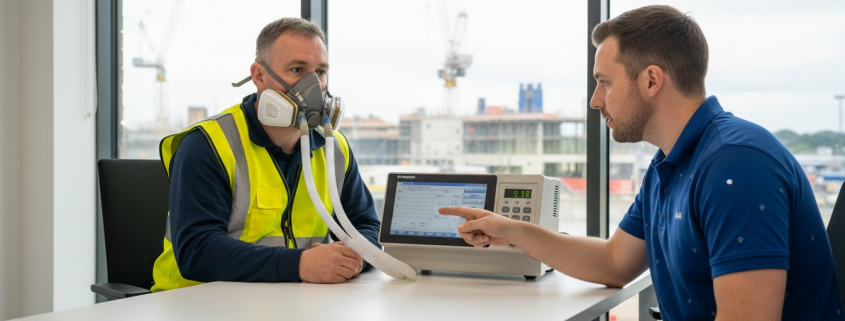
In contrast, a Quantitative Face Fit Test (QNFT) provides a precise, numerical measurement of the seal’s effectiveness. This objective test uses a specialised particle counting device, such as a Portacount machine. The machine measures the number of microscopic particles in the ambient air and compares it to the number of particles that leak into the mask. The result is an exact number called a ‘Fit Factor’. The key advantage of QNFT is its precision, removing any subjective judgement from the process. The protocols for both methods are clearly defined in the official HSE INDG479 Guidance.

Mandatory Scenarios for Quantitative Face Fit Testing

The quantitative face fit testing requirements are unambiguous when it comes to high-protection RPE. A subjective QLFT is not considered sufficiently reliable for masks designed to offer a high protection factor, where even a minor leak could have severe health consequences. QNFT is the only legally acceptable method for all full-face masks.

This mandatory requirement applies to equipment including:

  • Full-face respirators (both negative pressure and powered)
  • Self-Contained Breathing Apparatus (SCBA)
  • Supplied-air breathing apparatus

While QLFT is acceptable for half masks, QNFT is often the preferred and recommended method in high-risk environments, such as those involving asbestos removal or exposure to other highly toxic substances. For this RPE, only an objective, numerical measurement can provide the necessary assurance that the face seal meets the required safety standards.

For instance, in the tightly controlled environments of modern hydroponic facilities, where staff may handle fine nutrient powders or other agents, ensuring proper RPE fit is crucial. These facilities manage many environmental variables, and professionals in this field often explore LED Grow Lights to optimize conditions alongside ensuring staff safety.

The QNFT Process: A Step-by-Step Breakdown

A Quantitative Face Fit Test (QNFT) is a precise and methodical procedure designed to provide objective, numerical data on the seal of a respirator. To ensure a valid result, the entire process must be conducted by a competent and experienced tester who understands the intricate quantitative face fit testing requirements. The test is always performed using the exact make, model, and size of Respiratory Protective Equipment (RPE) the individual will wear in the workplace, as a successful test on one mask does not transfer to another.

Equipment and Environment Setup

The core of a QNFT is a specialised particle counting device, such as a TSI Portacount. This machine measures the number of microscopic dust particles in the ambient air and compares it to the number of particles inside the respirator. To facilitate this, the mask is temporarily adapted with a sampling probe that connects to the machine. The test must be conducted in a controlled environment with a sufficient concentration of ambient particles for the equipment to take an accurate reading. Before any tests are performed, the equipment must be properly calibrated to ensure its measurements are precise and reliable.

The Seven Standard Test Exercises

To verify the mask’s seal under realistic conditions, the wearer must perform a series of seven exercises prescribed by the Health and Safety Executive (HSE). The purpose of these movements is to simulate the physical activities an employee might undertake during their work day, challenging the integrity of the mask’s seal. The HSE provides detailed guidance on the Basics of RPE fit testing, which includes this mandatory exercise protocol. Each exercise lasts for approximately one minute, and the wearer must not adjust the mask at any point once the test has begun.

  • Normal Breathing: The wearer breathes normally, without talking.
  • Deep Breathing: The wearer breathes slowly and deeply to simulate physical exertion.
  • Head Side to Side: The wearer turns their head from one side to the other, pausing at each extreme.
  • Head Up and Down: The wearer moves their head up and down, as if looking at the ceiling and then their feet.
  • Talking: The wearer reads from a prepared text, such as the Rainbow Passage, to simulate jaw movement.
  • Bending Over: The wearer bends at the waist, as if to touch their toes, and then returns to an upright position.
  • Normal Breathing: The test concludes with another period of normal breathing.

Receiving and Understanding Your Fit Test Certificate

Upon successful completion of the test, a fit test certificate is issued. This is the formal, legal record proving the RPE provides adequate protection for the wearer. A valid certificate must include key details such as the wearer’s name, the specific make, model, and size of the RPE tested, the pass level (Fit Factor) achieved, and the date of the test. This document is essential for demonstrating compliance with UK health and safety regulations. Need a certified test to ensure you meet all quantitative face fit testing requirements? Let our safety experts handle your compliance.

Understanding Fit Factors: The Key to Passing the Test

In a quantitative face fit test, the success or failure of the Respiratory Protective Equipment (RPE) is determined by a single, crucial metric: the Fit Factor. This is not a subjective assessment but a precise, numerical measurement of how effectively the mask seals to the wearer’s face. The figure is calculated by a specialised machine that compares the concentration of ambient airborne particles outside the mask to the concentration of particles that have leaked inside.

The resulting ratio is the Fit Factor. Simply put, a higher Fit Factor signifies a more effective seal, less inward leakage, and therefore greater protection for the operative. Achieving the minimum required Fit Factor is the ultimate goal of the test and a fundamental part of UK health and safety compliance.

Required Fit Factors for Different RPE Types

The Health and Safety Executive (HSE) sets clear minimum pass levels as part of the official quantitative face fit testing requirements. A test is only considered a pass if the RPE meets or exceeds these specific thresholds. These are not guidelines; they are absolute minimums required for a pass certificate to be issued and for the RPE to be deemed suitable for the wearer.

The minimum required Fit Factors are:

  • Half Masks (Disposable or Reusable): A minimum Fit Factor of 100 is required.
  • Full-Face Masks: A minimum Fit Factor of 2000 is required.

Common Reasons for a Low Fit Factor (Test Failure)

A failed test indicates that the RPE is not providing adequate protection. This is a critical safety issue that must be addressed immediately. While our expert testers will help identify the cause, failures typically stem from a few common issues:

  • Incorrect Mask Size or Model: Faces vary significantly in shape and size. A mask that fits one person perfectly may be unsuitable for another.
  • Facial Hair: This is the most common reason for failure. Even a day’s stubble can compromise the seal. For a quantitative test to be valid, the wearer must be clean-shaven where the mask meets the skin.
  • Improper Donning Technique: If the mask is not put on correctly, with straps adjusted to the right tension, it will not seal properly.
  • Facial Features or Medical Conditions: Scars, moles, or unique facial structures can sometimes interfere with achieving a secure seal.

Understanding these core components of the quantitative face fit testing requirements is vital for ensuring your workforce remains safe and your business stays compliant. If you need expert assistance or wish to book accredited on-site testing, get in touch with the Safehouse team today.

Preparing for a Quantitative Fit Test: A Checklist for Managers

Effective preparation is the foundation of a successful respiratory protective equipment (RPE) programme. By ensuring your employees and your site are ready for testing, you can minimise test failures, reduce downtime, and ensure your investment in safety delivers the best results. Clear communication and coordination are essential to meeting your legal obligations and protecting your team.

As a manager, your role is to facilitate a smooth process. This involves briefing your staff correctly, having a suitable range of RPE available, and coordinating with your test provider. This checklist will help you manage the key aspects of preparation.

Pre-Test Instructions for Employees

To ensure the test can be conducted accurately, all employees must be informed of the pre-test conditions. Failure to adhere to these can result in an automatic fail and a wasted appointment. Provide your staff with the following instructions:

  • Be clean-shaven: The most common reason for test failure is facial hair. There must be no stubble or hair growth in the area where the mask’s seal meets the skin.
  • Avoid smoking, vaping, or eating: This should be avoided for at least 30 minutes prior to the test, as it can affect the results.
  • Bring relevant PPE: If the employee wears safety glasses, hearing protection, or a hard hat with the RPE, they must bring them to the test to ensure the mask fits correctly with their other equipment.
  • Be in good health: The test cannot be conducted if the individual has a cold, cough, or other respiratory issue that could affect their breathing.

What Happens After the Test?

The outcome of the fit test determines whether an employee is permitted to use a specific mask in a hazardous environment. If an employee passes, they receive a certificate confirming the make, model, and size of the RPE they are approved to wear. This certificate is a crucial part of your compliance records.

If an employee fails, they are not protected and must not use that mask. The process is then repeated with a different size or model of RPE until a suitable, protective fit is achieved. It is vital to document all results, including failures, as this demonstrates a robust approach to fulfilling the quantitative face fit testing requirements and protecting your workforce.

Frequency of Re-testing: When is it Required?

While the HSE does not mandate a specific expiry date for a fit test certificate, industry best practice recommends re-testing at least every two years. However, a re-test is legally required sooner if certain conditions are met:

  • Significant weight gain or loss.
  • Major dental work (e.g., extractions or dentures).
  • Facial injuries, scarring, or cosmetic surgery in the face seal area.
  • A change in the make, model, or size of the RPE being used.

Staying on top of these triggers is essential for maintaining compliance. For assistance in managing your company’s testing schedule and requirements, please get in touch with our expert team.

Partner with the Experts for Compliant Face Fit Testing

Navigating UK health and safety legislation is a significant responsibility for any employer. As this guide has outlined, quantitative face fit testing is a legal necessity for all full-face masks and is the required method when a half mask fails a qualitative test or requires a higher fit factor. Achieving a successful, numerical fit factor is the only verifiable proof that Respiratory Protective Equipment (RPE) offers the intended protection against airborne hazards. Understanding this process is therefore critical for both worker safety and your legal compliance.

Meeting the stringent quantitative face fit testing requirements demands precision and expertise that cannot be overlooked. Let our team of specialists take this complex burden from your shoulders. Our Fit2Fit accredited testers provide a comprehensive, professional service covering all types of RPE, ensuring every test is conducted to the highest standard. As a trusted local company with nationwide reach and expertise, we are ideally positioned to support your business wherever you operate in the UK.

Ensure your team is protected and compliant. Book your professional face fit testing service today.

Frequently Asked Questions

Who is considered a ‘competent person’ to conduct a quantitative face fit test?

A competent person is someone with the necessary knowledge, training, and practical experience to conduct the test correctly. As per HSE guidance (INDG 479), they must understand the testing equipment, the RPE being tested, and the exercises required. While not legally mandatory, accreditation from a scheme like Fit2Fit is the HSE’s recommended proof of competence. This ensures all UK quantitative face fit testing requirements are met, providing reliable and compliant results for your business.

Can you pass a quantitative face fit test with a beard or stubble?

No, it is not possible to pass a face fit test with any facial hair that interferes with the mask’s seal. Even a day’s stubble can create gaps, allowing hazardous airborne particles to bypass the filter. For any tight-fitting respirator, the wearer must be clean-shaven in the contact area between the mask and the skin. This is a non-negotiable safety requirement to ensure the Respiratory Protective Equipment (RPE) provides the intended level of protection.

What is the main difference in cost between quantitative and qualitative testing?

Quantitative testing is generally more expensive than qualitative testing. This is because it requires sophisticated and costly particle-counting equipment, such as a Portacount machine, and a more highly trained operator to administer the test. In contrast, qualitative testing uses a simple hood and taste solution. Typically, you can expect to pay from £45-£70 per person for a quantitative test, whereas a qualitative test may cost between £25-£40, depending on the provider.

How long does a single quantitative face fit test typically take?

A single quantitative face fit test session usually takes approximately 20 to 30 minutes to complete per individual. This includes a briefing on the test procedure, correct donning of the mask, and the test itself. The test involves the wearer performing a series of seven exercises designed to simulate typical work movements, such as turning the head, bending over, and speaking. This ensures the mask maintains its protective seal during a range of activities.

What is the legal consequence of not having a valid fit test certificate for an employee?

Failing to provide a valid fit test certificate for an employee using tight-fitting RPE is a breach of UK health and safety law, including COSHH and CAR 2012 regulations. The Health and Safety Executive (HSE) can issue enforcement notices, including prohibition notices that stop work immediately. In serious cases, this can lead to prosecution, resulting in significant fines for the company and, potentially, the responsible individuals. It is a critical compliance issue for any employer.

Does a fit test certificate cover all types of respirator masks?

No, a fit test certificate is specific to the exact make, model, and size of the respirator the employee was tested on. It does not provide a universal pass for all types of RPE. If an employee needs to switch to a different mask for any reason-even one that appears similar-a new face fit test must be conducted for that specific model. This ensures a protective seal is confirmed for every piece of equipment they are required to wear.

Investing in your team’s safety is a critical business decision, but navigating the financial commitment can be complex. When researching the typical IOSH Working Safely course cost in the UK, you’ll find a wide spectrum of prices for online and classroom training, often leading to uncertainty. What constitutes a fair price? Are there hidden fees for exams or certificates? And how can you be sure you are choosing a reputable provider that delivers genuine value beyond a low price tag?

This guide removes that ambiguity. Here, we provide a clear, authoritative breakdown of the costs you can expect for an accredited IOSH Working Safely course. We will examine the factors that influence the price, from the training format to the provider’s credentials, helping you make an informed investment. Our goal is to equip you with the confidence to select a high-quality course that not only fits your budget but also ensures your business remains safe and compliant.

Key Takeaways

  • Understand the typical price range for the IOSH Working Safely course, whether you choose online, virtual, or classroom-based training.
  • Discover the key factors that influence the final iosh working safely course cost, including provider accreditation and included materials.
  • Learn to evaluate the course not just as an expense, but as a crucial investment in legal compliance, staff safety, and business reputation.
  • Gain a practical framework to compare training providers, ensuring you select a partner that delivers the best value, not just the lowest price.

What is the IOSH Working Safely Course?

The IOSH Working Safely course is a foundational, one-day qualification designed to provide employees with the essential knowledge of health and safety in the workplace. It serves as an internationally recognised benchmark for safety awareness, accredited by the Institution of Occupational Safety and Health (IOSH). The course is suitable for staff at any level, across all industries, from construction and manufacturing to office-based environments.

Unlike purely compliance-driven training, Working Safely focuses on why health and safety is important to each individual’s role. It aims to change behaviours and improve a company’s safety culture from the ground up. For businesses, providing this accredited training is a key step in meeting the legal duty to ensure a safe working environment for all staff. Understanding the course content is crucial when considering the overall iosh working safely course cost and the significant return on investment it provides through reduced accidents and a more safety-conscious workforce.

Who is this qualification for?

This qualification is designed for maximum accessibility and is an excellent investment for a wide range of employees. It is particularly beneficial for:

  • New starters as a core component of their company induction process.
  • Any team member, regardless of their specific job role, to ensure a consistent level of safety awareness.
  • Young workers or apprentices who are new to the workforce and its inherent risks.
  • Individuals seeking a solid foundation before undertaking more advanced IOSH or NEBOSH qualifications.

Key Differences: Working Safely vs. Managing Safely

It is vital to choose the correct IOSH course for your needs. While both are highly respected, they serve different purposes and audiences:

  • Target Audience: Working Safely is for all employees, focusing on individual responsibility. Managing Safely is specifically for managers and supervisors responsible for the safety of their teams.
  • Course Duration: Working Safely is a concise one-day course. Managing Safely is a more in-depth programme, typically lasting three days.
  • Focus: Working Safely teaches how to keep oneself and colleagues safe. Managing Safely covers risk assessment, safety management systems, and leadership responsibilities.

This difference in scope and duration is also reflected in the price; the iosh working safely course cost is significantly more accessible than the managerial equivalent. Ensure you select the qualification that directly aligns with your job role and responsibilities.

Average IOSH Working Safely Course Cost in the UK

Understanding the typical iosh working safely course cost is a crucial first step in budgeting for this essential health and safety qualification. In the UK, the price varies significantly depending on the training provider and the delivery method you choose. As a general rule, the investment reflects the level of tutor interaction, the quality of course materials, and the overall learning experience. Below, we break down the average market prices for the three primary training formats.

Please note: All prices provided are indicative, per person, and exclusive of VAT. We always recommend confirming the final cost directly with your chosen training provider.

Online E-learning Course Prices

For individuals seeking maximum flexibility, online e-learning is the most cost-effective option, with prices typically ranging from £90 to £150. This format is ideal for self-motivated learners who are comfortable with digital platforms. The price generally includes:

  • Access to online learning modules to complete at your own pace.
  • A digital assessment to test your understanding.
  • An official IOSH Working Safely certificate upon successful completion.

Virtual Classroom Course Prices

A virtual classroom course offers a blend of convenience and expert guidance, with costs generally between £125 and £180. This method involves joining a scheduled, live training session with an accredited tutor via a video conferencing platform like Zoom or Teams. It provides a structured learning environment with the benefit of direct interaction, allowing you to ask questions and engage with the instructor and other delegates from any location.

In-Person Classroom Course Prices

The traditional in-person classroom setting provides the most comprehensive and immersive training experience, with prices ranging from £150 to £250. This format is perfect for those who benefit from face-to-face tuition and practical, hands-on learning away from workplace distractions. The higher cost covers the venue, physical course materials, and the invaluable opportunity for group discussions and direct networking with peers and the instructor.

While cost is an important consideration, the ultimate goal is to ensure your team receives high-quality training that genuinely improves workplace safety. The official IOSH Working Safely course is designed to provide a foundational understanding of health and safety principles. Choosing a reputable, IOSH-accredited provider ensures the training delivered meets the high standards required to keep your workforce safe and your business compliant.

What Factors Influence the Course Price?

When searching for an IOSH Working Safely course, you will encounter a wide range of prices. This variation can be confusing, but the headline figure rarely tells the whole story. A lower price does not always equate to better value. Understanding the key factors that determine the iosh working safely course cost allows you to look beyond the initial price tag and assess the quality, support, and overall return on your investment.

Making an informed decision ensures your team receives training that is not only compliant but genuinely effective in creating a safer workplace. Before you book, consider the following critical elements.

Training Provider’s Reputation and Accreditation

The provider’s standing in the industry is a primary driver of cost and quality. Established, IOSH-accredited training centres invest significantly in developing high-calibre course materials, employing experienced tutors, and providing robust administrative support. This commitment to quality ensures a valuable learning experience. Choosing an accredited provider is essential for demonstrating due diligence and meeting your legal obligations under key legislation like the Health and Safety at Work etc. Act 1974. Conversely, unusually cheap providers may be cutting corners on resources or support, which can compromise the training’s effectiveness. Always verify a provider is officially approved on the IOSH website.

What’s Included in the Fee?

A transparent pricing structure is the hallmark of a reputable provider. The advertised price should be comprehensive, but it is crucial to confirm what is covered to avoid unexpected “hidden” costs. Before committing, ask specific questions:

  • IOSH Certificate Fee: Is the official IOSH certificate cost (£25 as of 2023, but subject to change) included in the total price?
  • Exam and Retake Fees: Are there additional charges for the final assessment or for a potential retake if required?
  • Course Materials: Are workbooks, handouts, and other learning resources provided within the fee, or are they an extra expense?
  • Tutor Support: What level of access will delegates have to the tutor for questions and guidance throughout the course?

Group Bookings & In-Company Training

For businesses training multiple employees, significant cost efficiencies can be achieved. Most providers offer discounts for group bookings on public courses. An even more cost-effective solution for teams is in-company training, where a tutor delivers the course at your premises. This option not only reduces costs per delegate but also allows the training content to be tailored to your specific workplace hazards and operational procedures, making the learning directly relevant and impactful. Ask us about our group booking discounts.

Is the IOSH Working Safely Course a Good Investment?

When considering the iosh working safely course cost, it is more accurate to view it not as an expense, but as a critical investment in your organisation’s most valuable asset: its people. This foundational training delivers tangible returns that far outweigh the initial fee, safeguarding both your workforce and your business’s future. The value is realised through improved safety, enhanced compliance, and a more competent, risk-aware team.

Benefits for Employers: Compliance and Culture

For any business, the return on investment is clear and multifaceted. Enrolling your team demonstrates a proactive commitment to your legal duties under the Health and Safety at Work etc. Act 1974. This directly translates into a safer workplace, reducing accident rates, associated sick leave, and the risk of costly civil claims. More profoundly, it helps build a positive safety culture where every individual understands their role. When compared to potential fines from the Health and Safety Executive (HSE), which can be unlimited and are often based on company turnover, the course fee is a minor, preventative measure against catastrophic financial and reputational damage.

This commitment to a comprehensive safety culture naturally extends to other areas of business risk, such as data security and environmental compliance when disposing of old IT equipment. Ensuring sensitive information is properly destroyed is another crucial aspect of protecting a business from legal and financial penalties. For guidance on this specific area of corporate responsibility, specialist providers like Surplus Technology Solutions offer certified services that align with a robust, all-encompassing safety strategy.

Benefits for Employees: Skills and Safety

For individual employees, the course provides essential skills and a recognised qualification that enhances career prospects. The benefits are immediate and long-lasting:

  • A respected IOSH certificate to strengthen your CV and professional credibility.
  • Increased awareness of common workplace hazards, empowering you to keep yourself and your colleagues safe.
  • A clear signal to current and future employers of your professionalism and commitment to safety.
  • The confidence to identify, assess, and report risks effectively without hesitation.

Ultimately, the value of IOSH Working Safely extends far beyond a certificate. It fosters a shared responsibility for safety that protects individuals and strengthens the entire organisation. When evaluating the iosh working safely course cost, remember that investing in accredited, high-quality training is a non-negotiable part of responsible business practice. The cost of an accident-in human, financial, and legal terms-is always infinitely higher. Ensure your team receives the expert training they deserve by choosing a trusted provider. You can view our accredited IOSH courses to take the next step.

How to Choose the Right IOSH Training Provider

Finding the right training partner is about more than just comparing the iosh working safely course cost. The quality of the training directly impacts your team’s safety and your company’s compliance. A cheaper course from an unaccredited or inexperienced provider offers poor value and can leave your business exposed. Making an informed decision means looking beyond the price tag to the expertise, accreditation, and support on offer.

Verify IOSH Accreditation

This is the most critical check you must perform. Only training providers officially approved by the Institution of Occupational Safety and Health (IOSH) can deliver the course and issue a genuine, recognised certificate. You can verify a provider’s status directly on the IOSH website. A non-accredited course is a false economy, as the certificate will be invalid and the training will not meet the required standard.

Assess Tutor Expertise and Training Style

The person leading the course makes all the difference. Does the tutor have real-world, practical experience in health and safety, or are they simply reciting a textbook? Effective training is engaging and draws on frontline knowledge. To help you evaluate your options, consider this simple checklist:

  • Accreditation: Is the provider listed as an approved partner on the official IOSH website?
  • Tutor Experience: Do trainers have demonstrable, hands-on industry experience?
  • Training Style: Is the approach interactive and engaging, encouraging participation and questions?
  • Support: Is the tutor accessible and willing to provide support throughout the course?

Why Choose Safehouse for Your Training?

At Safehouse, we are committed to providing training that delivers real value and helps you stay safe and compliant. We take the burden of health and safety training away, giving you peace of mind. As a trusted partner, we offer:

  • Full IOSH Accreditation: We are a fully approved IOSH training provider, guaranteeing a valid and respected qualification.
  • Expert, Supportive Tutors: Our trainers are seasoned safety professionals who provide a personal, supportive, and engaging learning experience.
  • Practical Focus: We concentrate on building practical skills that make a tangible difference in your workplace.
  • Local Company, Nationwide Reach: Based in Barnsley, we combine the personal approach of a local business with the capacity to serve clients across the UK.

When considering the total iosh working safely course cost, remember that investing in expert training is an investment in your people and your business. Get in touch with our team to discuss your requirements and secure your place.

Your Next Step: Investing in a Safer, Compliant Workplace

As we have explored, the IOSH Working Safely course is a foundational investment in your organisation’s health and safety culture. While the price can vary depending on the training provider, location, and delivery format, its value extends far beyond the initial fee. Understanding the complete iosh working safely course cost involves recognising its critical role in ensuring legal compliance, reducing workplace incidents, and empowering your employees with essential safety knowledge. The key to maximising this return is selecting a provider that delivers quality and expertise.

At Safehouse Health and Safety Consultants Ltd, we are a Fully Accredited IOSH Training Provider dedicated to helping you stay safe and compliant. Our courses are led by Expert Tutors with Real-World Experience who deliver practical, engaging training. We are proud of our Personal Approach to Health & Safety Training, ensuring we understand your business needs to provide the most effective support and guidance.

Ready to take the definitive step towards a safer work environment? Contact our expert team to book your IOSH course today.

Frequently Asked Questions

How long is the IOSH Working Safely certificate valid for?

The IOSH Working Safely certificate does not have a formal expiry date. However, health and safety knowledge must be kept current to remain effective and compliant with evolving legislation. It is considered industry best practice for delegates to undertake a refresher course every three years. This ensures that employees’ awareness of workplace hazards and safety protocols remains at the required standard, protecting both your staff and your business.

Is there an exam at the end of the IOSH Working Safely course?

Yes, successful completion of the IOSH Working Safely course requires delegates to pass a two-part assessment. The first part is a short multiple-choice examination to test theoretical understanding of the key safety principles covered. The second part is a practical hazard-spotting assessment where delegates must identify potential risks in a series of workplace scenarios. Our expert trainers provide full support to ensure all delegates are prepared for these assessments.

Is IOSH Working Safely a recognised qualification in the UK?

Absolutely. The IOSH Working Safely certificate is a highly respected and internationally recognised qualification. Within the UK, it is valued by employers across all industries as a benchmark for essential health and safety training. Holding this qualification demonstrates a clear commitment to workplace safety and provides proof that individuals have received training that meets established standards. It is an essential component of a compliant and safe working environment.

What level is the IOSH Working Safely course?

The IOSH Working Safely course is designed as a foundational, entry-level qualification. While it is not formally on the UK’s Regulated Qualifications Framework (RQF), IOSH benchmarks it as being equivalent to a Level 1 award. This makes it an ideal course for employees at any level, in any sector, who need a fundamental understanding of workplace health and safety principles without requiring in-depth management-level detail.

Is an IOSH course the same as a CSCS card?

No, an IOSH course and a CSCS card serve different functions. IOSH Working Safely is a health and safety training qualification, whereas a CSCS card is a credential that provides proof of occupational competence required for access to most construction sites in the UK. However, successfully completing the IOSH Working Safely course, along with the CITB Health, Safety and Environment test, is a recognised route to applying for the green CSCS Labourer card.

Can my business get funding for IOSH training?

While direct government funding is uncommon for this course, some businesses may be able to reclaim costs. For construction companies registered with the Construction Industry Training Board (CITB), the IOSH Working Safely course is often eligible for grant funding. This can significantly reduce the overall IOSH Working Safely course cost for your business. We recommend checking the current CITB Levy and Grants Scheme for specific eligibility criteria and grant values.

Is your Site Supervisor Safety Training Scheme (SSSTS) certificate approaching its five-year expiry date? We understand the pressure of keeping your qualifications current while managing a demanding work schedule. The search for a convenient, CITB-accredited sssts refresher course near me can often feel like another task on an already long list, especially when you need training that minimises time away from site and is located right here in Yorkshire.

This guide is designed to remove that burden. We provide all the essential information to help you find, prepare for, and successfully complete your 1-day SSSTS Refresher course in the Barnsley area. We’ll cover what to expect from the updated curriculum, how to approach the final assessment with confidence, and how to choose a reputable training provider that ensures you stay safe and compliant. Let us assist you in securing your qualification efficiently, so you can continue to lead with authority on site.

Key Takeaways

  • Your SSSTS certificate is valid for five years; renewing it is mandatory to remain qualified for site supervisory roles and stay compliant.
  • The intensive 1-day course efficiently updates your knowledge on the latest health, safety, welfare, and environmental legislation.
  • Finding an ‘SSSTS refresher course near me’ is straightforward, with our Barnsley centre serving as a convenient location for all of South Yorkshire.
  • Learn how to prepare for your course and book your place with a trusted, CITB-approved provider focused on practical safety skills.

Why You Must Renew Your SSSTS Certificate: The 5-Year Rule

Your Site Supervisor Safety Training Scheme (SSSTS) certificate is a vital credential, but it is not permanent. It is valid for exactly five years from the date of issue. To remain qualified for supervisory roles on UK construction sites, renewing your certificate is a mandatory requirement. Letting it lapse can result in being denied site access, halting your work, and jeopardising your career progression.

Fortunately, maintaining your qualification is straightforward and cost-effective. The one-day SSSTS Refresher course is designed specifically to update your knowledge on the latest health and safety regulations, legislation, and best practices. It is a much quicker and more affordable route than having to re-take the full two-day course from scratch. Proactively searching for an “sssts refresher course near me” before your expiry date is the most efficient way to stay compliant and active in your role.

CITB Regulations on Certificate Expiry

The rules governing certificate renewal are set by the Construction Industry Training Board (CITB) and they are strict. You must attend and pass the one-day refresher course before your current SSSTS certificate expires. If your certificate’s expiry date passes, even by a single day, you will no longer be eligible for the refresher. Your only option at that point is to enrol in the full two-day SSSTS course again, costing you more time and money. We strongly advise you to check your certificate’s expiry date now to ensure you have ample time to book your renewal.

The Cost of Non-Compliance for You and Your Employer

An expired SSSTS certificate carries significant consequences for both individuals and their employers. For a site supervisor, it can mean an immediate loss of work and earnings, as you cannot legally fulfil your duties. For an employer, having unqualified supervisors on site creates a serious liability, potentially invalidating insurance policies and risking project delays or even fines during a safety audit. Ultimately, ensuring your qualifications are current is a shared responsibility that protects your career, your colleagues, and your company’s reputation.

What to Expect from the 1-Day SSSTS Refresher Course

The Site Supervisor Safety Training Scheme (SSSTS) Refresher is an intensive one-day programme, typically running for 7.5 hours, designed to bring your health and safety knowledge up to date with current industry standards. If you are looking for an “sssts refresher course near me,” you are taking a critical step to remain compliant and effective in your supervisory role. The primary goal is to ensure you are fully aware of recent changes in legislation and can continue to implement best practices on site.

This is not simply a lecture. The course is highly interactive, combining individual and group exercises, case studies, and open discussions. This format allows you to share experiences with peers and apply new knowledge to real-world scenarios, reinforcing best practices in risk assessment, method statements, and effective site supervision.

Key Topics Covered

Our expert tutors guide you through the most critical updates and core principles of modern site safety. The syllabus is focused on providing practical knowledge that you can apply immediately. Key areas of focus include:

  • A comprehensive review of the latest changes to UK construction safety regulations, including the Construction (Design and Management) Regulations 2015 (CDM).
  • Updates and reinforcement of the Health and Safety at Work Act and its implications for supervisors.
  • Methods for the effective supervision of occupational health, including mental health awareness and managing workplace stress.
  • Understanding behavioural safety and how to promote a positive, proactive safety culture within your team.

The End-of-Course Assessment

To successfully renew your qualification, you must pass a final assessment at the end of the day. This consists of a multiple-choice question paper covering the key topics discussed during the training. Our experienced tutors are dedicated to your success; they provide clear instruction and ensure you are well-prepared to confidently answer the questions. At Safehouse, we pride ourselves on our supportive training environment and consistently high pass rates, giving you the peace of mind that you are receiving industry-leading instruction. Upon successful completion, you will be issued with a renewed, CITB-accredited SSSTS certificate, valid for a further five years.

Finding Your Local Course in Barnsley & South Yorkshire

When you search for an “SSSTS refresher course near me,” you are prioritising convenience and efficiency. You need to renew your CITB qualification without the significant disruption of long-distance travel, overnight stays, and excessive time away from site. Wasting a full day on the motorway is an unnecessary cost to your business and your schedule.

Safehouse Health and Safety Consultants is strategically located in Barnsley, making us the ideal training provider for supervisors and managers across South Yorkshire. Our centre is perfectly positioned to serve professionals from Sheffield, Rotherham, and Doncaster, ensuring you can access industry-leading training right on your doorstep. By training locally, you not only save time and money but also benefit from tutors with direct experience of the regional construction industry, its unique challenges, and its safety standards.

Benefits of Choosing a Local Training Provider

Opting for a local provider for your SSSTS Refresher offers tangible advantages that support both you and your business. We are committed to making your compliance journey as straightforward as possible.

  • Reduced Costs and Downtime: Eliminate expensive fuel bills, public transport fares, and the need for hotel accommodation. More importantly, reduce non-productive travel time, allowing you to remain focused on your projects.
  • Hassle-Free Access: Our training centre is easy to reach and offers free on-site parking, removing the stress of finding a space on your training day.
  • Support a Yorkshire Business: As a local company, we are dedicated to upholding the highest safety standards within our region. Your investment supports local expertise and jobs.
  • Local Networking: Train alongside other site supervisors from the South Yorkshire area. This provides a valuable opportunity to share knowledge, discuss regional challenges, and build professional connections.

Our Barnsley Training Centre

Our purpose-built facility in Barnsley is designed to provide a professional and effective learning experience. You will train in modern, air-conditioned classrooms equipped with the latest presentation technology. We ensure a comfortable and focused environment where you can concentrate fully on updating your health and safety knowledge.

Conveniently situated with excellent access from the M1, A628, and other major routes, getting to us is simple. We take the burden out of your training logistics so you can focus on what matters: maintaining your qualification and keeping your sites safe and compliant. View upcoming course dates at our Barnsley centre.

How to Prepare and Book Your Place: A Simple Checklist

At Safehouse Health and Safety, we believe that renewing your SSSTS certificate should be a straightforward and stress-free process. Finding the right sssts refresher course near me is the first step; our goal is to make the next steps-preparation and booking-just as simple. This checklist will guide you through everything you need to do to ensure you are fully prepared for your training day. You can book your place securely online in minutes, or if you prefer, our expert team is available to assist you over the phone.

Step 1: Check Your Eligibility

Before booking, it is essential to confirm you meet the CITB’s requirements for the one-day refresher course. Taking a moment to verify these details now prevents any issues on the day of your training. Please ensure you have the following in order:

  • Your current SSSTS certificate: You must locate your original certificate.
  • Valid expiry date: Your certificate must be in-date. Expired certificates are not eligible for the refresher course.
  • Correct details: Check that your full name and CITB registration number on the certificate are accurate.
  • Language proficiency: You must have a good understanding of spoken and written English to participate fully.

Step 2: The Booking Process

Once you have confirmed your eligibility, securing your place is simple. Our online schedule makes it easy to find an sssts refresher course near me on a date that suits your diary. Follow these steps to complete your booking and take the next step in maintaining your site supervisor qualifications.

  • Visit our SSSTS Refresher course page to view all available dates.
  • Select your preferred training date and add it to your basket.
  • Complete the delegate information and payment details through our secure online portal.
  • Alternatively, you can call our friendly office team who will be happy to book your place over the phone.

Step 3: What to Bring on the Day

To ensure a smooth start to your training day, please arrive prepared with the required documentation and items. This allows our trainers to complete the necessary registration checks efficiently and begin the course on time. We provide lunch and refreshments to keep you focused throughout the day.

  • Valid Photo ID: A UK driving licence, passport, or another form of official photographic identification is mandatory.
  • SSSTS Certificate: Bring your current certificate or have your CITB registration number ready.
  • Note-taking materials: A pen and notebook are highly recommended for taking notes during the sessions.

If you have any questions about preparation or the booking process, please do not hesitate to get in touch with our support team. We are here to assist.

Why Choose Safehouse for Your CITB Training?

When searching for an “sssts refresher course near me,” the quality and approach of the training provider are paramount. At Safehouse, we are a trusted, CITB-approved training provider committed to a personal approach. Our focus extends beyond simply helping you pass an exam; we are dedicated to equipping you with practical safety knowledge that you can apply directly on site. We aim to be more than just a course provider-we strive to be your long-term health and safety partner.

As a local company with a nationwide reputation for excellence, we blend personalised service with industry-leading expertise to ensure you receive the highest standard of training.

Expert Tutors with Real-World Experience

Our training is delivered by seasoned construction safety professionals, not academics. Each of our instructors brings years of hands-on site experience, allowing them to share practical insights and real-world scenarios that go beyond the textbook. This approach ensures you learn not just the regulations, but how to implement them effectively in a live construction environment. You will benefit from a supportive and engaging learning atmosphere where questions are encouraged and knowledge is shared freely.

A Personal and Supportive Approach

We are committed to the success of every delegate. To achieve this, we intentionally maintain small class sizes to foster better interaction and allow for individual attention. Our tutors are always available to provide one-on-one support if you need extra guidance on a specific topic. This supportive environment ensures you leave the course feeling confident in your renewed knowledge and responsibilities as a site supervisor. Your success is our primary measure of success.

Have questions about course content or your eligibility? Talk to our safety experts today. We are here to assist you.

Your Next Step to SSSTS Compliance in Yorkshire

Maintaining your SSSTS qualification is essential for staying compliant and effective in your supervisory role. The one-day refresher course is a direct and efficient way to update your knowledge on the latest health and safety legislation. When looking for an sssts refresher course near me, choosing a trusted, local expert makes all the difference. At Safehouse, our experienced tutors bring real-world site knowledge to every session, ensuring you receive practical, relevant training that you can apply immediately.

As a CITB Approved Training Organisation based in Barnsley, we are dedicated to supporting professionals across Yorkshire. Our excellent pass rates and personal approach are why site supervisors trust us to help them stay safe and compliant. Don’t let your certificate expire and risk falling behind on crucial industry standards.

Book Your Local SSSTS Refresher Course in Barnsley Now.

Invest in your career and continue to lead with confidence. We look forward to welcoming you to our training centre.

SSSTS Refresher Course: Frequently Asked Questions

What happens if my SSSTS certificate has already expired?

Under CITB regulations, you must complete the refresher course before your current SSSTS certificate expires. If your certificate has expired, you are no longer eligible to take the one-day refresher. You will be required to attend the full 2-day SSSTS course again to obtain a new, valid certificate. We strongly advise booking your refresher course in advance to ensure you remain compliant and avoid any lapse in your qualification.

How long is the new SSSTS Refresher certificate valid for?

Upon successful completion of the SSSTS Refresher course, your new CITB Site Safety Plus certificate will be valid for a further five years. To maintain your supervisory qualification beyond this period, you must attend another one-day refresher course before the new certificate’s expiry date. This ensures your knowledge of health and safety legislation remains current and your qualification stays active on site, helping you to stay safe and compliant.

Can I take the SSSTS Refresher course online?

Yes, the CITB SSSTS Refresher course is available via remote online learning. This provides a convenient and fully accredited alternative to attending a physical training centre, allowing you to complete the qualification from your home or office. Our online courses are delivered live by expert tutors, ensuring an interactive and engaging experience. This is an excellent option if you are struggling to find a suitable classroom-based SSSTS refresher course near me that fits your schedule.

What form of photographic ID is acceptable for the course?

To meet CITB scheme rules, all delegates must present a valid form of photographic identification on the day of the course. The most common and acceptable forms of ID are a current passport or a UK photocard driving licence. This is a mandatory requirement for verification purposes for both online and classroom courses. Please ensure you have one of these available to present to the tutor at the start of your training session.

Is there a grant available from the CITB for this course?

Yes, the one-day SSSTS Refresher course is eligible for CITB grant funding. Employers who are registered with the CITB and up to date with their levy payments can claim a grant for each employee who successfully completes the course. The current grant amount is £30. As an accredited training provider, we can provide you with the necessary information and support to assist you in claiming this grant, helping you to reduce your training costs.

What is the pass mark for the SSSTS Refresher test?

The assessment for the SSSTS Refresher course is a multiple-choice examination. The test consists of 25 questions covering a range of health, safety, welfare, and environmental topics. To successfully pass the course and be awarded the CITB certificate, you must achieve a score of 80% or higher. This means you need to answer at least 20 out of the 25 questions correctly. Our tutors ensure you are fully prepared for this final assessment.

Navigating the path to becoming a construction site manager in the UK can feel like deciphering a complex code. With a sea of acronyms like SMSTS, SSSTS, CSCS, and NVQ, it is understandable to feel uncertain about the first step. This confusion often leads to the critical question: what qualifications do I need for a site manager? Perhaps you are weighing up a university degree against years of on-site experience, or you’re concerned about the time and cost involved in gaining the correct certifications.

We are here to provide clarity and expert support. This guide removes the guesswork by offering a clear, step-by-step roadmap to a successful career in site management. We will break down the mandatory UK qualifications, explain the different progression pathways, and assist you in confidently choosing the right accredited training courses. Consider this your definitive plan for building a secure and compliant future as a site manager, ensuring you have the expertise to lead with authority and confidence.

Key Takeaways

  • Understand the two primary pathways to becoming a site manager in the UK: the academic university route and the vocational, on-site experience route.
  • To answer what qualifications do i need for a site manager, you must prioritise accredited safety training like the CITB SMSTS, which is the recognised industry standard.
  • Discover why essential soft skills, such as leadership, problem-solving, and communication, are just as critical as your formal certifications for long-term success.
  • Follow a clear, step-by-step action plan designed to guide you from your current role towards achieving full site management qualification.

Understanding the Role: What Does a Construction Site Manager Actually Do?

Before exploring what qualifications do i need for a site manager, it is essential to understand the full scope of the position. A construction site manager is far more than a supervisor; they are the on-site leader responsible for transforming architectural plans into a tangible, high-quality structure. This pivotal Construction Site Manager Role involves overseeing the entire project lifecycle on the ground, ensuring every phase is executed safely, on schedule, and within budget. From the initial site setup to the final handover, the site manager is the central point of command and control, coordinating a complex network of trades, subcontractors, and direct staff to achieve the project’s goals.

Core Responsibilities and Duties

The daily duties of a site manager are diverse and demanding, requiring a blend of technical knowledge, management skill, and meticulous attention to detail. While specific tasks vary by project, the core responsibilities remain consistent:

  • Site Safety: Implementing and enforcing strict health and safety protocols to protect everyone on site. This is always the number one priority.
  • Project Management: Overseeing budgets, managing project timelines, and ensuring key milestones are met according to the plan.
  • Stakeholder Liaison: Acting as the main point of contact for clients, architects, engineers, and local authorities to ensure clear communication.
  • Quality Control: Conducting regular inspections of work to maintain high standards and ensure compliance with building codes and specifications.

Why Health and Safety is Non-Negotiable

In the UK, a site manager’s most critical responsibility is both legal and moral: ensuring the health, safety, and welfare of the workforce. Under the Health and Safety at Work Act 1974, site managers have a direct legal duty to prevent accidents and cultivate a safe working environment. This is not just about compliance; it’s about leadership. Proactively managing risks, conducting toolbox talks, and enforcing Health and Safety Executive (HSE) guidelines are fundamental. This is precisely why accredited training like the CITB Site Management Safety Training Scheme (SMSTS) is not just a recommendation but a core requirement for the role.

A typical day might begin with a site briefing with subcontractors, followed by a safety inspection, problem-solving with engineers, and reporting progress to the client. It ends only after a final site walk-through to ensure it is secure. Understanding this demanding, multi-faceted role is the first step in determining what qualifications do i need for a site manager to succeed.

The Two Main Pathways to Becoming a Site Manager in the UK

When considering a career in construction management, it is essential to understand that there are two primary routes to becoming a site manager: the academic path and the vocational, experience-led path. Both routes ultimately lead to the same responsible position, but they begin from different starting points. These two approaches are recognised throughout the industry, a fact supported by official UK Government Careers Advice, which details the different entry points into the profession. It is also worth noting that structured apprenticeships can provide a blend of both pathways. Regardless of your chosen route, extensive, practical on-site experience is non-negotiable. It is the bedrock upon which all successful and compliant site management careers are built.

The Academic Route: University and Higher Education

This pathway typically begins with a university degree (BSc) or a Higher National Diploma (HND) in a relevant subject such as Construction Management, Civil Engineering, or Building Studies. This provides a strong theoretical foundation in project management, building science, and contract law. Many major construction firms offer structured graduate schemes, providing a fast-tracked route where graduates gain mentored experience across various departments before moving into an assistant site manager role. It is critical to understand that a degree alone is not sufficient. It must be supplemented with significant on-site experience and the industry-standard CITB Site Management Safety Training Scheme (SMSTS) qualification to ensure you are competent to manage site safety and legal compliance.

The Vocational Route: Experience-Led Progression

This is an extremely common and highly respected route within the UK construction industry. This path involves progressing from a trade background-such as a joiner, bricklayer, or electrician-or another on-site role into a supervisory position. For those wondering what qualifications do I need for a site manager without a degree, this route provides a clear answer focused on industry-accredited training. Progression is demonstrated by acquiring key certifications, starting with the Site Supervisor Safety Training Scheme (SSSTS) and then advancing to the comprehensive SMSTS. This hands-on journey ensures managers have an invaluable, ground-level understanding of site operations, logistics, and workforce dynamics, which is often highly prized by employers.

Essential Qualifications & Certifications for UK Site Managers

If you are asking, “what qualifications do I need for a site manager?”, you have reached the core of the matter. The UK construction industry relies on a clear framework of qualifications to verify competence and ensure on-site safety. These certifications are not just lines on a CV; they are the industry-recognised standard for proving you have the necessary skills and safety knowledge. The pathway typically starts with foundational safety training before progressing to a formal assessment of your managerial competence.

The CITB Site Management Safety Training Scheme (SMSTS)

The SMSTS course is widely regarded as the essential health and safety qualification for anyone with management responsibilities on a UK construction site. This five-day course provides a comprehensive understanding of your legal duties and the practical steps required to ensure a safe working environment. Key topics include:

  • The Health and Safety at Work Act
  • Construction (Design and Management) Regulations 2015 (CDM)
  • Risk assessments and method statements
  • Scaffolding, excavations, and demolitions

Most major contractors require this certificate as a minimum for all site managers. To remain valid, the qualification must be renewed every five years by attending a two-day SMSTS Refresher course.

NVQs in Construction Site Management (Level 6 & 7)

Unlike a classroom-based course, a National Vocational Qualification (NVQ) is a work-based assessment that proves your practical competence in your role. To progress to the highest level of site management, you will need to achieve an NVQ Level 6 or 7 in Construction Site Management. This qualification demonstrates that you can consistently perform your duties to the required national standard. It is typically completed while you are working, with an assessor observing your performance and reviewing a portfolio of evidence you compile.

The CSCS Black Card (Manager Card)

The CSCS Black Card is the industry’s ultimate verification of your managerial skills and qualifications. It is not a course you can attend but a card you must apply for once you meet the strict criteria. Holding this card signifies to employers that you have the highest level of competence. To be eligible, you must:

  1. Pass the specialist CITB Managers and Professionals (MAP) Health, Safety and Environment Test.
  2. Hold a relevant construction management NVQ at Level 6 or 7.

Together, these qualifications create a robust portfolio, demonstrating your knowledge (SMSTS), your practical ability (NVQ), and your official industry recognition (CSCS Black Card).

Key Skills and Competencies Every Great Site Manager Needs

While the answer to ‘what qualifications do i need for a site manager?’ often focuses on certifications like the SMSTS, the reality on a busy UK construction site is that personal competencies are just as crucial for success. Formal training provides the essential framework for health and safety compliance, but these practical skills are what enable you to apply that knowledge effectively, day in and day out. They are the difference between simply holding a ticket and being a truly effective leader.

Leadership and Communication Skills

A site manager is the central hub of the project, and your ability to lead is paramount. This involves more than just giving orders; it is about motivating a diverse team to work towards a common goal safely and efficiently. Key leadership duties include:

  • Effective Team Management: Directing and motivating different trades, from groundworkers to electricians, ensuring collaboration and high standards.
  • Subcontractor Coordination: Effectively managing and liaising with specialist firms, such as window and door suppliers like Custom Trade Systems Ltd, to ensure their work integrates seamlessly with the overall project schedule and quality standards.
  • Clear Communication: Confidently leading daily briefings and toolbox talks, as well as reporting progress clearly to senior stakeholders and clients.
  • Conflict Resolution: Acting as a decisive mediator to resolve on-site disputes over scheduling or resources before they escalate.

Problem-Solving and Commercial Awareness

No construction project runs perfectly to plan. An effective site manager must be an expert problem-solver, capable of thinking on their feet when unexpected issues arise, such as a delayed materials delivery or unforeseen ground conditions. Crucially, every decision has a financial implication. Strong commercial awareness means you understand how to manage resources, control costs, and make choices that protect the project’s budget without compromising on safety or quality. This includes forward-planning to anticipate risks and implement mitigation strategies before they impact the bottom line.

Technical Knowledge and IT Skills

While you do not need to be a master of every trade, a solid foundation in construction methods, materials, and regulations is non-negotiable. You must be able to confidently read and interpret technical drawings and plans to ensure work is completed to specification. In the modern construction industry, IT proficiency is also essential. Competence with project management software, digital reporting tools, and health and safety management systems is now a standard requirement for maintaining accurate records and ensuring the site remains fully compliant. Developing these competencies is a career-long process, supported by the very accredited training that builds confidence and authority on site.

Your Step-by-Step Action Plan to Get Qualified

Understanding the various certifications is one thing; knowing the right order to pursue them is another. To answer the question ‘what qualifications do I need for a site manager?‘ in the most practical way, we have created a clear action plan. This roadmap is designed for those currently on the tools or in a supervisory role, outlining a logical progression towards a senior management position in the UK construction industry.

For Aspiring Supervisors and New Entrants

Your journey begins with building a solid foundation. These initial steps are essential for gaining site access and taking your first formal step into a role with health and safety responsibilities.

  • Step 1: Gain Practical Experience. Before any formal training, immerse yourself in the site environment. Understanding the day-to-day operations, workflows, and hazards from the ground up is an invaluable and non-negotiable first step.
  • Step 2: Obtain Your CSCS Card. This is your passport to site. You must pass the CITB Health, Safety and Environment (HS&E) test for Operatives to apply for the relevant CSCS card, proving you have the basic safety knowledge required.
  • Step 3: Complete the SSSTS Course. The two-day Site Supervision Safety Training Scheme (SSSTS) is your first major qualification. It equips you with the legal, health, safety, and environmental knowledge to supervise others effectively and confidently.

For Experienced Supervisors Moving to Management

Once you have supervisory experience and your SSSTS certificate, you are ready to pursue the industry-standard qualifications that define a fully-fledged and competent Site Manager.

  • Step 4: Book and Complete the 5-day SMSTS Course. The Site Management Safety Training Scheme (SMSTS) is the industry benchmark. This comprehensive course covers everything from risk assessments and method statements to CDM regulations, preparing you for the responsibilities of managing an entire site.
  • Step 5: Begin Your NVQ Level 6. This competency-based qualification proves you can perform the role of a manager in practice. An NVQ Level 6 in Construction Site Management is a key requirement for the highest-level CSCS card.
  • Step 6: Pass the CITB MAP HS&E Test. You must pass the specialist CITB Manager’s and Professional’s (MAP) Health, Safety and Environment Test. This is a mandatory component of your Black Card application and must be valid.
  • Step 7: Apply for Your CSCS Black Manager Card. With your SMSTS and NVQ Level 6 complete, you can apply for the CSCS Black Card. This card is the ultimate proof of your management-level competence and is recognised across the UK.

This structured path provides a clear framework for your career progression. At Safehouse, we are here to support you with expert-led, accredited training to help you achieve your goals.

Ready to take the next step? View our SMSTS courses.

Your Pathway to Site Management Starts Here

Becoming a successful construction site manager in the UK is an achievable goal, built on a solid foundation of practical experience, leadership skills, and recognised certifications. The journey involves a strategic combination of hands-on learning and formal education, ensuring you are equipped to handle the diverse responsibilities of the role with full competence.

Ultimately, the answer to what qualifications do i need for a site manager points towards a blend of on-site capability and formal training, with the CITB Site Management Safety Training Scheme (SMSTS) being an indispensable industry standard. This qualification is your key to demonstrating a high level of health and safety awareness.

At Safehouse Health and Safety Consultants Ltd, we provide the expert guidance you need to achieve this critical qualification. As a fully accredited CITB training provider, our courses are led by expert instructors with extensive, real-world site experience. We are committed to helping professionals like you stay safe and compliant while advancing your career. Take the essential step in your management career. Explore our CITB SMSTS courses today.

Your journey to leading a construction site with confidence and authority begins with the right training.

Frequently Asked Questions

Do I need a university degree to become a site manager?

A university degree in a field like construction management is a common route, but it is not a mandatory requirement. Many successful site managers progress through vocational pathways, gaining on-site experience alongside qualifications like an NVQ in Construction Site Management. The key is demonstrating competence, so both academic and practical training routes are valid ways to build a career in site management and ensure you have the right skills for the role.

What is the difference between the SSSTS and SMSTS courses?

The primary difference lies in the level of responsibility they cover. The Site Supervision Safety Training Scheme (SSSTS) is designed for team leaders and supervisors, focusing on their specific health and safety duties. The Site Management Safety Training Scheme (SMSTS), however, is for project and site managers. It covers the full scope of managing site safety, including planning, organising, monitoring, and controlling health and safety across an entire construction site in compliance with UK regulations.

How long does it take to become a fully qualified site manager?

The timeframe varies depending on your chosen career path. A university graduate may take 2-3 years after their degree to gain the necessary on-site experience. An individual starting in a trade or apprenticeship role might take 5-10 years to progress through supervisory positions to management. Gaining qualifications like an NVQ Level 6 and an SMSTS certificate are critical milestones in this journey, demonstrating both practical experience and theoretical knowledge.

How much does a construction site manager earn in the UK?

Salaries for site managers in the UK vary based on experience, location, and project complexity. An assistant or trainee site manager might start on a salary between £30,000 and £40,000. An experienced site manager can expect to earn between £50,000 and £70,000 per year. For senior roles on large-scale projects, particularly in London and the South East, salaries can exceed £75,000. These figures are often supplemented by a company vehicle and other benefits.

Is the SMSTS qualification a legal requirement?

While the SMSTS certificate is not a direct legal requirement, UK law demands that site managers are competent to oversee health and safety. The SMSTS is recognised by the UK Contractors Group (UKCG) and the wider industry as the essential standard for demonstrating this competence. Therefore, it is a non-negotiable part of the qualifications you need for a site manager role on almost any reputable UK site, ensuring you can manage safety in a compliant manner.

How often do I need to renew my SMSTS certificate?

Your CITB SMSTS certificate is valid for five years from the date of issue. To maintain your qualification, you must complete a two-day SMSTS Refresher course before the expiry date on your certificate. It is critical to renew it in time. If your certificate expires, you will not be eligible for the refresher course and will be required to attend the full five-day SMSTS course again to become recertified, which is a significant commitment of time and cost.

Navigating the complex landscape of UK construction safety regulations, from CDM 2015 to the latest HSE directives, can be a significant burden for any site manager. The constant pressure to maintain compliance, prevent accidents, and avoid costly fines or site shutdowns is immense. This is precisely why a comprehensive health and safety audit for a construction site is not merely a procedural task-it is a critical component of responsible project management and your first line of defence against risk.

This complete UK guide is designed to remove that pressure and provide you with a clear, actionable framework. We will demystify the entire process, breaking down your legal obligations and offering a practical checklist you can use immediately. By following our expert advice, you will understand exactly what a thorough audit entails, how to address shortcomings effectively, and how to maintain the documentation required to pass any potential HSE inspection with confidence. Let us help you ensure your site is not just compliant, but genuinely safe for everyone.

Key Takeaways

  • Learn the critical distinction between a routine site inspection and a comprehensive audit, which evaluates your underlying safety management systems, not just individual hazards.
  • A successful health and safety audit for construction site goes beyond a simple walkthrough; discover the core components it must cover to ensure your procedures are robust and legally compliant.
  • Follow a clear, step-by-step process for conducting an audit and gain access to a practical checklist you can use to assess your own site’s performance.
  • Determine when an internal review is sufficient and when engaging an independent external expert is essential for objective insights and demonstrating due diligence.

What is a Construction Site Health and Safety Audit? (And Why It’s Non-Negotiable)

A construction site health and safety audit is a systematic, independent, and documented review of an organisation’s entire health and safety management system. It is a critical deep-dive, designed to verify compliance with legal standards and identify systemic weaknesses before they lead to incidents. It is far more comprehensive than a routine site inspection, which typically focuses on immediate hazards, or a toolbox talk, which addresses specific risks. The primary goal is to assess the effectiveness of your policies, procedures, and practices, ensuring they are not just present on paper but are actively working to protect your team. This proactive approach is fundamental to maintaining high standards in Construction site safety.

The Legal Framework: Complying with HSE Requirements

Under UK law, particularly the Health and Safety at Work etc. Act 1974 and the Construction (Design and Management) Regulations 2015 (CDM), employers and site managers have a stringent duty of care. A formal audit provides documented proof that you have taken ‘reasonably practicable’ steps to manage risks. For the Health and Safety Executive (HSE), this is not a suggestion; it is a requirement. The consequences of non-compliance are severe and can include unlimited fines, imprisonment for individuals, and director disqualification, making a robust health and safety audit for construction site operations an essential part of your governance.

The Business Case: Protecting People, Profits, and Reputation

Beyond legal compliance, a diligent approach to safety audits delivers tangible business benefits. A strong safety culture is a profitable one. By proactively identifying and rectifying systemic failures, you are investing in the stability and growth of your company. Key advantages include:

  • Reduced Accident Rates: Fewer injuries mean less downtime, reduced project delays, and consistent productivity.
  • Lower Operating Costs: A strong safety record can lead to lower insurance premiums and helps you avoid costly legal battles and HSE fees for intervention.
  • Enhanced Company Reputation: Demonstrating a commitment to safety makes your company a more attractive partner for clients, helping you win valuable new contracts.
  • Improved Worker Morale: When workers feel safe and valued, morale and engagement increase, leading to a more positive and productive site culture.

The Core Components: What a Thorough Site Audit Actually Covers

A comprehensive health and safety audit for a construction site is not a simple box-ticking exercise. It is a systematic review designed to assess the effectiveness of your entire safety management system, not just to spot isolated hazards. A truly thorough audit provides a 360-degree view by examining three interconnected areas: the documentation that underpins your policies, the physical conditions on the ground, and the processes for managing high-risk work. While every site has unique challenges, these core principles of assessment apply universally.

Documentation and Management Systems

This is the foundation of your compliance. An auditor will scrutinise your paperwork to ensure that safety is planned, implemented, and recorded, not left to chance. This review confirms that your management systems are robust and fit for purpose. Key areas of focus include:

  • Health and Safety Policy: Review of the core policy and evidence of its practical implementation.
  • RAMS: Assessment of risk assessments and method statements to ensure they are suitable and sufficient.
  • Competence and Training: Verification of worker induction records, qualifications, and ongoing training certificates.
  • Incident Reporting: Checking that procedures for reporting accidents and near-misses are in place and records are maintained.

Site-Wide Physical Conditions and Hazards

Here, the audit verifies that documented policies are reflected in the site’s day-to-day reality. The physical state of a site provides immediate evidence of the prevailing safety culture. Auditors assess compliance with fundamental standards, many of which are detailed by the Health and Safety Executive (HSE), focusing on:

  • Site Organisation: Clear signage, effective traffic management, and secure perimeter fencing.
  • Good Order: General housekeeping, organised material storage, and compliant waste management.
  • Welfare Facilities: Adequacy and cleanliness of toilets, washing areas, and rest facilities.
  • Emergency Preparedness: Clearly marked fire points, accessible extinguishers, and defined assembly areas.
  • Fire & Security Systems: Verification that fire alarm and security systems are professionally installed and maintained to meet regulations. Specialists such as Quartz Empire Fire & Security Ltd are often engaged to manage this critical aspect of site safety.

Maintaining good order and high standards of cleanliness, particularly in welfare facilities, is a simple but effective way to improve site safety and morale. Many sites outsource this to ensure consistent compliance, relying on professional commercial cleaners such as That’s Cleaning to uphold the necessary standards.

High-Risk Activities and Controls

Construction involves inherent risks, and a key part of any audit is to examine how the most hazardous tasks are controlled. An auditor will rigorously inspect the specific safety measures put in place for high-risk activities to ensure they effectively mitigate danger to workers. This critical inspection covers:

  • Working at Height: Integrity of scaffolding, correct use of edge protection, and proper fall arrest systems.
  • Excavations: Correct installation of shoring and support systems to prevent collapse.
  • Lifting Operations: Crane maintenance records, LOLER certification, and proof of slinger/signaller competence.
  • Specific Hazards: Controls for hazardous substances (COSHH) and measures for ensuring electrical safety on site.

The Audit Process: A Step-by-Step Walkthrough

A health and safety audit for a construction site should not be viewed as a test to pass or fail, but as a collaborative tool for continuous improvement. The process is designed to be transparent and supportive, providing your management team with the expert insight needed to enhance site safety and ensure compliance. To demystify the experience, we structure our audits into three distinct and logical phases, working in partnership with you from start to finish.

Phase 1: Planning and Preparation (Pre-Audit)

Effective preparation is the foundation of a valuable audit. In this initial phase, we work with your site management team to establish clear expectations. This involves defining the scope and objectives of the audit, whether it’s a general compliance check or a focus on a specific high-risk activity. We will request key documentation to understand your existing systems, including your health and safety policy, Risk Assessments and Method Statements (RAMS), training records, and evidence of compliance with core legislation such as the Construction (Design and Management) Regulations 2015. Finally, we schedule the on-site visit and agree on a clear itinerary to ensure minimal disruption to your operations.

Phase 2: The On-Site Assessment

This is where we observe your safety management system in action. The day begins with an opening meeting to confirm the plan with site management. Our auditor then undertakes a comprehensive site tour, making impartial observations of workplace conditions, active tasks, and general site practices. A key part of the assessment includes:

  • Interviews: Engaging with operatives and supervisors to gauge their understanding of safety procedures and the overall site safety culture.
  • Observation: Watching work activities to see if safe systems of work are being followed in practice.
  • Documentation Sampling: Reviewing on-the-day records such as permits-to-work, plant inspection logs, and induction records.

Phase 3: Reporting and Follow-Up

Following the on-site visit, our findings are compiled into a formal, structured report. This document is not just a list of faults; it is a practical roadmap designed to help you stay safe and compliant. The report clearly details all non-conformities (where standards are not being met), observations (areas that could become future issues), and examples of good practice. Most importantly, we provide clear, prioritised recommendations for corrective actions. Each recommendation is accompanied by a realistic deadline, giving you an actionable plan to strengthen your safety performance and protect your workforce.

Your Essential Construction Site Audit Checklist

To prepare effectively for an external assessment, conducting regular internal checks is crucial. This checklist serves as a practical, actionable tool for site managers to self-assess their site’s current state of compliance. By systematically working through these key areas, you can identify and rectify potential issues before they become significant problems. Use this as a starting point for your internal health and safety audit for construction site management.

Please note: This checklist is a guide for internal preparation and is not a substitute for a comprehensive, professional audit conducted by a qualified safety consultant.

Site Setup & Welfare

The foundation of a safe site begins with its layout and the provision of adequate facilities. Verify that the fundamental elements of site organisation and worker welfare are in place and maintained to a high standard.

  • Is the site perimeter secure with appropriate fencing and clear, compliant signage (e.g., “Danger Construction Site”) at all entrances?
  • Are welfare facilities (toilets, washing areas, canteen) clean, fully stocked, and sufficient for the number of workers on site?
  • Is there a documented traffic management plan that segregates pedestrians and vehicles, with clear markings and designated routes?
  • Are fire points and first aid stations clearly identified, unobstructed, and properly equipped?

Plant, Equipment & PPE

All machinery and equipment must be fit for purpose and used correctly. Personal Protective Equipment (PPE) is the last line of defence and its proper use is non-negotiable. This section ensures your hardware and gear are compliant.

  • Is all plant and equipment, particularly lifting gear (LOLER), subject to regular, documented inspections and certification?
  • Are all workers wearing the correct, properly-fitted PPE for their specific tasks?
  • Are portable electrical tools subject to regular Portable Appliance Testing (PAT), with records available?
  • Is there a clear system for workers to report faulty equipment, and a designated quarantine area to prevent its use?

Documentation & Competency

A safe site is a well-documented one. Your paperwork provides the evidence that you have planned for safety and that your workforce is competent. An auditor will always scrutinise your records.

  • Are site induction records complete and available for every person currently working on site?
  • Are Risk Assessments and Method Statements (RAMS) available for all relevant tasks and have they been briefed to the operatives involved?
  • Are training and competency records (e.g., CSCS cards, SMSTS, SSSTS, specific plant operator tickets) on file and up to date?
  • Is the accident book correctly maintained, stored in a private location, and are RIDDOR procedures understood?

High-Risk Activities

Certain construction activities carry a significantly higher risk and demand more stringent controls. These areas require daily attention and specific, formal procedures to ensure they are managed safely.

  • Is all scaffolding inspected weekly by a competent person and displaying an up-to-date Scafftag?
  • Are excavations properly supported or battered back, and are they inspected daily before work commences?
  • Are formal permits-to-work being issued and managed for high-risk tasks such as hot works or entry into confined spaces?
  • Are detailed lifting plans in place for all crane operations, prepared by a competent Appointed Person?

While this checklist provides a solid framework, a professional, independent health and safety audit for construction site operations offers the assurance and expertise needed to be fully compliant. To ensure nothing is missed and to take the burden of compliance away from your team, get in touch with our expert consultants today.

Internal vs. External Audits: When to Call in the Experts

A key component of a mature safety management system is understanding not just how to perform a health and safety audit for a construction site, but who should conduct it. Both internal and external reviews have a distinct and valuable role to play in keeping your site compliant and your team safe. The decision isn’t about choosing one over the other; it’s about leveraging each for maximum effect.

The Role of Internal Audits

Regular internal audits are the bedrock of continuous safety improvement. Conducted by a competent site manager or an internal health and safety advisor, these checks are vital for maintaining established standards and reinforcing your safety culture on a day-to-day basis. They help identify immediate hazards and ensure control measures are working as intended. However, their primary limitation is familiarity. Over time, internal teams can develop blind spots, leading to a ‘checklist-ticking’ mentality that may miss deeper, systemic issues.

The Power of an Independent External Audit

An external audit provides a completely impartial and objective assessment of your site’s safety performance. An independent expert brings a fresh perspective, uninfluenced by internal politics or routines, and can identify non-compliance or systemic risks that have become normalised over time. This level of scrutiny is invaluable for true risk management.

  • Unbiased Expertise: External auditors possess deep, current knowledge of HSE regulations, including complex areas like CDM 2015 duties.
  • Enhanced Credibility: A formal report from an independent consultancy demonstrates due diligence and provides powerful assurance to clients, insurers, and regulatory bodies like the HSE.
  • Systemic Improvements: They are skilled at looking beyond isolated incidents to identify root causes and recommend robust, long-term improvements to your safety management system.

Ultimately, a comprehensive approach to site safety should be a two-part strategy. Use internal audits to maintain your standards week to week, and engage external experts for a periodic, in-depth review that validates your processes and uncovers hidden risks. This proactive approach provides the ultimate peace of mind and demonstrates an unwavering commitment to safety.

If you require an objective and thorough assessment of your site, let our experts provide an impartial audit to take the burden away. Our accredited consultants can assist in ensuring you remain fully compliant and your workforce is protected. Get in touch with Safehouse Health and Safety Consultants Ltd today to discuss your requirements.

Your Path to a Safer, Compliant Construction Site

As we’ve detailed, a proactive approach to site safety is not just a legal requirement under UK regulations-it is the bedrock of a successful construction project. A regular, thorough audit moves beyond a simple box-ticking exercise; it is a critical process for identifying hazards, protecting your workforce, and upholding your professional reputation. The key is to implement a structured process that turns compliance from a burden into a core strength of your operation.

Carrying out a comprehensive health and safety audit for a construction site ensures you meet these obligations, but you don’t have to navigate it alone. As an accredited CITB and IOSH training provider with deep expertise in CDM 2015 regulations, Safehouse Health and Safety Consultants offers the specialist support you need. We are a local company with a nationwide reach, dedicated to taking the burden of compliance from your shoulders. Ensure your site is compliant and safe. Book a professional health and safety audit with our experts.

Take the definitive step towards a safer worksite today.

Frequently Asked Questions

How often should a construction site have a health and safety audit?

While no strict legal timeframe is dictated by the HSE, best practice recommends a formal audit at least annually. For complex or high-risk projects, or sites with a history of incidents, more frequent audits are advisable. The frequency should align with your company’s safety management system and any specific requirements from the principal contractor or client. Regular audits demonstrate a proactive commitment to maintaining a safe and compliant working environment for everyone on site.

What is the difference between a safety audit and a safety inspection?

A safety inspection is a snapshot in time, focusing on identifying immediate hazards and unsafe conditions on site, such as faulty equipment or incorrect use of PPE. In contrast, a safety audit is a systematic, in-depth review of your entire health and safety management system. It assesses policies, procedures, training records, and risk assessments to ensure they are not only compliant with UK regulations but are also effective and being implemented correctly across the project.

What are the most common failings found during a construction site audit?

Common failings often relate to documentation and on-site practices. These include incomplete or generic Risk Assessments and Method Statements (RAMS), inadequate welfare facilities, and poor site housekeeping. We frequently identify non-compliance with the Working at Height Regulations, such as improperly erected scaffolding or missing edge protection. Incomplete training records and a failure to conduct regular toolbox talks are also significant issues that a comprehensive audit will uncover, posing serious compliance risks.

What happens if our site fails a health and safety audit?

Failing a health and safety audit for a construction site is an opportunity to rectify issues before they lead to an incident or HSE intervention. You will receive a detailed report outlining all non-conformities, typically categorised by severity. A corrective action plan with clear deadlines will be established. Our consultants can assist you in implementing these changes to ensure you become fully compliant. A follow-up audit is often conducted to verify that all necessary improvements have been made.

How much does a professional construction site safety audit cost?

The cost of a professional audit depends on several factors, including the size and complexity of the construction site, the number of personnel, and the overall scope of the review. As a guide, a straightforward audit for a smaller site may start from around £400 – £600. For larger, more complex projects requiring a more in-depth systems analysis, the cost can be £1,000 or more. We provide a personal approach, offering a clear, bespoke quotation after an initial consultation.

Can a safety audit help lower our company’s insurance premiums?

Yes, it certainly can. Regularly conducting a thorough health and safety audit for a construction site demonstrates a proactive commitment to risk management. Insurance providers view this favourably, as it indicates you are actively working to prevent accidents and subsequent claims. Providing evidence of robust safety systems and independent audits can often lead to reduced premiums for your Employers’ Liability and Public Liability insurance, as your business is recognised as a lower-risk client.

Navigating the complexities of Personal Protective Equipment procurement can be a significant challenge for any business. Ensuring your team has the correct, fully compliant gear for every specific task, while avoiding counterfeit products and managing unpredictable supply chains, is a critical responsibility. Choosing the right Portwest PPE supplier in the UK is therefore not just a purchasing decision-it is a fundamental component of your commitment to workplace safety and legal compliance.

This guide is designed to remove that burden. We will provide expert insight into selecting the most effective Portwest PPE for your operational needs, ensuring every item meets stringent UK safety standards. Discover how partnering with a specialist supplier like Safehouse can streamline your procurement, guarantee stock availability, and integrate equipment supply with accredited safety training. Let us assist you in making informed decisions that protect your workforce and reinforce your company’s safety culture.

Key Takeaways

  • Understand why Portwest’s century-long commitment to quality and innovation makes it a leading choice for certified workplace protection.
  • Choosing the right portwest ppe supplier uk is as critical as the equipment itself; learn the key criteria for selecting a reliable partner.
  • Discover the full head-to-toe Portwest PPE range to ensure you can select the correct, compliant protection for every task and team member.
  • Move beyond simple supply by partnering with an expert who delivers a complete safety solution, ensuring both compliance and peace of mind.

Why Choose Portwest? A Commitment to Safety and Innovation

When it comes to protecting your workforce, compromise is not an option. That is why, as a leading portwest ppe supplier uk, we place our trust in Portwest. With over a century of experience, Portwest has established itself as a global leader in designing and manufacturing high-quality workwear, safety footwear, and Personal Protective Equipment (PPE). Their unwavering reputation is built on a foundation of innovation, quality, and a deep understanding of workplace hazards. Choosing Portwest means you are not just buying equipment; you are investing in a proven system of safety that protects your most valuable asset-your people.

Unmatched Quality and Durability

Portwest’s commitment to excellence begins with the materials they use. From robust fabrics to high-performance components, every product is engineered for resilience in demanding environments. Each item undergoes rigorous in-house testing to ensure it can withstand the toughest conditions. This focus on durability translates directly into better long-term value for your business, reducing replacement costs and ensuring your team remains protected day after day.

Certified to UK & International Standards

In the UK, compliance is non-negotiable. Portwest products are fully certified to meet and often exceed stringent British, European (EN), and international (ISO, ANSI) standards. This certification provides absolute assurance that your PPE is legally compliant and fit for purpose. For your workers, it means their high-visibility jackets, safety helmets, and protective gloves will perform exactly as specified, providing reliable protection when it is needed most and helping you stay safe and compliant.

A Comprehensive Range for Every Industry

Whatever your sector, Portwest has a specialised solution. Their extensive catalogue covers everything from construction and engineering to hospitality, healthcare, and professional cleaning. Whether you require advanced flame-resistant workwear from the Bizflame range, high-visibility clothing for roadside safety, or specialist hand protection, Portwest provides a single-source solution. As your dedicated supplier, we can assist you in navigating this comprehensive range to find the precise protection your team requires.

This need for high-quality protective gear is universal, extending to service providers who must ensure their teams are safe. For instance, a business like The Rutland Cleaning Company must equip its staff with appropriate hand and respiratory protection to handle different environments and cleaning agents safely.

Selecting the Right Portwest PPE Supplier: What to Look For

Choosing your Personal Protective Equipment (PPE) provider is as critical as selecting the equipment itself. The right supplier is more than a vendor; they are a partner in your commitment to workplace safety, compliance, and operational continuity. While price is a factor, true value lies in reliability, expertise, and comprehensive support. A premier portwest ppe supplier uk invests in your safety, ensuring your team is protected and your business remains compliant.

When evaluating potential suppliers, consider the following essential criteria to ensure you are forming a partnership that strengthens your safety culture:

Official Distributor Status

Sourcing from an official Portwest distributor is the foundational step. This guarantees you receive 100% authentic, fully certified products that meet stringent safety standards. An official partner provides access to the complete Portwest catalogue, from new innovations to specialised gear, and ensures that all products are backed by a full manufacturer’s warranty and support. Anything less introduces a significant risk of non-compliant or counterfeit equipment.

Expertise and Product Knowledge

Does your supplier understand the specific hazards of your industry? A knowledgeable partner can advise on the correct product for a task, ensuring your investment provides the right level of protection. This goes beyond simply matching a product code. Suppliers with a background in health and safety consultancy can provide invaluable guidance, helping you navigate complex UK workplace safety regulations and select PPE that is not only compliant but also practical for your workforce.

Stock Availability and Reliable Delivery

Project delays due to PPE shortages are both costly and dangerous. A reliable supplier maintains substantial stock levels to meet your demands without interruption. Choosing a UK-based supplier ensures a faster, more dependable supply chain, minimising lead times and allowing you to respond quickly to changing site requirements. Your team’s safety cannot be put on hold waiting for a delivery.

Integrated Safety Services

The most valuable suppliers offer a holistic approach to safety that extends beyond the product list. A true safety partner can support your business with integrated services that build a robust safety framework. This includes essential offerings like accredited IOSH training for managers and RPE Face Fit Testing to ensure respiratory equipment is effective. This level of integrated support transforms a simple transaction into a long-term safety partnership.

A Guide to the Portwest PPE Range: Protecting Your Team Head-to-Toe

Understanding the full scope of Personal Protective Equipment is crucial for ensuring total workplace safety. Portwest offers one of the most comprehensive PPE collections available, designed to provide compliant, comfortable, and reliable protection for every part of the body. As your dedicated portwest ppe supplier uk, we can assist you in selecting the correct equipment from their extensive catalogue to meet your specific operational risks.

Head, Eye, and Hearing Protection

Protecting the head from impact, flying particles, and excessive noise is a fundamental safety requirement. Portwest’s range includes hard hats compliant with EN 397 for construction and industrial sites, alongside safety glasses and goggles meeting EN 166 standards for robust impact resistance. For noisy environments, their ear defenders and plugs are rated by SNR (Single Number Rating) to help you choose the appropriate level of noise reduction. Fit and comfort are paramount for user adoption, and Portwest designs its headwear for all-day wearability.

High-Visibility & All-Weather Clothing

In the UK, high-visibility clothing is a legal requirement for anyone working on or near roads or in low-light conditions, governed by the EN ISO 20471 standard. Portwest offers a complete range of hi-vis jackets, trousers, vests, and coveralls across all three classes of conspicuity. This is complemented by an extensive selection of all-weather workwear, including waterproof jackets and insulated trousers (EN 343 & EN 342), ensuring your team remains safe, dry, and productive in adverse British weather.

Specialist Workwear: Flame-Resistant and Anti-Static

For high-risk sectors such as utilities, welding, or offshore energy, standard workwear is insufficient. Portwest’s specialist collections include flame-resistant (FR) and anti-static (ESD) garments engineered to protect against thermal hazards and electrostatic discharge. Portwest’s specialist ranges demonstrate a deep commitment to safety and innovation, using advanced fabrics that are inherently flame-resistant, ensuring protection doesn’t wash out over time. Selecting the correct protection level is critical, and we can advise on the right solution for your specific risks.

Protective Footwear and Hand Protection

Completing the head-to-toe solution, Portwest provides robust safety footwear and a vast array of protective gloves. Their safety boots and shoes meet EN ISO 20345 standards, with features including:

  • Steel or composite toe caps for impact protection.
  • Anti-penetration midsoles to guard against sharp objects.
  • Slip-resistant (SRC) outsoles for secure footing.

Similarly, their hand protection range covers everything from high-dexterity handling gloves to specialised options offering cut (EN 388), chemical (EN 374), and thermal (EN 407) protection. Contact us for advice on the right Portwest gear for your tasks.

Beyond Supply: How Safehouse Delivers a Complete Safety Solution

Choosing the right PPE is a critical first step, but it is only one component of a robust health and safety strategy. At Safehouse, we go beyond the role of a standard equipment vendor. We position ourselves as your dedicated safety partner, integrating high-quality Portwest products with the expert consultancy and training required to build a genuinely safe and compliant workplace. As a trusted portwest ppe supplier uk, we understand that this integrated approach saves you time, reduces operational risk, and takes the burden of compliance from your shoulders.

Expert Advice with Every Purchase

We don’t simply dispatch boxes from a warehouse; we deliver tailored safety solutions. Our experienced consultants are available to assist your business in conducting thorough risk assessments, helping you to precisely identify your team’s PPE requirements. This ensures you invest cost-effectively in the correct equipment for the specific hazards your staff face, avoiding unnecessary expenditure while guaranteeing complete protection. This personal, expert-led approach is fundamental to our service.

Integrate PPE with Accredited Training

High-performance Portwest gear is only effective when your team is trained to use, maintain, and inspect it correctly. We bridge this critical gap by aligning our PPE provision with our portfolio of fully accredited training courses, including industry-recognised qualifications from CITB and IOSH. This holistic method ensures your workforce is not just equipped, but also competent and confident in their safety procedures. By combining equipment with education, we help you cultivate a lasting, positive safety culture that protects everyone.

Compliance Guaranteed with RPE Face Fit Testing

For any task requiring Respiratory Protective Equipment (RPE), supplying a mask is only half the job. To meet stringent Health and Safety Executive (HSE) regulations, each individual user must be fit-tested to ensure the RPE provides an adequate seal against airborne contaminants. Safehouse provides an accredited RPE Face Fit Testing service, demonstrating our deep understanding of UK compliance. This crucial step validates that your Portwest respirators are effective, protecting your team and keeping your business fully compliant with the law.

This integrated system of expert advice, training, and compliance verification transforms us from a simple supplier into a complete safety solution provider. To learn more about how we can support your business, get in touch with our team of experts today.

How to Order Your Portwest PPE from Safehouse

We believe sourcing essential safety equipment should be straightforward and stress-free. Our process is designed around a personal approach, taking the burden of PPE procurement off your shoulders. We provide a direct, expert-led service from initial enquiry to final delivery, ensuring you get the right equipment, on time, every time. As your dedicated Portwest PPE supplier UK, we are committed to making your compliance journey simpler.

Step 1: Initial Consultation & Expert Advice

The first step is a simple conversation. Contact our safety experts directly via phone or email to discuss your specific requirements. We take the time to understand your operational needs, whether you require a few specialised items or a complete site load-out. Our team is here to provide practical advice, helping you select the most effective and compliant Portwest products for your workforce and ensuring you get maximum value and protection.

Step 2: A Clear, Personalised Quotation

Following our consultation, we will prepare a detailed, itemised quotation tailored to your business. You will receive a clear breakdown of costs with no hidden fees or surprises. We can assist with complex requirements, such as coordinating correct sizing and quantities for your entire team, ensuring everyone is properly equipped from day one. Our competitive pricing is always backed by the expert service and support that sets us apart from other suppliers.

Step 3: Fast, UK-Wide Delivery

Once you confirm your order, our team works efficiently to process it for prompt dispatch. We manage the logistics to ensure reliable delivery of your Portwest PPE directly to your site, office, or designated location anywhere across the UK. Our service doesn’t end at the delivery; we are your ongoing partner for all future safety needs, providing consistent support and making re-ordering simple and efficient.

Ready to equip your team with industry-leading Portwest PPE? Get in touch with Safehouse today to start your consultation and experience our personal approach to safety.

Your Partner in Protection: Choose the Right Portwest PPE Supplier

Selecting the right Personal Protective Equipment is a critical decision for ensuring workforce safety. As we’ve explored, Portwest’s commitment to innovation and quality makes their range a superior choice for any industry. However, the supplier you partner with is equally important, transforming a simple transaction into a comprehensive safety strategy that protects your most valuable asset-your people.

At Safehouse, we provide more than just products; we deliver peace of mind. As your dedicated portwest ppe supplier uk, we leverage our status as an Official Portwest Distributor to give you access to the complete range. This is backed by the deep expertise of our on-staff Health & Safety Consultants and our role as an accredited CITB and IOSH Training Centre. This unique combination means we don’t just equip your team-we empower them with the knowledge and support to stay safe and compliant.

Take the next step in securing your team’s well-being. Request a quote for your Portwest PPE requirements today. Let us be your partner in building a safer, more compliant workplace.

Frequently Asked Questions

Do you have a minimum order quantity for Portwest PPE?

No, we do not enforce a minimum order quantity. We are committed to supporting businesses of all sizes, from sole traders requiring a single item to large contractors needing to equip an entire workforce. Our personal approach means we provide the same level of service whether your order is large or small. Our priority is to ensure you can access the safety equipment you need to stay compliant.

What are the typical delivery times for Portwest equipment in the UK?

Our standard delivery for in-stock Portwest equipment is typically 3-5 working days to most UK mainland addresses. We understand that sometimes you need equipment urgently to remain operational and compliant. For this reason, we also offer an express next-day delivery service for orders placed before 1 PM. Please contact our team to confirm stock availability for urgent requirements.

Is all the Portwest gear you supply certified to current UKCA standards?

Yes, absolutely. As a responsible Portwest PPE supplier UK, we guarantee that all personal protective equipment we provide is fully certified and compliant with the latest UKCA (UK Conformity Assessed) standards. We understand that meeting your legal health and safety obligations is paramount, and we take our role in your supply chain very seriously. Your team’s safety and your company’s compliance are our primary concerns.

Can you help with sizing for our entire team to ensure a correct fit?

Yes, we can certainly assist with this. A correct fit is critical for both the comfort and, more importantly, the protective performance of any PPE. We can provide official Portwest sizing guides and offer expert advice to help you accurately measure and collate the requirements for your entire team. This support ensures the equipment you purchase provides the intended level of protection for every individual on site.

We need more than just PPE; can you provide a combined quote for equipment and SMSTS training?

Certainly. We pride ourselves on being a complete health and safety partner for our clients. We can provide a single, streamlined quote that covers both your Portwest PPE requirements and your site management training, such as the CITB SMSTS course. This integrated approach simplifies your procurement process and helps us take the burden of compliance coordination away from you, ensuring your site is both safe and fully qualified.

Are you an official Portwest distributor?

Yes, we are an official and fully approved Portwest distributor. Our status as a trusted Portwest PPE supplier UK businesses rely on is built upon our direct relationship with the manufacturer. This ensures we only supply authentic, high-quality products and have access to the entire Portwest catalogue and the latest technical specifications. You can purchase with full confidence that you are receiving genuine, compliant safety equipment.

Navigating the legal requirements for workplace safety can be a significant burden for any Leeds-based business. From determining whether your risk assessment demands a 1-day or 3-day qualification to the logistical challenge of finding a reputable provider, organising the right first aid at work course in Leeds for your team can feel overwhelming. The pressure to protect your staff while ensuring you are fully compliant and avoiding the risk of potential HSE fines is considerable.

This definitive guide is designed to remove that burden. We provide the clear, expert guidance you need to make an informed decision, taking the stress out of compliance. We will explain your legal obligations, clarify the differences between accredited course types, and show you how to find a cost-effective solution. Our goal is to help you get your team certified, confident, and prepared for any emergency, giving you complete peace of mind that you are both safe and compliant.

Key Takeaways

  • Learn the specific legal duties UK employers have for providing first aid to ensure your business remains fully compliant.
  • Discover the crucial differences between the 1-day EFAW and 3-day FAW courses to select the correct training for your workplace risk level.
  • Understand what a high-quality, practical training day involves, from CPR practice to building real confidence for emergencies.
  • Get clear, actionable information on pricing, certification, and booking to easily arrange your first aid at work course in Leeds.

Why First Aid at Work Training is a Legal Requirement in Leeds

For any business operating in Leeds and the surrounding areas, providing adequate first aid provisions is not just good practice – it is a fundamental legal obligation. Governed by the Health and Safety (First-Aid) Regulations 1981, this duty is non-negotiable and applies to every employer in the UK, regardless of size or industry. Compliance starts with conducting a thorough ‘first aid needs assessment’ to identify the specific risks present in your workplace.

Meeting these legal requirements is the minimum standard. A robust first aid strategy demonstrates a commitment to your team’s welfare, boosting morale and creating a safer, more secure working environment for everyone. It ensures that should an accident or sudden illness occur, your staff are prepared to respond effectively and confidently.

Understanding Your Duties Under HSE Regulations

The Health and Safety Executive (HSE) requires all employers to provide ‘adequate and appropriate’ equipment, facilities, and personnel to administer first aid to employees if they are injured or fall ill at work. This involves designating either an ‘appointed person’ to manage first aid arrangements or training staff to become qualified ‘first aiders’. Your needs assessment determines the necessary level of training, from basic emergency procedures to a comprehensive understanding of first aid principles and a fully stocked first aid kit.

Low-Risk vs. High-Risk Workplaces: Which Are You?

Your workplace risk level directly dictates the type of training and provision required.

  • Low-Risk Environments: These include offices in Leeds city centre, retail shops in areas like the Corn Exchange, or small studios. Here, the primary hazards are minimal. Provision may only require a basic first aid kit and a designated appointed person.
  • High-Risk Environments: This category covers construction sites, manufacturing plants in areas such as Stourton, or warehouses. The potential for serious injury is significantly higher. For these businesses, a comprehensive first aid at work course in Leeds is essential to ensure you have fully qualified first aiders on site. Safehouse Health and Safety Consultants Ltd, based nearby in Barnsley, provides accredited training solutions for businesses across the Leeds area and wider Yorkshire region, ensuring your team meets these critical requirements.

The True Cost of Non-Compliance vs. The Value of Training

Failing to comply with HSE regulations can lead to severe consequences, including substantial fines, legal action, and significant reputational damage if an incident is handled poorly. Investing in accredited training, such as that provided by Safehouse Health and Safety Consultants Ltd, is not an expense; it is a vital investment in your people and the resilience of your business. By ensuring your team is properly trained, you are not just ticking a compliance box—you are building a culture of safety and protecting your most valuable asset: your employees.

Choosing Your Course: EFAW vs. FAW Explained

One of the most common challenges for employers is determining the appropriate level of first aid provision. Your decision must be based on a thorough first aid needs assessment, which considers workplace hazards, staff numbers, and the nature of your operations. This assessment ensures you meet your legal obligations as outlined in the Health and Safety (First-Aid) Regulations 1981 and select the right training to keep your team safe and compliant. To assist, we have clarified the two main qualifications below.

Emergency First Aid at Work (EFAW): The 1-Day Essential Course

The EFAW is an intensive one-day course designed for low-risk work environments such as offices, retail shops, and small businesses. It is also ideal for individuals designated to support a fully qualified First Aid at Work (FAW) first aider in a larger organisation. This qualification equips participants with the essential skills to respond confidently to common life-threatening emergencies, including CPR, managing an unresponsive casualty, and treating minor injuries.

First Aid at Work (FAW): The Comprehensive 3-Day Course

The three-day FAW course is the required standard for workplaces with higher-risk activities, such as construction, manufacturing, engineering, or warehousing. This comprehensive qualification provides a deeper level of knowledge, covering a wider range of injuries and illnesses. Participants gain practical skills in managing everything from fractures and head injuries to heart attacks, strokes, and anaphylaxis, making them a fully competent and certified first aider for any situation.

FAW Requalification: The 2-Day Refresher Course

To remain a certified first aider, your FAW certificate must be renewed every three years. This two-day requalification course is specifically for those whose 3-day FAW certificate is approaching its expiry date. It serves as a vital refresher, updating delegates on the latest best practices and reinforcing their practical skills. To be eligible, you must hold a valid or recently expired FAW certificate, ensuring your expertise remains current and sharp.

On-Site Training in Leeds: The Convenient Choice for Teams

For businesses looking to train multiple staff members, arranging an on-site first aid at work course leeds is the most efficient and cost-effective solution. We bring our accredited training directly to your premises, minimising disruption to your operations. This allows us to tailor content to your specific workplace risks and provides a convenient learning environment for your team. Request a quote for on-site training at your Leeds workplace.

What to Expect From Our Leeds First Aid at Work Course

Completing a first aid at work course with Safehouse is about more than just ticking a box for compliance. We believe that genuine competence comes from practical experience, not just passive learning. Our training is designed to be fully interactive and engaging, creating a supportive environment where you can build the real-world skills and confidence needed to act decisively in an emergency.

Core Skills You Will Master

Our curriculum is comprehensive, ensuring you gain practical ability in the most critical areas of emergency first aid. These are the essential skills required to meet your obligations under The Health and Safety (First-Aid) Regulations 1981 and, more importantly, to save a life. You will master:

  • Cardiopulmonary Resuscitation (CPR) for adults
  • Safe and effective use of an Automated External Defibrillator (AED)
  • Placing a casualty in the recovery position
  • Managing choking incidents
  • Controlling severe bleeding and treating wounds
  • Dealing with burns, seizures, and shock

Practical Scenarios to Build Real Confidence

Knowledge is only useful when you can apply it under pressure. That’s why our training is built around realistic workplace scenarios. You will get extensive hands-on practice with modern CPR manikins and training equipment, allowing you to build muscle memory and confidence. Our goal is to ensure that when you complete our first aid at work course leeds, you don’t just leave with a certificate-you leave feeling capable and prepared to respond effectively.

Led by Expert and Experienced Instructors

The quality of any training course depends on the instructor. Our trainers are seasoned professionals with real-world emergency response experience, providing context you won’t find in a textbook. In line with our company’s ‘personal approach’, they foster a reassuring and supportive learning environment, encouraging questions to ensure every delegate feels comfortable. This commitment to expert-led, practical training is what makes our first aid at work course in Leeds a trusted choice for businesses seeking to stay safe and compliant.

Booking Your Course: Logistics, Certification & Next Steps

Organising essential workplace training should be a straightforward process. At Safehouse, we take the burden of compliance away by providing a clear and efficient path to getting your team fully certified. This section details the simple logistics of booking your first aid at work course in Leeds, from initial enquiry through to receiving your accredited certification.

Flexible Training Options Across Leeds

To minimise disruption to your operations, our expert instructors deliver training directly at your premises anywhere in Leeds and across West Yorkshire. We work around your schedule to find a date and time that suits your business. For individuals or companies needing to train just one or two employees, we also offer places on our open courses, providing a flexible and cost-effective solution. Our goal is to make vital safety training accessible and convenient.

Receiving Your Accredited Certificate

Upon successful completion of the course, each delegate will receive a nationally recognised certificate valid for three years. This qualification confirms that your designated first aiders meet the standards required by the Health and Safety Executive (HSE), ensuring your business remains compliant. While certification is valid for three years, the HSE strongly recommends that first aiders undertake a brief annual skills refresher to maintain confidence and keep their life-saving knowledge up to date.

Ready to Get Your Team Certified?

Booking your first aid at work course is a simple process designed to give you complete peace of mind. Here’s how it works:

  • Step 1: Initial Contact: Call our office or fill out our online contact form with your requirements.
  • Step 2: Consultation & Quote: We will discuss your specific needs, group size, and preferred dates to provide a clear, detailed quote.
  • Step 3: Training Delivery: Our experienced instructor will arrive at your site to deliver the engaging, practical training session.
  • Step 4: Certification: Once the course is complete, your official certificates will be processed and sent to you promptly.

Ensure your team has the skills and confidence to act effectively in an emergency. To arrange your training, simply get in touch with our specialists. Contact our team today to discuss your Leeds training needs.

Secure Your Compliance and Protect Your Team in Leeds

Investing in professional first aid training is not just about ticking a box; it’s a fundamental legal responsibility that protects your most valuable asset-your people. As we’ve covered, understanding the distinction between EFAW and FAW ensures you select the appropriate level of training for your workplace’s risk profile, guaranteeing you meet HSE requirements effectively.

Choosing the right partner for your first aid at work course leeds is crucial. At Safehouse Health and Safety Consultants Ltd, we take the burden of compliance from your shoulders. Our training is fully accredited to meet HSE standards and is delivered by expert instructors with extensive real-world experience. For maximum convenience, we can deliver our courses directly on-site at your Leeds location, minimising disruption to your operations.

Don’t leave safety to chance. Take the definitive step towards creating a safer, fully compliant workplace for your team. Book your accredited First Aid at Work course in Leeds today.

Frequently Asked Questions

How many first aiders does my business in Leeds need?

The number of first aiders required is determined by your workplace’s specific first aid needs assessment. This assessment considers factors such as the level of risk (e.g., a low-risk office versus a high-risk construction site), the number of employees, and shift patterns. As a minimum, all employers must have an appointed person to manage first aid arrangements. We can assist you in conducting this assessment to ensure your business remains fully compliant.

What is the difference between an ‘appointed person’ and a ‘first aider’?

An ‘appointed person’ is responsible for managing first aid arrangements, which includes looking after the first aid kit and calling emergency services when required. They do not need formal first aid training. In contrast, a ‘first aider’ is someone who has completed formal training, such as this course, and holds a valid, in-date certificate. They are qualified to administer first aid treatment in the event of an accident or illness at work.

How long is a First Aid at Work certificate valid for?

A First Aid at Work (FAW) certificate is valid for three years from the date of issue. To ensure skills remain current and effective, the Health and Safety Executive (HSE) strongly recommends that all certified first aiders undertake an annual refresher course. This helps maintain confidence and ensures readiness to act in an emergency. We provide both the full qualification and the recommended annual refresher training to help you stay compliant.

Can you deliver first aid training at our own business premises in Leeds?

Yes, we specialise in delivering training directly at your location. Our instructors can provide a fully accredited first aid at work course leeds businesses can host on-site, minimising disruption to your operations. This personal approach ensures training is relevant to your specific environment and saves your team valuable travel time. Get in touch with our team to discuss your requirements and schedule a convenient session at your premises.

Is this First Aid at Work course fully accredited and HSE compliant?

Yes, our First Aid at Work course is fully compliant with the Health and Safety (First-Aid) Regulations 1981. The training meets all current HSE guidelines, ensuring your business fulfils its legal obligations. Upon successful completion, delegates receive a recognised certificate, providing you with the peace of mind that your team is trained to the highest, most compliant standards required for UK workplaces.

What should I wear and bring to a practical first aid course?

We recommend wearing comfortable, casual clothing and flat, sensible footwear, as you will be participating in practical exercises that may involve kneeling on the floor. You may wish to bring a notebook and pen for taking notes. All essential course materials and training equipment will be provided for you on the day, so you only need to bring yourself and a willingness to learn these vital skills.

Do you offer discounts for group bookings in the Leeds area?

Yes, we provide competitive pricing and discounts for group bookings across Leeds and the wider Yorkshire region. Training your team together is a highly cost-effective way to ensure compliance and build essential skills across your workforce. Please contact our office directly to discuss your specific group size and training needs, and we will be happy to provide a tailored, no-obligation quotation that offers excellent value for your business.

Securing your CSCS card is a vital step for working on any UK construction site, yet the process can often feel unnecessarily complex. Between navigating different card types, identifying the correct CITB test, and avoiding unofficial third-party sites that add hidden fees, it’s easy to feel overwhelmed and unsure where to begin. This confusion can lead to costly delays and prevent you from getting on-site when you need to.

This guide is designed to remove that burden and provide a clear, direct path forward. We understand that you need to know exactly how to get cscs card for your specific role, without the stress or uncertainty. As health and safety experts, our goal is to assist you in becoming fully compliant as efficiently as possible. We will break down the entire application into four simple, actionable steps, from choosing the right card to passing your test and receiving your card in the post.

Follow this guide to gain a clear understanding of the official costs involved-currently £22.50 for the CITB test and £36 for the card itself-and the confidence that you are following the correct procedure to get the right card for your job, fast.

Key Takeaways

  • The first step in how to get a CSCS card is identifying the correct one for your role, as this determines all other requirements.
  • A key part of how to get a CSCS card is passing the mandatory CITB Health, Safety and Environment (HS&E) test, but you also need a separate, role-specific qualification to be eligible.
  • Our guide on how to get your CSCS card breaks the process down into four clear steps, from passing the correct tests to submitting your final application.
  • Once your tests and qualifications are complete, the final step in how to get a CSCS card is a straightforward application with a fixed card fee of £36.

Step 1: Identify the Right CSCS Card for Your Role

Before you book any tests or submit an application, the critical first step is to identify the specific CSCS card you are eligible for. The most common mistake applicants make is assuming one card fits all, which can lead to wasted time and money. The Construction Skills Certification Scheme (CSCS) is designed to certify that individuals working on construction sites have the required training and qualifications for the type of work they carry out. Therefore, the card you need is directly linked to your specific job role, your formal qualifications (such as an NVQ or SVQ), and your level of experience.

Understanding this from the outset is fundamental to learning how to get a CSCS card correctly. The scheme uses a colour-coded system to easily identify a worker’s skill level and occupation, ranging from entry-level labourers to senior managers.

Common CSCS Card Types Explained

While there are over a dozen types of CSCS cards, most workers will fall into one of the following primary categories. Each colour represents a different level of qualification and seniority on site:

  • Green Card (Labourer): This is the entry-level card for individuals performing labouring duties. It requires a Level 1 Award in Health and Safety in a Construction Environment or an equivalent qualification.
  • Blue Card (Skilled Worker): To obtain this card, you must have achieved a construction-related NVQ or SVQ Level 2, or have completed an approved apprenticeship. It demonstrates proven competence in a specific trade.
  • Gold Card (Advanced Craft/Supervisory): This card is for workers with a high level of skill (requiring a construction-related NVQ/SVQ Level 3) or for those in supervisory positions (requiring a supervisory NVQ/SVQ Level 3 or 4).
  • Black Card (Manager): Reserved for managers and senior personnel who have achieved a relevant construction management NVQ/SVQ at Level 4, 5, 6, or 7.

How to Use the Official CSCS Card Finder

The simplest and most reliable way to determine your eligibility is by using the official CSCS Card Finder tool on the CSCS website. This free resource removes all guesswork from the process. Simply enter your occupation and then select the qualifications you hold from the provided list. The tool will then provide a definitive answer, confirming the exact card you should apply for and, just as importantly, the specific CITB Health, Safety and Environment (HS&E) test you must pass. Using this tool ensures you are on the correct path from the very beginning.

Step 2: Pass the CITB Health, Safety and Environment (HS&E) Test

Before you can apply for almost any CSCS card, you must pass the relevant CITB Health, Safety and Environment (HS&E) test. This is a mandatory requirement designed to ensure that every worker on a UK construction site has a minimum level of health and safety awareness. It is a critical step in the process of how to get a CSCS card and demonstrates your commitment to maintaining a safe working environment for yourself and your colleagues.

The test costs £22.50 and your pass certificate is valid for two years. You must use this certificate to apply for your card within this timeframe, otherwise you will be required to retake the test. Successfully passing this test is a non-negotiable prerequisite before moving on to the final application stage.

Understanding the Different HS&E Test Levels

The specific HS&E test you need to take depends on your role and the type of CSCS card you are applying for. It is essential to book the correct one, as passing the wrong test will invalidate your card application. The three main levels are:

  • Operatives Test: This is the most common test, required for the Labourer (Green) card, most Skilled Worker (Blue) cards, and Apprentice cards.
  • Specialist Test: This test is for individuals in specialised roles and includes targeted questions. Examples include tests for supervisors (Gold card) or for specific trades like demolition, plumbing, and working at height.
  • Managers and Professionals (MAP) Test: This is the highest level test, designed for those applying for the Black (Manager) or White (Academically or Professionally Qualified Person) CSCS cards.

How to Book Your Test and Avoid Extra Fees

To ensure you pay the official price and receive genuine booking confirmation, you must book directly with the CITB. You can do this via the official CITB Test Booking website or by calling their booking line. We strongly advise against using unofficial third-party booking sites, as they often charge significant administrative fees for the same service. On the day of your test, you must bring your booking confirmation and a valid form of photo ID, such as a UK driving licence or a passport.

Preparing for the Test: Revision and Mock Exams

While the test is straightforward, preparation is key to ensuring a first-time pass. We recommend using the official revision materials provided by CITB. The most effective tools are the CITB HS&E app and the official revision books, which contain all the questions and answers you could be asked. These resources also include mock tests, allowing you to practice under exam conditions and identify any areas where your knowledge may be weak. Investing time in revision is the most reliable way to secure your pass certificate and continue the process of how to get a CSCS card without delay.

Step 3: Complete Your Required Qualification or Course

This is often the most confusing part of the process for applicants. A common question we hear is, “Do I need a course as well as the test?” The answer is unequivocally yes. Passing the CITB Health, Safety and Environment (HS&E) test demonstrates your awareness of on-site safety, while your formal qualification proves your competence for a specific role. These are two separate and mandatory requirements.

The specific training or qualification you need is determined entirely by the type of CSCS card you are applying for. Understanding this distinction is a crucial step in learning how to get a CSCS card without unnecessary delays or expense.

The Green Labourer Card Requirement

To qualify for the Green Labourer Card, you must hold a specific health and safety qualification. The most common routes are either achieving the RQF Level 1 Award in Health and Safety in a Construction Environment or completing the CITB Site Safety Plus Health and Safety Awareness Course. As an accredited provider, Safehouse delivers this essential training, giving you the knowledge and certification needed to work safely on-site.

Qualifications for Blue, Gold, and Black Cards

For skilled, supervisory, or managerial roles, you must demonstrate your competence through a relevant construction-related National Vocational Qualification (NVQ) or Scottish Vocational Qualification (SVQ). The level of your NVQ/SVQ directly corresponds to the card you can apply for:

  • Blue Skilled Worker Card: Requires a Level 2 NVQ/SVQ in a construction-related trade.
  • Gold Advanced Craft/Supervisory Card: Requires a Level 3 or 4 NVQ/SVQ.
  • Black Manager Card: Requires a Level 4, 5, 6, or 7 NVQ/SVQ in construction management or a related field.

Completing a recognised apprenticeship is also a primary route to achieving the NVQ needed for a skilled worker card.

Finding an Accredited Training Provider

It is vital to choose a training provider that is accredited by the Construction Industry Training Board (CITB) or another recognised awarding body. This guarantees that your qualification will be accepted by CSCS and that you are receiving industry-standard instruction. Expert instruction from a dependable provider ensures you gain the practical skills and knowledge to stay safe and compliant, taking the burden of uncertainty away from you. This is a critical investment in your construction career.

For those looking for intensive, short-term courses to gain these qualifications, accredited centres like YTA Training provide a direct path to getting the certifications you need for your card.

Need the right qualification? View our CITB-accredited courses.

Step 4: Apply for Your CSCS Card

You have successfully passed your CITB Health, Safety and Environment test and have your required qualifications in order. This is the final, straightforward step in the process of securing your access to construction sites across the UK. The application itself is the formal request for your card, confirming you meet the industry-endorsed standards for your role.

The cost for the CSCS card is currently £36. The most efficient and recommended method for application is through the official CSCS online service, which simplifies the entire procedure and reduces waiting times.

Your Application Checklist

To ensure a smooth and rapid application, gather the following essential items before you begin. Having these ready will prevent delays and allow you to complete the submission in one sitting.

  • A clear, scanned copy or photograph of your qualification certificate (e.g., your NVQ or SVQ).
  • The unique ID number from your CITB HS&E test pass certificate.
  • A valid credit or debit card to pay the £36 application fee.

The Online Application Process

Navigating the final part of how to get a CSCS card is designed to be user-friendly. First, you will need to create a personal account on the official CSCS website. Once registered, the system will guide you through the application form, where you will be prompted to enter your personal details and your CITB test ID number.

You will then be asked to upload the digital copy of your qualification certificate. The system will verify your details, after which you can proceed to the secure payment portal to submit the fee. Once paid, your application is officially submitted for review.

Receiving and Using Your Card

Once your application is approved, your physical CSCS card will be printed and posted to your registered address, typically arriving within 3-5 working days. However, for immediate site access, you can use the official MyCSCS app. Your virtual card is often available in the app instantly upon approval, allowing you to present it on your smartphone.

Remember that your CSCS card has an expiry date. It is your professional responsibility to monitor this and begin the renewal process in good time to ensure you always remain compliant and site-ready. If you require further accredited training to renew or upgrade your card, our team at Safehouse Health and Safety Consultants Ltd can provide the necessary support.

Secure Your CSCS Card with Confidence

Securing your CSCS card is a clear and manageable process when broken down into key stages. The journey hinges on two critical milestones: passing the mandatory CITB Health, Safety and Environment (HS&E) test and obtaining the correct qualification for your specific role. By following the steps outlined in this guide, you have a definitive roadmap for understanding how to get a CSCS card and demonstrating your competence on site.

The qualification step is often the most significant, but it doesn’t have to be a barrier. As a fully accredited CITB & IOSH training provider, we are here to support you. Our expert instructors, who bring real-world site experience to every session, take a personal approach to ensure you gain the skills needed to stay safe and compliant. Need the right qualification to get your card? View our accredited CITB courses.

With the right preparation and support, your CSCS card is well within reach. Take the next step today and open the door to new opportunities in the UK construction industry.

Frequently Asked Questions About CSCS Cards

What is the total cost to get a CSCS card?

The total mandatory cost to obtain a CSCS card is £58.50. This is comprised of two separate fees. The first is for the CITB Health, Safety and Environment (HS&E) test, which costs £22.50. The second is the fee for the CSCS card application itself, which is £36. These prices are set by CITB and CSCS respectively and are standard across the UK. Be aware of third-party services that may charge additional administrative fees.

How long is a CSCS card valid for?

The validity period of a CSCS card depends on the type of card you hold. Most skilled worker cards, such as the Blue Skilled Worker and Gold Supervisor cards, are valid for five years. However, temporary cards, like the Red Trainee or Apprentice cards, have shorter validity periods designed to be held while you complete a recognised qualification. It is your responsibility to renew your card before it expires to maintain site access.

Can I get a CSCS card without any qualifications or an NVQ?

For most skilled CSCS cards, a relevant NVQ or an equivalent qualification is a mandatory requirement. However, it is possible to get the green CSCS Labourer card without an NVQ. To be eligible for the green card, you must pass the CITB HS&E test and also complete a specific qualification, such as the RQF Level 1 Award in Health and Safety in a Construction Environment. This provides a clear entry-level pathway into the industry.

How quickly can I get on site after passing my tests?

You can get on site very quickly. Once you pass the CITB HS&E test, you can apply for your CSCS card immediately. Many applications are processed within hours, and upon approval, your virtual CSCS card becomes available instantly via the My CSCS app on your smartphone. This allows you to prove your credentials and gain site access without waiting for the physical card, which typically arrives by post within 3-5 working days.

What happens if I fail the CITB Health, Safety and Environment test?

If you fail the CITB HS&E test, you must retake it and pass before you can apply for your CSCS card. You are required to wait a minimum of 48 hours before you can book another test. A new booking will be necessary, and you will have to pay the full test fee of £22.50 again. We strongly recommend using official revision materials to ensure you are fully prepared and can pass on your next attempt.

Is it possible to get a CSCS card for free?

While you cannot get a CSCS card for free directly from CSCS due to the fixed application and test fees, some employers or training providers may cover these costs for you. This is often part of an employment package, an apprenticeship scheme, or a government-funded training programme. If you are looking into how to get a CSCS card, it is always worth enquiring with your employer or training centre to see if they offer financial support for the process.

Do I need a CSCS card if I am only visiting a construction site?

For a one-off, escorted visit where you are supervised at all times, a CSCS card is generally not required. However, the final decision rests with the site’s principal contractor or manager. For individuals who visit sites regularly but do not perform construction work, such as architects or consultants, a specific card like the Professionally Qualified Person (PQP) card may be necessary to demonstrate health and safety awareness for unsupervised access.