Navigating the complexities of UK health and safety regulations can feel like a significant burden, especially when the wellbeing of your workforce is on the line. For employers providing tight-fitting Respiratory Protective Equipment (RPE), understanding the specific quantitative face fit testing requirements laid out by the Health and Safety Executive (HSE) is not just best practice-it is a critical legal duty. Confusion over when this precise testing method is mandatory, or what technical terms like ‘fit factor’ actually mean for compliance, can leave your business exposed to significant risk and your employees inadequately protected.
This comprehensive guide is designed to remove that uncertainty. We will provide a clear, practical breakdown of the entire process, helping you to stay safe and compliant. We will detail the specific UK legal obligations, the step-by-step testing protocol, and the pass criteria you must meet. Our aim is to take the stress of compliance from your shoulders, providing you with the expert knowledge and confidence needed to ensure your respiratory protection program is robust, effective, and legally sound.
Key Takeaways
- Understand that face fit testing is not just best practice but a legal duty under UK law, essential for protecting your employees and avoiding non-compliance penalties.
- Learn to distinguish between qualitative and quantitative testing to determine which method is legally mandated for the specific types of RPE your team uses.
- Meeting the UK’s quantitative face fit testing requirements hinges on achieving a specific ‘Fit Factor’-a numerical score that proves the mask’s seal is effective.
- Implement a pre-test checklist to properly prepare your employees, significantly increasing the pass rate and minimising costly re-tests and operational downtime.
UK Legal Framework: Understanding the Mandate for Face Fit Testing
In the United Kingdom, the requirement for face fit testing is not merely best practice; it is a legal mandate underpinned by a robust framework of health and safety law. The foundation of this framework is the Health and Safety at Work etc. Act 1974, which establishes a broad duty of care on employers to ensure, so far as is reasonably practicable, the health, safety, and welfare of their employees at work. This includes providing suitable and adequate protective equipment where risks cannot be eliminated.
When it comes to respiratory hazards, this duty of care is enforced by the Health and Safety Executive (HSE). The HSE makes it unequivocally clear that if you provide Respiratory Protective Equipment (RPE) to your employees, you must ensure it offers effective protection. A key part of this is ensuring it fits correctly through a formal fit test.
COSHH Regulations and RPE Requirements
The Control of Substances Hazardous to Health (COSHH) Regulations 2002 provide specific legal duties regarding RPE. COSHH mandates that RPE should only be used as a last line of defence, after all other reasonably practicable measures to control exposure have been taken. When RPE is required, Regulation 7 states it must be adequate and suitable. For tight-fitting facepieces, “suitable” means it must be correctly fitted to the individual wearer. An improper fit renders the RPE ineffective, providing a false sense of security and leaving your business non-compliant.
HSE’s INDG 479 and HSG53: The Official Guidance
The HSE provides detailed guidance to help employers comply with the law. The two most critical documents are:
- INDG 479: This is the primary guidance document offering clear, accessible advice on RPE at work.
- HSG53: This provides more in-depth guidance on the selection, use, and maintenance of RPE.
Both documents explicitly state that face fit testing must be carried out by a competent person for all tight-fitting RPE. While this guidance is not law itself, its special legal status means that failure to follow it can be used in legal proceedings as proof that you have not met your legal obligations. These documents provide the definitive framework, clarifying the quantitative face fit testing requirements for masks used in high-risk environments. For a foundational Respirator fit test overview, it’s clear that the seal between the mask and the wearer’s face is the critical factor for protection, a principle the HSE’s guidance is designed to uphold.
Quantitative vs. Qualitative: When is QNFT Legally required?
When selecting a face fit test for your Respiratory Protective Equipment (RPE), the choice is not a matter of preference but a strict requirement dictated by the type of mask being used. Understanding the difference between Qualitative and Quantitative testing is fundamental to ensuring you remain compliant and your workforce is adequately protected. One method is a subjective check, while the other provides objective, numerical proof of a secure fit.
How Each Test Method Works
A Qualitative Face Fit Test (QLFT) is a pass/fail test that relies on the wearer’s sense of taste or smell. The individual wears their RPE under a hood, and the tester sprays a bitter (Bitrex) or sweet (Saccharin) solution into the hood. The wearer performs a series of exercises, and if they cannot taste the solution, the face seal is considered effective. This method is only suitable for disposable half masks and reusable half-face masks.
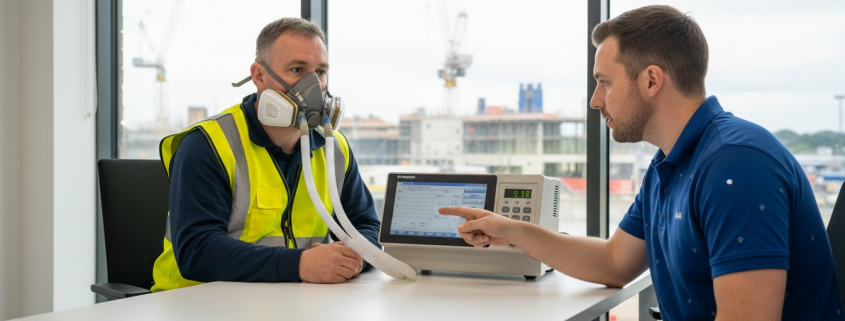
In contrast, a Quantitative Face Fit Test (QNFT) provides a precise, numerical measurement of the seal’s effectiveness. This objective test uses a specialised particle counting device, such as a Portacount machine. The machine measures the number of microscopic particles in the ambient air and compares it to the number of particles that leak into the mask. The result is an exact number called a ‘Fit Factor’. The key advantage of QNFT is its precision, removing any subjective judgement from the process. The protocols for both methods are clearly defined in the official HSE INDG479 Guidance.
Mandatory Scenarios for Quantitative Face Fit Testing
The quantitative face fit testing requirements are unambiguous when it comes to high-protection RPE. A subjective QLFT is not considered sufficiently reliable for masks designed to offer a high protection factor, where even a minor leak could have severe health consequences. QNFT is the only legally acceptable method for all full-face masks.
This mandatory requirement applies to equipment including:
- Full-face respirators (both negative pressure and powered)
- Self-Contained Breathing Apparatus (SCBA)
- Supplied-air breathing apparatus
While QLFT is acceptable for half masks, QNFT is often the preferred and recommended method in high-risk environments, such as those involving asbestos removal or exposure to other highly toxic substances. For this RPE, only an objective, numerical measurement can provide the necessary assurance that the face seal meets the required safety standards.
For instance, in the tightly controlled environments of modern hydroponic facilities, where staff may handle fine nutrient powders or other agents, ensuring proper RPE fit is crucial. These facilities manage many environmental variables, and professionals in this field often explore LED Grow Lights to optimize conditions alongside ensuring staff safety.
The QNFT Process: A Step-by-Step Breakdown
A Quantitative Face Fit Test (QNFT) is a precise and methodical procedure designed to provide objective, numerical data on the seal of a respirator. To ensure a valid result, the entire process must be conducted by a competent and experienced tester who understands the intricate quantitative face fit testing requirements. The test is always performed using the exact make, model, and size of Respiratory Protective Equipment (RPE) the individual will wear in the workplace, as a successful test on one mask does not transfer to another.
Equipment and Environment Setup
The core of a QNFT is a specialised particle counting device, such as a TSI Portacount. This machine measures the number of microscopic dust particles in the ambient air and compares it to the number of particles inside the respirator. To facilitate this, the mask is temporarily adapted with a sampling probe that connects to the machine. The test must be conducted in a controlled environment with a sufficient concentration of ambient particles for the equipment to take an accurate reading. Before any tests are performed, the equipment must be properly calibrated to ensure its measurements are precise and reliable.
The Seven Standard Test Exercises
To verify the mask’s seal under realistic conditions, the wearer must perform a series of seven exercises prescribed by the Health and Safety Executive (HSE). The purpose of these movements is to simulate the physical activities an employee might undertake during their work day, challenging the integrity of the mask’s seal. The HSE provides detailed guidance on the Basics of RPE fit testing, which includes this mandatory exercise protocol. Each exercise lasts for approximately one minute, and the wearer must not adjust the mask at any point once the test has begun.
- Normal Breathing: The wearer breathes normally, without talking.
- Deep Breathing: The wearer breathes slowly and deeply to simulate physical exertion.
- Head Side to Side: The wearer turns their head from one side to the other, pausing at each extreme.
- Head Up and Down: The wearer moves their head up and down, as if looking at the ceiling and then their feet.
- Talking: The wearer reads from a prepared text, such as the Rainbow Passage, to simulate jaw movement.
- Bending Over: The wearer bends at the waist, as if to touch their toes, and then returns to an upright position.
- Normal Breathing: The test concludes with another period of normal breathing.
Receiving and Understanding Your Fit Test Certificate
Upon successful completion of the test, a fit test certificate is issued. This is the formal, legal record proving the RPE provides adequate protection for the wearer. A valid certificate must include key details such as the wearer’s name, the specific make, model, and size of the RPE tested, the pass level (Fit Factor) achieved, and the date of the test. This document is essential for demonstrating compliance with UK health and safety regulations. Need a certified test to ensure you meet all quantitative face fit testing requirements? Let our safety experts handle your compliance.
Understanding Fit Factors: The Key to Passing the Test
In a quantitative face fit test, the success or failure of the Respiratory Protective Equipment (RPE) is determined by a single, crucial metric: the Fit Factor. This is not a subjective assessment but a precise, numerical measurement of how effectively the mask seals to the wearer’s face. The figure is calculated by a specialised machine that compares the concentration of ambient airborne particles outside the mask to the concentration of particles that have leaked inside.
The resulting ratio is the Fit Factor. Simply put, a higher Fit Factor signifies a more effective seal, less inward leakage, and therefore greater protection for the operative. Achieving the minimum required Fit Factor is the ultimate goal of the test and a fundamental part of UK health and safety compliance.
Required Fit Factors for Different RPE Types
The Health and Safety Executive (HSE) sets clear minimum pass levels as part of the official quantitative face fit testing requirements. A test is only considered a pass if the RPE meets or exceeds these specific thresholds. These are not guidelines; they are absolute minimums required for a pass certificate to be issued and for the RPE to be deemed suitable for the wearer.
The minimum required Fit Factors are:
- Half Masks (Disposable or Reusable): A minimum Fit Factor of 100 is required.
- Full-Face Masks: A minimum Fit Factor of 2000 is required.
Common Reasons for a Low Fit Factor (Test Failure)
A failed test indicates that the RPE is not providing adequate protection. This is a critical safety issue that must be addressed immediately. While our expert testers will help identify the cause, failures typically stem from a few common issues:
- Incorrect Mask Size or Model: Faces vary significantly in shape and size. A mask that fits one person perfectly may be unsuitable for another.
- Facial Hair: This is the most common reason for failure. Even a day’s stubble can compromise the seal. For a quantitative test to be valid, the wearer must be clean-shaven where the mask meets the skin.
- Improper Donning Technique: If the mask is not put on correctly, with straps adjusted to the right tension, it will not seal properly.
- Facial Features or Medical Conditions: Scars, moles, or unique facial structures can sometimes interfere with achieving a secure seal.
Understanding these core components of the quantitative face fit testing requirements is vital for ensuring your workforce remains safe and your business stays compliant. If you need expert assistance or wish to book accredited on-site testing, get in touch with the Safehouse team today.
Preparing for a Quantitative Fit Test: A Checklist for Managers
Effective preparation is the foundation of a successful respiratory protective equipment (RPE) programme. By ensuring your employees and your site are ready for testing, you can minimise test failures, reduce downtime, and ensure your investment in safety delivers the best results. Clear communication and coordination are essential to meeting your legal obligations and protecting your team.
As a manager, your role is to facilitate a smooth process. This involves briefing your staff correctly, having a suitable range of RPE available, and coordinating with your test provider. This checklist will help you manage the key aspects of preparation.
Pre-Test Instructions for Employees
To ensure the test can be conducted accurately, all employees must be informed of the pre-test conditions. Failure to adhere to these can result in an automatic fail and a wasted appointment. Provide your staff with the following instructions:
- Be clean-shaven: The most common reason for test failure is facial hair. There must be no stubble or hair growth in the area where the mask’s seal meets the skin.
- Avoid smoking, vaping, or eating: This should be avoided for at least 30 minutes prior to the test, as it can affect the results.
- Bring relevant PPE: If the employee wears safety glasses, hearing protection, or a hard hat with the RPE, they must bring them to the test to ensure the mask fits correctly with their other equipment.
- Be in good health: The test cannot be conducted if the individual has a cold, cough, or other respiratory issue that could affect their breathing.
What Happens After the Test?
The outcome of the fit test determines whether an employee is permitted to use a specific mask in a hazardous environment. If an employee passes, they receive a certificate confirming the make, model, and size of the RPE they are approved to wear. This certificate is a crucial part of your compliance records.
If an employee fails, they are not protected and must not use that mask. The process is then repeated with a different size or model of RPE until a suitable, protective fit is achieved. It is vital to document all results, including failures, as this demonstrates a robust approach to fulfilling the quantitative face fit testing requirements and protecting your workforce.
Frequency of Re-testing: When is it Required?
While the HSE does not mandate a specific expiry date for a fit test certificate, industry best practice recommends re-testing at least every two years. However, a re-test is legally required sooner if certain conditions are met:
- Significant weight gain or loss.
- Major dental work (e.g., extractions or dentures).
- Facial injuries, scarring, or cosmetic surgery in the face seal area.
- A change in the make, model, or size of the RPE being used.
Staying on top of these triggers is essential for maintaining compliance. For assistance in managing your company’s testing schedule and requirements, please get in touch with our expert team.
Partner with the Experts for Compliant Face Fit Testing
Navigating UK health and safety legislation is a significant responsibility for any employer. As this guide has outlined, quantitative face fit testing is a legal necessity for all full-face masks and is the required method when a half mask fails a qualitative test or requires a higher fit factor. Achieving a successful, numerical fit factor is the only verifiable proof that Respiratory Protective Equipment (RPE) offers the intended protection against airborne hazards. Understanding this process is therefore critical for both worker safety and your legal compliance.
Meeting the stringent quantitative face fit testing requirements demands precision and expertise that cannot be overlooked. Let our team of specialists take this complex burden from your shoulders. Our Fit2Fit accredited testers provide a comprehensive, professional service covering all types of RPE, ensuring every test is conducted to the highest standard. As a trusted local company with nationwide reach and expertise, we are ideally positioned to support your business wherever you operate in the UK.
Ensure your team is protected and compliant. Book your professional face fit testing service today.
Frequently Asked Questions
Who is considered a ‘competent person’ to conduct a quantitative face fit test?
A competent person is someone with the necessary knowledge, training, and practical experience to conduct the test correctly. As per HSE guidance (INDG 479), they must understand the testing equipment, the RPE being tested, and the exercises required. While not legally mandatory, accreditation from a scheme like Fit2Fit is the HSE’s recommended proof of competence. This ensures all UK quantitative face fit testing requirements are met, providing reliable and compliant results for your business.
Can you pass a quantitative face fit test with a beard or stubble?
No, it is not possible to pass a face fit test with any facial hair that interferes with the mask’s seal. Even a day’s stubble can create gaps, allowing hazardous airborne particles to bypass the filter. For any tight-fitting respirator, the wearer must be clean-shaven in the contact area between the mask and the skin. This is a non-negotiable safety requirement to ensure the Respiratory Protective Equipment (RPE) provides the intended level of protection.
What is the main difference in cost between quantitative and qualitative testing?
Quantitative testing is generally more expensive than qualitative testing. This is because it requires sophisticated and costly particle-counting equipment, such as a Portacount machine, and a more highly trained operator to administer the test. In contrast, qualitative testing uses a simple hood and taste solution. Typically, you can expect to pay from £45-£70 per person for a quantitative test, whereas a qualitative test may cost between £25-£40, depending on the provider.
How long does a single quantitative face fit test typically take?
A single quantitative face fit test session usually takes approximately 20 to 30 minutes to complete per individual. This includes a briefing on the test procedure, correct donning of the mask, and the test itself. The test involves the wearer performing a series of seven exercises designed to simulate typical work movements, such as turning the head, bending over, and speaking. This ensures the mask maintains its protective seal during a range of activities.
What is the legal consequence of not having a valid fit test certificate for an employee?
Failing to provide a valid fit test certificate for an employee using tight-fitting RPE is a breach of UK health and safety law, including COSHH and CAR 2012 regulations. The Health and Safety Executive (HSE) can issue enforcement notices, including prohibition notices that stop work immediately. In serious cases, this can lead to prosecution, resulting in significant fines for the company and, potentially, the responsible individuals. It is a critical compliance issue for any employer.
Does a fit test certificate cover all types of respirator masks?
No, a fit test certificate is specific to the exact make, model, and size of the respirator the employee was tested on. It does not provide a universal pass for all types of RPE. If an employee needs to switch to a different mask for any reason-even one that appears similar-a new face fit test must be conducted for that specific model. This ensures a protective seal is confirmed for every piece of equipment they are required to wear.