
First Aid Course: The Complete UK Guide for Workplaces
Ensuring your business meets its legal health and safety obligations is a critical responsibility. When it comes to workplace emergencies, selecting the correct first aid course can feel like navigating a maze of acronyms like EFAW and FAW, all while trying to satisfy HSE requirements. The pressure to choose an accredited, high-quality provider-and avoid wasting time and budget on the wrong training-is a significant concern for any diligent employer.
This guide is designed to remove that uncertainty. We are here to take the burden of compliance away by providing a clear, authoritative path through UK workplace first aid training. We will break down your legal duties, explain the differences between the essential courses, and empower you to assess your workplace’s specific risk level accurately. Our goal is to provide the expert knowledge you need to move forward with confidence.
By the end of this article, you will be equipped to not only choose a fully compliant training solution but also to ensure your team has the practical, life-saving skills they need. You will understand how to secure a recognised certificate, protect your staff, and gain the peace of mind that comes with being thoroughly prepared.
Key Takeaways
- Understand your legal obligations under The Health and Safety (First Aid) Regulations 1981 to ensure your workplace is fully compliant.
- Learn the crucial differences between Emergency First Aid at Work (EFAW) and First Aid at Work (FAW) to select the correct training for your business’s risk profile.
- Choosing the right first aid course means investing in practical training that builds genuine life-saving confidence, not just theoretical knowledge.
- Discover why regular refresher training is essential for maintaining skills and how to manage qualification expiry dates to avoid compliance breaches.
Understanding Your Legal Duties: First Aid at Work Regulations
Providing adequate first aid in the workplace is not just a matter of good practice-it is a legal obligation for every UK employer. Your responsibilities are clearly defined under The Health and Safety (First Aid) Regulations 1981, which operate under the broader framework of the Health and Safety at Work etc. Act 1974. As an employer, you have a duty of care to protect your employees by ensuring they receive immediate attention if they are injured or taken ill at work. This legal duty is absolute.
Failing to meet these requirements can lead to severe consequences. Non-compliance can result in investigation and enforcement action by the Health and Safety Executive (HSE), leading to substantial fines, prosecution, and in serious cases, imprisonment. Beyond the financial and legal penalties, a failure in duty of care can cause irreparable damage to your business’s reputation. The first step to ensuring you are fully compliant is to conduct a thorough needs assessment.
What is a First Aid Needs Assessment?
A first aid needs assessment is a straightforward process to evaluate the specific risks and requirements of your workplace. It removes the guesswork and ensures your provisions are appropriate. Key factors to consider include:
- The total number of employees, including shift workers and remote staff.
- The nature of your work and any specific hazards (e.g., machinery, chemicals, manual handling).
- The difference between low-risk environments like an office and high-risk sites such as factories or construction zones.
- Your business’s location and distance from emergency medical services.
The outcome of this assessment will determine the number of first aiders you need and the level of equipment required.
Appointed Person vs. Certified First Aider
Your assessment will dictate whether you need an Appointed Person or a fully Certified First Aider. An Appointed Person is suitable for low-risk environments and is responsible for managing first aid arrangements, such as calling emergency services and restocking the first aid kit. They do not require formal training. In contrast, a Certified First Aider has successfully completed an accredited first aid course, like the Emergency First Aid at Work (EFAW) or First Aid at Work (FAW), and is qualified to administer treatment. For any workplace with significant hazards or a larger workforce, having at least one Certified First Aider is a legal necessity.
Choosing the Right Course: EFAW vs. FAW Explained
Selecting the appropriate first aid training is not a one-size-fits-all decision. To ensure your business is fully compliant and your team is adequately prepared for an emergency, it is vital to understand the key differences between the main accredited qualifications. The correct first aid course for your organisation is determined by the findings of your workplace needs assessment.
This assessment is a legal requirement under the Health and Safety (First-Aid) Regulations 1981, which outlines an employer’s duty to provide adequate and appropriate equipment, facilities, and personnel. Your assessment will identify the level of risk in your workplace, guiding you to the most suitable training solution.
Emergency First Aid at Work (EFAW) – 1 Day Course
The EFAW qualification is the most common in the UK and is designed for lower-risk workplaces, such as offices and retail environments. This intensive one-day course provides employees with the essential skills to act as an emergency first aider. Delegates learn to manage an unconscious casualty, perform CPR, control bleeding, and respond to seizures and choking, providing critical support until professional medical help arrives.
First Aid at Work (FAW) – 3 Day Course
For businesses operating in higher-risk sectors like construction, manufacturing, or engineering, the comprehensive three-day FAW qualification is the required standard. This course covers all topics from the EFAW syllabus in greater depth, plus advanced skills for managing specific injuries such as fractures, dislocations, burns, and spinal injuries. It is the definitive choice for designated workplace first aiders in environments where accidents may be more severe.
Paediatric First Aid Courses
For professionals working directly with children, such as in schools, nurseries, or as childminders, a specialised Paediatric First Aid course is essential. Training covers critical skills tailored to infants and children, including CPR, choking, and managing common childhood illnesses like meningitis and febrile convulsions. For many Ofsted-registered childcare providers, holding a valid Paediatric First Aid certificate is a legal requirement.
Ensuring providers have properly trained staff is crucial when making care decisions. Online directories such as Guide2Care can be a valuable resource for finding a comprehensive list of care providers across the UK.
EFAW vs. FAW: At a Glance
| Feature | Emergency First Aid at Work (EFAW) | First Aid at Work (FAW) |
|---|---|---|
| Duration | 1 Day | 3 Days |
| Ideal For | Low-risk environments (offices, shops) | Higher-risk environments (construction, manufacturing) |
| Key Topics | CPR, choking, minor injuries, seizures | All EFAW topics plus fractures, burns, spinal injuries, major illnesses |
What to Expect From Your First Aid Training Day
A successful first aid course moves far beyond theoretical knowledge to build practical, life-saving confidence. At Safehouse, we have designed our training days to be engaging, interactive, and memorable. Forget endless PowerPoint slides; our focus is on hands-on practice that develops the muscle memory you need to act effectively and decisively in a real emergency. The typical structure of the day blends expert instruction with practical scenarios.
Our experienced instructors play a crucial role in this process. They create a supportive and reassuring learning environment where every delegate feels comfortable asking questions and practicing techniques until they feel confident. This personal approach ensures you leave not just with a certificate, but with the genuine ability to make a difference when it matters most.
Core Skills and Topics Covered
Our comprehensive first aid course curriculum is structured to equip you with the most critical skills for managing workplace incidents. The content aligns with Health and Safety (First-Aid) Regulations 1981 and covers foundational techniques essential for any first aider. While course content can be tailored, the core modules you will master include:
- The Primary Survey (DRABC): Learning the systematic approach to assessing a casualty, checking for Danger, Response, Airway, Breathing, and Circulation.
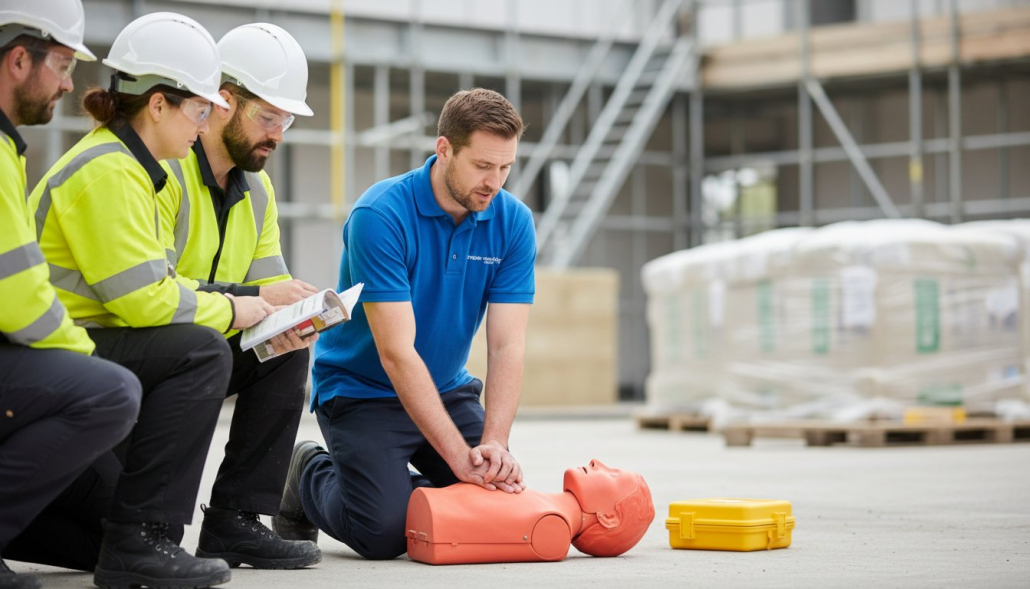
- Performing CPR and Using an AED: Gaining hands-on experience with resuscitation manikins and learning how to correctly operate an automated external defibrillator (AED).
- Managing an Unresponsive Casualty: How to safely place a casualty in the recovery position to maintain an open airway.
- Controlling Severe Bleeding and Shock: Practical techniques for applying pressure, dressing wounds, and recognising and treating for clinical shock.
These topics are standard across accredited programmes, ensuring your training meets national standards for First Aid at Work (FAW) courses.
Assessment and Certification
Your skills and understanding are assessed throughout the training day in a supportive manner. Assessment is not designed to be a high-pressure exam but a method to confirm your competence. This involves a combination of continuous practical observation by the instructor as you perform key techniques and a final multiple-choice question paper to verify your theoretical knowledge.
Upon successful completion of the course, you will be awarded a nationally recognised certificate. This qualification is valid for three years, after which a shorter requalification course is required to keep your skills sharp and your certification current, ensuring your business remains fully compliant.
Maintaining Compliance: Refresher Courses and Qualification Renewal
Completing an initial first aid course is a critical first step in workplace safety, but it is not the last. First aid skills, particularly those used infrequently, can fade over time. To ensure your designated first aiders remain confident, competent, and compliant, a structured approach to qualification renewal and skills maintenance is essential. This not only fulfils your legal duties but also guarantees your team is genuinely prepared to act effectively in an emergency.
First Aid Certificate Validity
Both the Emergency First Aid at Work (EFAW) and the full First Aid at Work (FAW) certificates are valid for three years. To continue acting as a workplace first aider, an individual must undertake a requalification course before their current certificate expires. Allowing a certificate to lapse has significant consequences:
- The individual is no longer considered a competent or qualified first aider.
- Your business may no longer meet the minimum first aid provision requirements identified in your needs assessment.
- The individual will be required to complete the full, longer first aid course again, rather than the shorter requalification programme.
Annual Refresher Training (Recommended)
While formal requalification is required every three years, the Health and Safety Executive (HSE) strongly recommends that all first aiders complete an annual refresher course. This short, typically half-day session is designed to reinforce essential skills and update knowledge. It is an excellent way to boost a first aider’s confidence in performing CPR and managing an unconscious casualty, ensuring they are ready to respond without hesitation. Investing in this training demonstrates your organisation’s proactive commitment to maintaining the highest standards of safety compliance. Contact us about our annual refresher courses.
Requalification Courses
A requalification course is a condensed programme designed for those who currently hold a valid EFAW or FAW certificate. It serves to refresh knowledge, practice practical skills, and cover any updates to first aid protocols and guidelines. For example, the First Aid at Work Requalification course is a 2-day programme, compared to the 3-day initial course. Completing this training ensures your first aiders’ qualifications remain uninterrupted, providing you with peace of mind and maintaining your business’s safety credentials.
Why Choose Safehouse for Your First Aid Training?
Choosing a training provider is a critical decision for your business. At Safehouse, we understand that effective first aid training is about more than just ticking a compliance box; it’s about building the genuine confidence your team needs to act decisively in an emergency. As a local company with a nationwide reach, we offer a personal approach to help you stay safe and compliant. We take the burden of organising training away, providing a complete solution tailored to the specific risks and realities of your industry.
Expert Instructors with Real-World Experience
Our training is delivered by seasoned professionals, not academics. You will learn from instructors who have managed real-life emergencies as paramedics, emergency responders, and industry safety officers. This background allows them to deliver an engaging and highly practical first aid course, enriched with real-world insights. Their specialist knowledge, particularly in high-risk sectors like construction, ensures the content is not just theoretical but immediately applicable to your workplace.
A Practical, Hands-On Approach
Confidence is built through practice. Our courses are designed with a strong emphasis on hands-on learning. We move beyond PowerPoint presentations to focus on practical scenarios that reflect the potential incidents your employees could face. Delegates are given ample time to practice essential skills, from CPR on manikins to applying dressings, ensuring the techniques become second nature. Our goal is for every participant to leave not just with a certificate, but with the self-assurance to act correctly and calmly when it matters most.
Flexible Training and Simple Booking
We make arranging your next first aid course straightforward and stress-free. You can choose to attend courses at our fully-equipped, dedicated training centre in Barnsley, or we can bring the training directly to you with our on-site delivery service anywhere in the UK. Our expert team is on hand to guide you through a simple booking process, ensuring you get the right training for your needs without unnecessary complications. View our upcoming course dates and book your place.
Your Next Step to a Safer, Compliant Workplace
Navigating your workplace’s first aid requirements comes down to a few critical steps. It begins with a clear understanding of your legal duties, followed by a thorough risk assessment to determine whether an EFAW or a more comprehensive FAW qualification is necessary. Finally, maintaining these life-saving skills through regular refresher training is essential for ensuring your team is always prepared and your business remains fully compliant with UK regulations.
Choosing a training provider is as crucial as selecting the course itself. At Safehouse, we remove the complexity from this process. As a fully accredited training centre, we provide more than just a certificate; we offer a personal approach from a dedicated safety partner. Our expert instructors, with direct industry experience, deliver the practical skills and confidence your team needs. The right first aid course is a vital investment in your employees’ wellbeing and your company’s resilience.
Take the definitive step to protect your workforce and meet your legal obligations. View our course schedule and book your accredited first aid training today. Secure your compliance and gain the peace of mind that comes with being prepared for any situation.
Frequently Asked Questions About First Aid at Work
How long does a first aid certificate last in the UK?
A First Aid at Work (FAW) or Emergency First Aid at Work (EFAW) certificate is valid for three years from the date of issue. To remain a qualified first aider, you must complete a requalification course before the certificate expires. The Health and Safety Executive (HSE) also strongly recommends that all first aiders undertake an annual refresher course. This ensures their skills remain sharp and they are updated on any changes in first aid protocols, helping your business stay safe and compliant.
What is the main difference between EFAW and FAW courses?
The primary difference lies in the course duration and the depth of topics covered, which corresponds to workplace risk levels. The Emergency First Aid at Work (EFAW) is a 1-day course designed for lower-risk environments, such as offices and shops. The First Aid at Work (FAW) is a more comprehensive 3-day course intended for higher-risk workplaces, including construction sites, factories, and warehouses. Your company’s first aid needs assessment will determine which qualification is appropriate for your staff.
How many first aiders does my company need by law?
UK law does not specify a fixed number of first aiders. Instead, The Health and Safety (First-Aid) Regulations 1981 require all employers to make an assessment of their first-aid needs to determine what is adequate and appropriate. This assessment must consider factors such as the level of workplace hazard, the number of employees, company size and layout, and the history of accidents. This ensures your provision is tailored to your specific operational risks, keeping your workforce protected.
Is an online-only first aid course valid for the workplace?
For the purposes of workplace compliance in the UK, an online-only first aid course is not valid for either the FAW or EFAW qualifications. The HSE is clear that training must include practical, hands-on assessment of key life-saving techniques by a qualified trainer. While blended learning-combining online theory with a face-to-face practical session-is a valid option, the practical component is non-negotiable to ensure competence and meet legal requirements for a workplace first aid course.
What key topics are covered in a 1-day Emergency First Aid at Work course?
A 1-day EFAW course provides essential skills for managing common workplace emergencies. Key topics include the roles and responsibilities of a first aider, assessing an incident, and managing an unresponsive casualty. Delegates receive practical training in cardiopulmonary resuscitation (CPR) and the use of an automated external defibrillator (AED). The course also covers how to handle situations involving choking, shock, wounds, bleeding, and minor injuries like cuts, grazes, and burns, providing a solid foundation in emergency response.
Do I need a paediatric first aid course for my business?
A paediatric first aid course is a specific legal requirement for businesses that work directly with children and infants, such as nurseries, childminders, and schools registered with Ofsted. For most other workplaces, a standard EFAW or FAW qualification is sufficient. However, if your business environment frequently includes children-for example, a family-focused leisure centre or restaurant-your first aid needs assessment may identify a requirement for staff with paediatric first aid skills to ensure comprehensive safety for all visitors.











Leave a Reply
Want to join the discussion?Feel free to contribute!